

Winning Against Aggressive Freight Insurers in a Hobbs Truck Accident Lawsuit
Take Fast Steps After a Hobbs Truck Accident
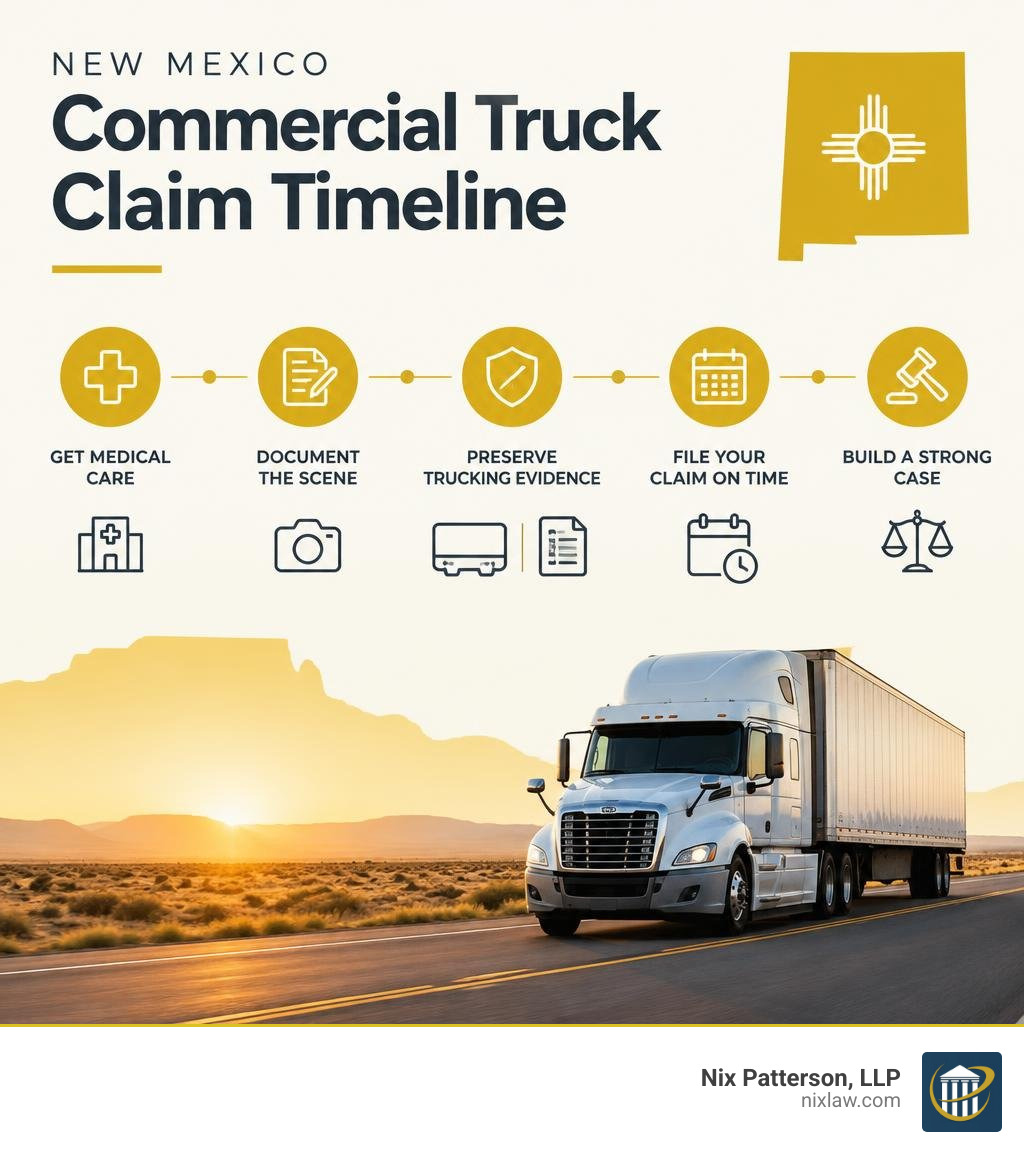
To pursue a Hobbs truck accident lawsuit, get medical care, document what you can, and act quickly to preserve the trucking company’s evidence. A lawyer can send a preservation notice for black-box data, electronic logs, dashcam video, maintenance files, and dispatch records before they are overwritten or lost.
Commercial freight crashes on Hobbs-area roads can involve more than one responsible party. The driver, motor carrier, cargo loader, maintenance provider, or equipment manufacturer may each have a role. Freight insurers often begin investigating immediately, so injured people should avoid recorded statements or quick settlement offers before they understand the full extent of their injuries and available coverage.
New Mexico generally gives injured people three years to bring a personal-injury claim, but waiting can make proof harder to obtain. If a government-owned vehicle is involved, a much shorter notice deadline may apply.
Nix Patterson, LLP helps clients investigate serious commercial truck collisions, identify every available insurance layer, and build claims backed by records rather than assumptions.
Understanding Commercial Carrier Liability on Permian Basin Freight Corridors
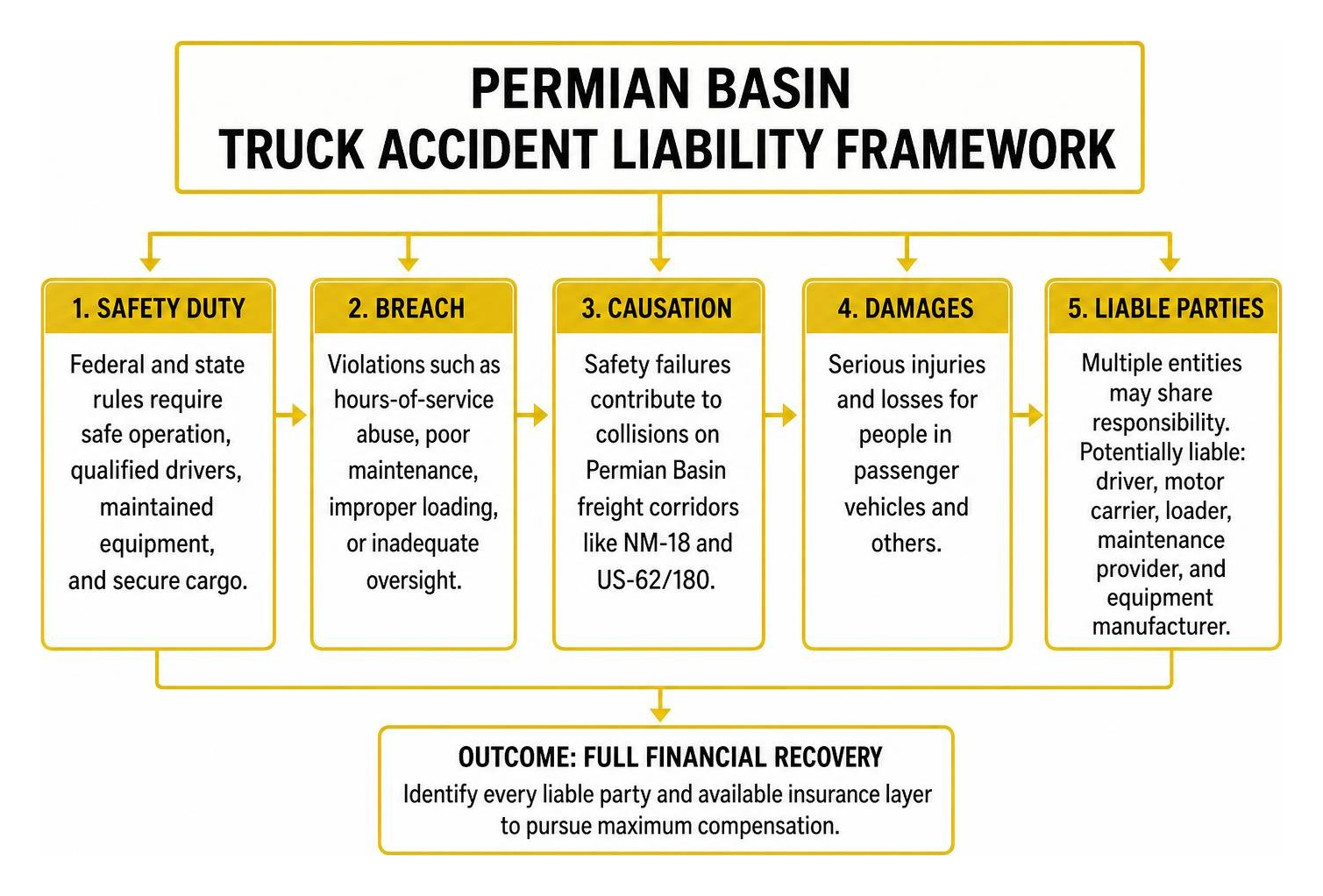
The Permian Basin is one of the most active industrial regions in the world, and Lea County serves as a major operational hub. Commercial freight volume here is relentless. Heavy tractor-trailers, sand haulers, water tankers, and flatbeds crowd highways like NM-18 and US-62/180 daily. This dense mix of heavy industrial haulers and everyday commuter traffic creates high-risk driving environments.
Navigating freight collisions requires an understanding of both state tort law and federal safety mandates. When an 80,000-pound rig collides with a passenger car, the resulting harm is rarely minor. Proving liability means showing exactly where safety rules broke down.
Under the Federal Motor Carrier Safety Regulations (FMCSR), interstate motor carriers must follow strict rules regarding driver qualification, cargo securement, vehicle maintenance, and driving hours. When trucking companies rush deliveries or cut maintenance corners to boost oilfield profits, systemic safety failures occur.
Identifying Liable Parties in Permian Oilfield Collisions
Commercial truck crashes rarely involve simple driver-versus-driver disputes. Instead, multiple commercial entities often share responsibility for a single run. Holding each entity accountable is critical to securing full financial recovery.
When we investigate these claims, we examine every link in the logistics chain. Potential defendants include:
- The Motor Carrier: Responsible for vetting drivers, enforcing safety policies, and maintaining fleet vehicles.
- Third-Party Cargo Loaders: Liable when improperly secured, unbalanced, or shifting cargo causes rollovers or extended braking distances.
- Maintenance Contractors: Accountable when third-party shops perform shoddy brake repairs, miss structural cracks, or return unsafe rigs to service.
- Freight Brokers and Shippers: Liable when they negligently hire carriers with poor safety track records or history of federal safety violations.
Uncovering these complex corporate relationships is a core part of identifying liable parties in truck accidents. When companies fail in their oversight duties, victims have strong legal grounds to sue trucking companies for systemic negligence.
Independent Contractor Classifications and Employer Duties
Trucking companies often attempt to shield themselves from liability by classifying drivers as independent contractors rather than direct employees. Under the traditional doctrine of respondeat superior, employers are liable for the negligent acts of their employees committed within the scope of employment. Motor carriers routinely use independent contracts to try to escape this obligation.
However, federal regulations and court precedents limit this defense. Under federal “statutory employee” rules, if a motor carrier operates a commercial motor vehicle under its DOT operating authority, it remains responsible for the driver’s safety compliance regardless of tax classification.
Courts examine the right-of-control standard by evaluating whether the carrier controlled the driver’s routes, schedules, equipment, and daily methods. Significant judicial rulings, including precedents on independent contractor carrier liability, illustrate how contractual phrasing, equipment security interests, and operational control can determine whether a parent company shares direct liability. We evaluate these arrangements alongside established commercial trucking laws and safety regulations to help ensure that no responsible corporate entity avoids accountability.
Critical Steps to Building a Hobbs Truck Accident Lawsuit
Building a successful claim in Lea County requires prompt investigation and formal discovery before the Fifth Judicial District Court. Freight insurers deploy rapid-response teams to the crash site within hours. These investigators work to protect their company’s bottom line. Leveling the playing field requires matching that urgency.
Securing Black Box Data and Electronic Logging Devices
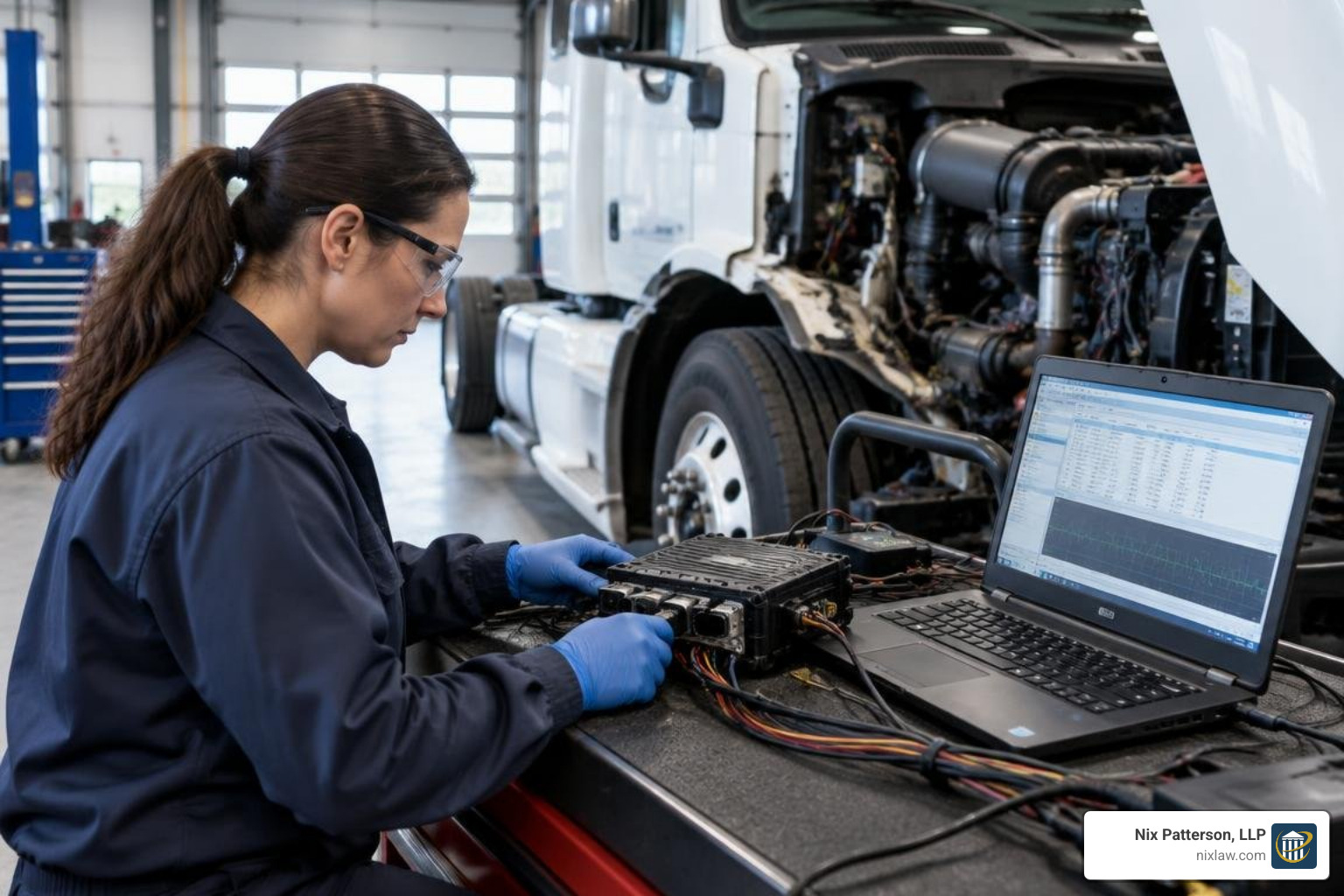
Modern commercial trucks are equipped with Electronic Control Modules (ECMs), often called “black boxes,” alongside Electronic Logging Devices (ELDs). This onboard technology records vital real-time data before, during, and after an impact:
- Vehicle speed and throttle position
- Braking status and sudden deceleration events
- Steering angles and stability control activation
- Hours of service (HOS) logs showing driving duration and required rest breaks
- GPS location stamps and route deviations
This electronic evidence is vulnerable. Many ECMs overwrite crash data after a set number of ignition cycles or within 30 days. To prevent this, we send formal spoliation letters to the carrier, their insurer, and maintenance yards, demanding the preservation of all physical and digital records. Knowing the critical steps to take following a commercial crash protects key data. Working with skilled legal representation for 18-wheeler accidents ensures that digital forensic experts extract and preserve this data before it is lost.
Why Immediate Action Is Crucial in a Hobbs Truck Accident Lawsuit
Under New Mexico statute NMSA § 37-1-8, victims generally have three years from the date of an accident to file a personal injury lawsuit. However, waiting until the deadline approaches can harm a case:
- Physical roadway evidence, such as tire scrub marks, gouges, and fluid trails, washes away within days.
- Commercial vehicles are quickly repaired, sold, or scrapped.
- Independent witnesses move or forget vital details.
- If a collision involves a government-owned vehicle or roadway maintenance defect, the New Mexico Tort Claims Act requires a formal notice of claim within just 90 days.
Securing prompt advocacy from a Hobbs truck accident lawyer protects critical evidence. Our team of experienced New Mexico truck crash attorneys acts quickly to inspect vehicles, interview witnesses, and file necessary pleadings in Lea County courts.
Overcoming Complex Defense Tactics and Corporate Restructuring
When faced with catastrophic injury claims, commercial freight carriers and their insurers rarely admit fault easily. They employ aggressive legal tactics, ranging from shifting blame onto passenger vehicle drivers to complex corporate restructuring designed to shield valuable assets behind shell companies and bankruptcy filings.
Navigating Corporate Bankruptcy in a Hobbs Truck Accident Lawsuit
A significant challenge arises when a trucking company, parent entity, or equipment dealer files for Chapter 11 bankruptcy. A bankruptcy petition triggers an “automatic stay” under federal bankruptcy law, which temporarily halts all pending state court lawsuits and collection efforts against the debtor.
Injured victims must navigate federal bankruptcy court to protect their right to compensation:
- Filing Motions for Relief from Stay: In many cases, we petition the bankruptcy court to lift the automatic stay. This allows the personal injury lawsuit to proceed in state or federal district court specifically up to the limits of the debtor’s commercial liability insurance policies, which are often carved out from the general bankruptcy estate.
- Classifying Claims in Liquidation Plans: If the corporate defendant undergoes Chapter 11 liquidation, tort claims are generally categorized as general unsecured claims. For example, during complex automotive and transportation restructuring proceedings—such as the Chapter 11 liquidation plans seen in large-scale corporate restructurings like the Rhodes Companies or Bill Heard Enterprises cases—unsecured creditors vote on plan confirmations and receive distributions managed by a liquidating trustee.
- Adhering to Bankruptcy Bar Dates: Missing a bankruptcy court’s proof of claim deadline can permanently extinguish an otherwise valid injury claim. We monitor court dockets and file timely claims to protect client recoveries across both civil and bankruptcy venues.
Proving Design and Equipment Defects Under Product Liability Standards
Not all truck crashes stem entirely from driver error. Defective equipment, structural component failures, and dangerous trailer designs play major roles in highway wrecks. When a mechanical failure causes an accident, liability expands beyond the motor carrier to include equipment manufacturers, parts distributors, and design engineers.
For instance, dump trailers and heavy-haul flatbeds have high centers of gravity that make them prone to tip-overs when unloaded on uneven ground slopes or when structural welds crack over time. Key legal battles, including appellate precedents on trailer design defects, demonstrate how product liability doctrines hold manufacturers accountable for structural design flaws, inadequate anti-tipover systems, and failure to warn of stability limits.
| Claim Element | Driver / Motor Carrier Negligence | Equipment Manufacturer Product Liability |
|---|---|---|
| Primary Legal Basis | FMCSR violations, speeding, fatigue, improper maintenance | Design defects, manufacturing flaws, failure to warn |
| Key Evidence | ELD logs, ECM black-box data, dashcam, dispatch records | Engineering schematics, metallurgical weld tests, recall history |
| Responsible Parties | Truck driver, fleet operator, maintenance contractor | Component manufacturer, trailer fabricator, parts distributor |
| Standard of Proof | Failure to exercise reasonable care under the circumstances | Strict liability for unreasonably dangerous product design |
Calculating Compensation and Insurance Coverage Layers
Because commercial collisions involve heavy machinery and high speeds, the physical and financial consequences are often life-altering. Victims may suffer traumatic brain injuries, spinal cord damage, complex fractures, and severe burns. Calculating full compensation requires looking beyond initial emergency room bills to measure lifetime care needs.
We work with medical professionals, vocational rehabilitation experts, and forensic economists to build detailed life-care plans. These plans account for:
- Past and future surgical, rehabilitation, and medical expenses
- In-home supportive care, home modifications, and adaptive medical equipment
- Lost earnings and diminished future earning capacity
- Physical pain, mental anguish, disfigurement, and loss of enjoyment of life
Evaluating Policy Limits, Umbrella Coverage, and Settlement Factors
Federal law requires interstate freight carriers to maintain minimum public liability coverage starting at $750,000 for general freight, with requirements rising to $1 million or $5 million for hazardous materials and oilfield transport. However, catastrophic injuries frequently exceed these baseline policies.
Securing fair compensation requires identifying and tapping into multiple layers of insurance:
- Primary Commercial Liability: The motor carrier’s frontline insurance policy covering vehicular operations.
- Excess and Commercial Umbrella Coverage: Higher-tier policies that activate once the primary policy limits are exhausted.
- Broker and Shipper Contingent Coverage: Additional liability layers applicable when cargo intermediaries negligently assign freight to unsafe carriers.
- Equipment and Interchange Policies: Separate insurance policies associated with leased chassis, third-party trailers, or maintenance vendors.
Understanding these coverage layers is one of the key factors influencing truck settlement value. Our team provides dedicated commercial truck accident representation, stacking applicable policies and pursuing every available corporate entity to maximize recovery.
Frequently Asked Questions About Hobbs Commercial Truck Claims
How does pure comparative fault apply under New Mexico law?
New Mexico follows the doctrine of pure comparative fault, established in Scott v. Rizzo. Under this rule, an injured person can recover damages even if they were partially at fault for the crash. The court assigns a percentage of fault to every party involved, including non-parties, and the plaintiff’s total financial recovery is reduced in direct proportion to their share of responsibility. For example, if a jury determines your damages total $1,000,000 but finds you were 15% responsible for the collision, you can still recover $850,000 from the remaining at-fault defendants.
What happens if the trucking company files for Chapter 11 bankruptcy?
If a trucking company files for Chapter 11 bankruptcy, an automatic stay pauses all state court litigation against that debtor. However, this does not mean your recovery is blocked. An attorney can file a motion for relief from the automatic stay, requesting permission from the bankruptcy judge to proceed against the company’s commercial insurance carrier. In addition, claims against other responsible parties—such as third-party maintenance shops, equipment manufacturers, or cargo loaders—can often proceed independently.
How long do victims have to file a claim after an 18-wheeler crash?
Under NMSA § 37-1-8, victims generally have three years from the date of the collision to file a personal injury lawsuit in New Mexico courts. For wrongful death claims, the statute of limitations is also three years from the date of the victim’s passing. However, if a city, county, or state vehicle was involved, the New Mexico Tort Claims Act requires formal written notice within 90 days of the incident. Promptly consulting Hobbs personal injury attorneys helps ensure that all filing deadlines are met and that crucial physical and digital evidence is preserved.
Conclusion
Commercial trucking companies and their insurers defend catastrophic crash claims with extensive resources and teams of defense lawyers. Overcoming these defense tactics requires an aggressive, well-funded legal strategy that is prepared for trial from day one.
Nix Patterson, LLP has built a national reputation for taking on large corporations and freight insurers in high-stakes personal injury and commercial litigation. Backed by deep resources—including private-jet travel capabilities that allow our trial lawyers to reach crash sites quickly, advanced courtroom technology, and a track record of multi-billion-dollar recoveries—we handle complex litigation on a contingency-fee basis. You pay no upfront expenses or attorney fees unless we achieve a successful financial recovery for you.
If you or a loved one suffered severe harm in an 18-wheeler collision on Permian Basin roads, contact us today for a free, confidential Hobbs catastrophic injury claim consultation to discuss your legal options.