

Delaware Basin Crush Injuries and Amputations Demand Aggressive Legal Action
Legal Frameworks Governing Offshore and Oil Rig Amputation Claims
Navigating an oil rig injury requires identifying which federal and state legal systems control your recovery. Unlike standard land-based workers’ compensation, offshore and maritime operations fall under distinct statutes with vastly different standards of proof, allowable damages, and procedural rules. Securing proper amputation injury compensation depends largely on how your worksite is classified under maritime law.
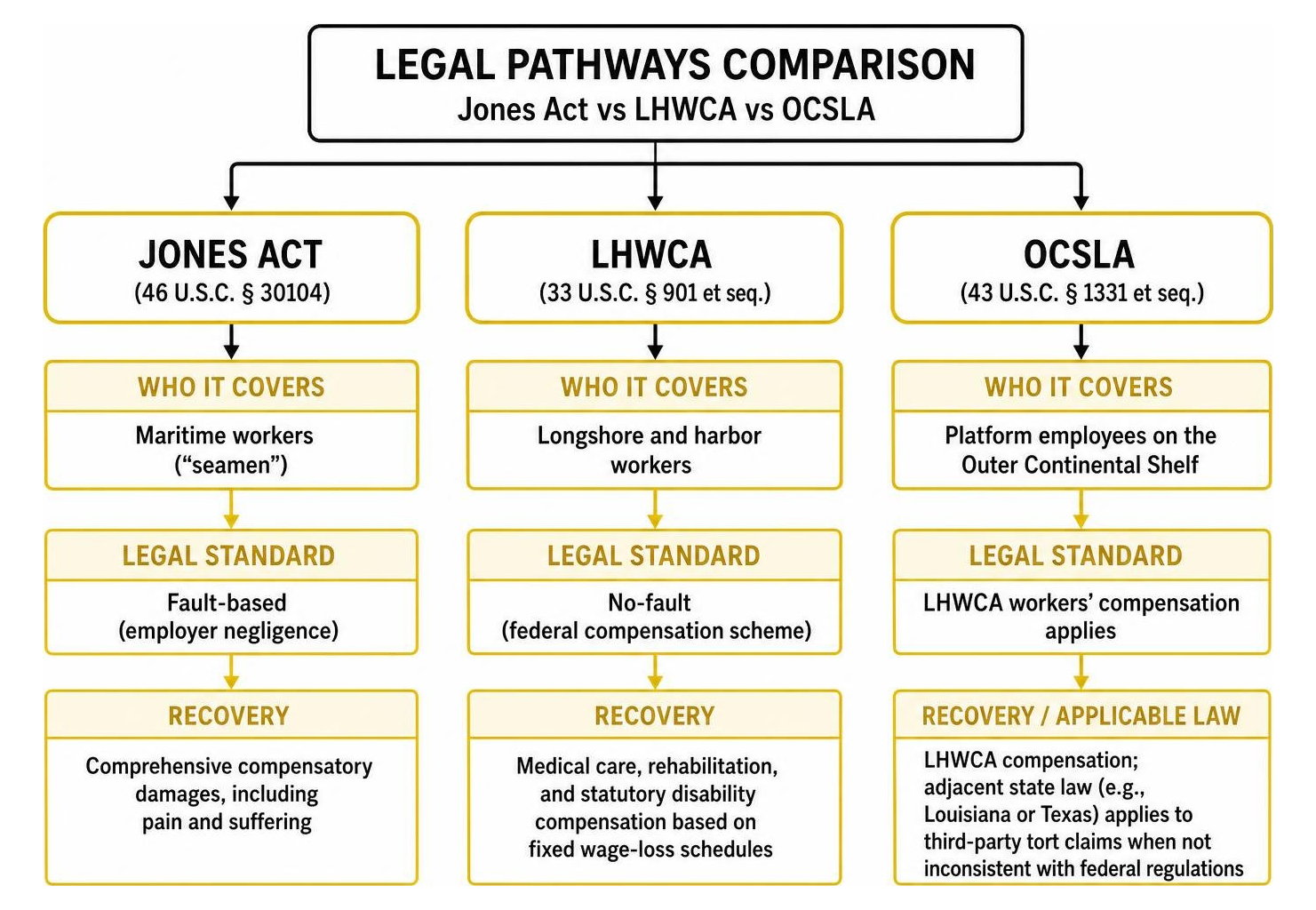
Three primary statutory frameworks govern these serious incidents:
- The Jones Act (46 U.S.C. § 30104): Provides a fault-based cause of action for maritime workers (“seamen”) against their employers. If employer negligence contributed even slightly to the loss of a limb, the seaman can recover comprehensive compensatory damages, including pain and suffering.
- The Longshore and Harbor Workers’ Compensation Act (LHWCA, 33 U.S.C. § 901 et seq.): A federal no-fault compensation scheme providing medical care, rehabilitation, and statutory disability compensation based on fixed wage-loss schedules.
- The Outer Continental Shelf Lands Act (OCSLA, 43 U.S.C. § 1331 et seq.): Extends federal jurisdiction to the subsoil and seabed of the Outer Continental Shelf and all artificial islands and fixed installations. OCSLA adopts the LHWCA as its workers’ compensation mechanism for platform employees, while applying the laws of the adjacent state (such as Louisiana or Texas) as surrogate federal law for third-party tort claims when not inconsistent with federal regulations.
| Legal Framework | Typical Worksite / Worker Status | Standard of Proof | Available Damages |
|---|---|---|---|
| Jones Act | MODUs (Jack-ups, Drillships, Semi-subs) / Qualifying Seamen | Employer negligence (featherweight burden) + Unseaworthiness | Past & future lost wages, full medical care, pain and suffering, mental anguish |
| LHWCA | Shore-side, maritime non-seamen, fixed platforms via OCSLA | No-fault administrative system | Scheduled statutory disability benefits, medical expenses, vocational rehab |
| OCSLA (Third-Party Tort) | Fixed platforms on the Outer Continental Shelf | State negligence standard (as surrogate federal law) | Full tort damages: lost earning capacity, pain and suffering, physical impairment |
Choosing the wrong legal framework can lead to significant delays, reduced benefits, or outright dismissal of your claim.
Fixed Platforms vs. MODUs: Determining Vessel Status
A critical dividing line in offshore amputation litigation is whether your injury occurred on a “vessel in navigation” or an artificial island. This distinction determines whether maritime tort law and the Jones Act apply, or if the case proceeds under the statutory scheme of OCSLA and state surrogate law. Our workplace injury lawyers frequently encounter cases where this classification dictates the entire legal strategy.
A Mobile Offshore Drilling Unit (MODU), including jack-up rigs, semi-submersibles, and drillships, is generally classified as a vessel. Even when a jack-up rig lowers its legs and raises its hull above the water to drill, maritime law may continue to treat it as a vessel in navigation. Workers assigned to these units may qualify for seaman status.
In contrast, fixed platforms, tension-leg platforms (TLPs) permanently anchored to the seabed, and compliant towers are generally classified as artificial islands under OCSLA. If an amputation happens on a fixed platform outside state territorial waters, the worker cannot bring a Jones Act claim against their direct employer. Instead, their exclusive remedy against the employer is administrative compensation through the LHWCA, though they retain the right to pursue full tort damages against negligent third parties (such as the platform operator or an equipment contractor).
The Chandris Test and How an Oil Rig Amputation Attorney Proves Seaman Status
To sue an employer under the Jones Act, a worker must qualify as a “seaman.” In Chandris, Inc. v. Latsis, 515 U.S. 347 (1995), the U.S. Supreme Court established a two-prong test to evaluate seaman status:
- Contribution to Function: The worker’s duties must contribute to the function of the vessel or to the accomplishment of its mission.
- Substantial Connection: The worker must have a connection to a vessel in navigation (or an identifiable fleet of vessels under common ownership or control) that is substantial in both duration and nature.
Under the maritime “rule of thumb” recognized in the Fifth Circuit, an employee who spends at least 30 percent of their total working time on a vessel or fleet of vessels generally satisfies the temporal threshold for seaman status. If you are a directional driller, mud engineer, or casing hand rotating between fixed platforms and drillships, calculating this percentage is vital. Demonstrating that your time aboard MODUs meets the 30 percent standard unlocks the ability to sue your employer directly for negligence. For more on maritime law, see Admiralty law.
Common Causes of Rig Amputations and Critical Evidence Collection
The industrial environment of a drilling or production rig presents severe mechanical and operational hazards. When safety protocols fail, heavy machinery and high-pressure systems can cause catastrophic crush injuries, traumatic amputations, or injuries requiring surgical removal of a limb. Handling these matters alongside catastrophic injury lawyers requires a deep technical understanding of drilling operations and equipment safety standards.
Traumatic amputations offshore and in the oilfield frequently stem from specific hazards:
- Rotating Machinery and Iron Roughnecks: Hands and limbs can become caught in untagged spinning drill pipe, catheads, top drives, rotary tables, and automated pipe-handling systems.
- Crane and Rigging Failures: Offloading cargo from supply vessels in heavy seas can lead to dropped loads, snapped cables, shifting containers, and severe pinch-point crushes against bulkheads or decks.
- Blowout Preventer (BOP) and High-Pressure Line Failures: Sudden hydraulic fluid releases, failed pressure tests, or structural blowouts generate extreme mechanical force capable of severing limbs instantly.
- Tong and Winch Catastrophes: Improperly snubbed makeup tongs, uncontrolled wireline winches, or defective safety latches can trap a roughneck against the rig floor or mast.
- Caught-Between/Pinch-Point Traps: Working in close proximity to moving tubulars, drawworks, and automated catwalks without functional emergency stop mechanisms.
Preserving technical evidence after such events is time-sensitive. We immediately move to secure electronic rig data (such as electronic driller logs and pipe tally books), crane maintenance logs, digital surveillance footage, daily drilling reports (IADC logs), and the physical equipment involved before it can be altered, repaired, or discarded.
Proving Operator Fault Through BSEE Regulations and INCs
Offshore safety in federal waters is regulated by the Bureau of Safety and Environmental Enforcement (BSEE). BSEE enforces strict operational standards under 30 C.F.R. Part 250, mandating that operators implement comprehensive Safety and Environmental Management Systems (SEMS).
When an amputation or major mechanical failure occurs, BSEE inspectors deploy to the facility. Following an investigation, BSEE may issue Incidents of Noncompliance (INCs) to the lease operator or contractor. INCs serve as critical administrative evidence in third-party negligence suits, establishing that:
- The operator failed to maintain equipment in safe working order.
- The crew was operating under an unapproved or deficient Job Safety Analysis (JSA).
- Required physical guards or automated shutdown mechanisms were bypassed or missing.
- Safety alerts and previous equipment recalls were disregarded.
Obtaining BSEE investigative files, witness statements collected by federal regulators, and historical INC inspection records across the Gulf of Mexico helps establish a clear pattern of operational negligence.
Overcoming Multi-Contractor Liability and the Louisiana Oilfield Indemnity Act
Oil rigs are complex multi-employer worksites where operators, drilling contractors, mud logging firms, well-testing outfits, and specialized tool providers work side by side. When an amputation occurs, these entities often point fingers at one another, relying on Master Service Agreements (MSAs) containing broad indemnity and defense provisions.
Understanding state anti-indemnity laws is essential. For injuries on fixed platforms in the Gulf where Louisiana law applies as surrogate federal law under OCSLA, the Louisiana Oilfield Indemnity Act (LOIA, La. R.S. 9:2780) plays a major role. LOIA voids any provision in an oilfield agreement that requires one party to defend or indemnify another for the other party’s own negligence or fault.
This means a negligent operator or contractor cannot simply contract away its liability and force a subcontractor to pay for its safety mistakes. We identify each independent entity on the rig, isolate their individual safety failures, and prevent culpable parties from escaping financial responsibility through void contractual waivers.
When to Consult an Oil Rig Amputation Attorney for Maximum Financial Recovery
Suffering an amputation is a life-altering event requiring long-term medical planning and financial security. The compensation recovered must account for immediate trauma as well as decades of specialized healthcare, assistive technology, and lost earning capacity. Reviewing the full scope of types of catastrophic injuries reinforces why calculating lifetime care costs requires sophisticated forensic analysis.

A comprehensive financial recovery strategy involves working with medical, vocational, and economic experts to construct an exhaustive Life Care Plan addressing:
- Advanced Myoelectric and Robotic Prosthetics: Modern prosthetics can cost tens of thousands of dollars per unit and must be replaced every 3 to 5 years, along with regular socket adjustments, maintenance, and liners.
- Stump Revision Surgeries and Pain Management: Ongoing treatment for phantom limb pain, nerve entrapments, heterotopic ossification, and infectious complications.
- Home and Vehicle Modifications: Structural alterations to accommodate reduced mobility, including ramps, specialized vehicle controls, and assistive adaptive equipment.
- Vocational Rehabilitation and Lost Earning Capacity: Most rig workers who suffer an amputation cannot return to heavy industrial labor. Economic experts calculate the difference between future projected oilfield earnings (including overtime and offshore differentials) and what the worker can realistically earn in an alternate, sedentary occupation.
Damages Under the Jones Act vs. LHWCA and OCSLA
The statutory channel through which you seek recovery determines the categories of damages available. Our team of oil field injury lawyers navigates these complex damages models to secure the fullest recovery permitted by law.
Under the Jones Act, an injured seaman is entitled to full tort damages against their employer:
- Past and Future Pain and Suffering: Compensation for the physical agony of the amputation and ongoing phantom limb pain.
- Mental Anguish and Emotional Distress: Accounting for the psychological impact, PTSD, and loss of enjoyment of life.
- Past and Future Lost Wages: Comprehensive recovery of actual lost earnings and future capacity.
- Maintenance and Cure: An absolute, no-fault maritime obligation requiring the employer to pay daily living expenses (maintenance) and all reasonable, curative medical costs (cure) until the worker reaches Maximum Medical Improvement (MMI).
Under the LHWCA (and fixed-platform OCSLA claims against employers), non-economic damages like pain and suffering are barred against the direct employer. Recovery is instead governed by statutory formulas:
- Medical Benefits (Section 907): Full coverage for reasonable medical care, surgery, and prosthetic devices.
- Permanent Partial Disability (Section 908(c)): The LHWCA contains a “Schedule of Disabilities” assigning a fixed number of weeks of compensation for the total loss of specific limbs (e.g., 312 weeks for an arm, 288 weeks for a leg, 205 weeks for a hand, 160 weeks for a foot), paid at two-thirds of the worker’s average weekly wage.
However, if an OCSLA fixed-platform worker is injured by a negligent third party (such as a third-party crane operator or platform owner), the worker can file a separate maritime/surrogate tort lawsuit to recover full, un-capped non-economic damages, including pain and suffering.
Death on the High Seas Act (DOHSA) vs. State Wrongful Death Remedies
When an amputation or severe crush trauma leads to fatal complications offshore, the geographic location of the incident dictates the remedies available to surviving family members:
- Death on the High Seas Act (DOHSA, 46 U.S.C. § 30301 et seq.): Applies to deaths occurring beyond three nautical miles from the shore of any U.S. state. DOHSA strictly limits recovery to pecuniary damages—the quantifiable financial loss sustained by the surviving spouse, children, or dependents (e.g., lost financial support and funeral expenses). It generally bars non-pecuniary damages for the family’s grief, loss of companionship, and mental anguish.
- State Wrongful Death Statutes (Inside 3 Nautical Miles or Under OCSLA/Surrogate Law): If a fatal incident occurs within state territorial waters, or on a fixed platform where adjacent state law applies through OCSLA, families can often pursue broader wrongful death and survival actions. Under Louisiana Civil Code articles 2315.1 and 2315.2, for example, surviving beneficiaries can recover for the decedent’s conscious pain and suffering prior to death, as well as their own emotional loss and loss of consortium.
Navigating these jurisdictional boundaries requires careful geographic mapping and legal analysis of where the fatal event began and ended.
Immediate Actions and Deadlines: Protecting Your Amputation Claim
The days and hours following an offshore industrial trauma are critical. The steps you take immediately after the incident directly influence the strength of your legal claim. If you have been injured, We Represent Workers Injured on Oil Rigs against aggressive defense teams and corporate risk managers.
To protect your legal rights and health, follow these vital steps:
- Demand Immediate Independent Medical Care: While on-rig medics stabilize traumatic injuries for transport, you have the legal right under maritime law and the LHWCA to choose your own treating physicians and orthopedic surgeons. Do not allow company-selected doctors to dictate the scope or termination of your care.
- Report the Incident and Secure the Report Number: Ensure an official company injury report is completed. Request a copy or document the incident report number, the date, and the names of the supervisors who took the report.
- Do Not Provide Recorded Statements: Company claims adjusters and defense investigators often attempt to obtain recorded interviews while an injured worker is still hospitalized, heavily medicated, or in shock. Politely decline any interview or written statement until you have consulted counsel.
- Preserve Physical Evidence and Witness Information: Document the names, titles, and phone numbers of all crew members, crane operators, and third-party contractors present on the tour. If possible, have a trusted coworker photograph the equipment, broken cables, missing guards, and the unaltered scene before repairs are made.
Understanding Strict Statutes of Limitations for Offshore Injuries
Failing to initiate your claim within the statutory deadline permanently extinguishes your right to financial recovery. Maritime and offshore personal injury statutes have distinct prescriptive periods:
- Jones Act Claims: Must be filed within 3 years from the date of the injury (46 U.S.C. § 30106).
- Longshore and Harbor Workers’ Compensation Act (LHWCA): Notice of injury must be given in writing to the employer and the Department of Labor within 30 days. A formal claim for compensation (Form LS-203) must be filed within 1 year of the injury or the last voluntary compensation payment.
- OCSLA Third-Party Tort Claims (Louisiana Adjacent): Subject to Louisiana’s prescriptive period for torts, which is 2 years for incidents occurring on or after July 1, 2024 (under prior law, it was 1 year).
Early investigation is crucial. Evidence such as Voyage Data Recorders (VDRs), closed-circuit TV (CCTV) footage, SEMS inspection logs, and electronic wellbore telemetry can be overwritten or lost unless legal preservation letters are issued promptly.
How an Oil Rig Amputation Attorney Protects Independent Contractors
Independent contractors and specialized third-party service hands face distinct legal hurdles. Companies frequently argue that an injured worker is a “borrowed servant” of the general contractor or platform operator to block personal injury tort lawsuits under statutory employer immunity.
We defend against these strategies by:
- Demonstrating lack of direct operational control and supervision by the operator over the contractor’s specialized work methods.
- Pursuing simultaneous third-party claims against negligent equipment manufacturers for mechanical design defects, failed weldments, or defective safety shutoffs under product liability law.
- Asserting claims under Section 905(b) of the LHWCA if a vessel owner’s operational negligence or active control contributed to the injury.
These multi-tiered claims allow injured contractors to receive necessary statutory benefits while pursuing full tort damages against all other liable third parties.
Frequently Asked Questions About Oil Rig Amputation Claims
Can an independent contractor recover under the Jones Act for a severed limb?
An independent contractor can recover under the Jones Act only if they qualify as an employee of a maritime company and meet the Chandris test for seaman status. If an independent contractor lacks direct employment with the vessel owner, they cannot bring a traditional Jones Act negligence claim against that company as an employer. However, they retain the right to file third-party maritime tort actions or an LHWCA Section 905(b) action against the vessel owner for active negligence, defective equipment, or failure to maintain a safe working environment.
What is maintenance and cure, and how does it apply to amputation victims?
Maintenance and cure is a long-standing, no-fault maritime protection owed by a maritime employer to an injured seaman. Maintenance provides a modest daily living allowance for housing, food, and basic utilities. Cure requires the employer to pay reasonable and necessary medical treatment, surgical revisions, hospital stays, physical therapy, and prescribed prosthetic devices. This obligation continues until the seaman reaches Maximum Medical Improvement (MMI), which is the point when further curative improvement is not expected. For an amputation victim, cure can include ongoing prosthetic fittings and adjustments needed to maintain function during recovery.
Why are BSEE Incidents of Noncompliance (INCs) vital to an amputation lawsuit?
BSEE Incidents of Noncompliance are official federal citations issued when an operator or contractor violates offshore safety and environmental standards. In an amputation lawsuit, INCs provide objective, government-documented evidence of regulatory failures. They establish that a rig operator was aware of safety violations, bypassed critical SEMS procedures, operated malfunctioning equipment, or neglected to provide mandatory physical guarding, making it much harder for defense teams to claim the incident was an unavoidable accident.
Conclusion
Catastrophic crush injuries and amputations in the oilfield and offshore waters require relentless investigation, deep technical resources, and experienced trial lawyers who understand the interplay of maritime law, OCSLA, and federal safety regulations. Big exploration companies and maritime insurers protect their interests aggressively after a major incident. Injured workers need advocates prepared to match those resources.
Nix Patterson, LLP is a national contingency-fee litigation firm with a record of multi-billion-dollar recoveries in complex personal injury and commercial matters. Our attorneys bring substantial trial experience and resources, including private-jet travel for rapid deployment, maritime and engineering expertise, and advanced courtroom technology, to pursue accountability from negligent rig operators, drillers, and equipment manufacturers.
If you or a loved one suffered a catastrophic injury on an offshore rig or oilfield site, learn how our Carlsbad oil field accident lawyers and maritime trial teams can protect your rights, preserve critical evidence, and pursue the financial recovery you and your family deserve. Contact our team today for a confidential, no-obligation case evaluation.