

Navigating the Complex Medical Evidence Required in a Hobbs Brain Injury Lawsuit
Key Stages in Building a Hobbs Brain Injury Lawsuit
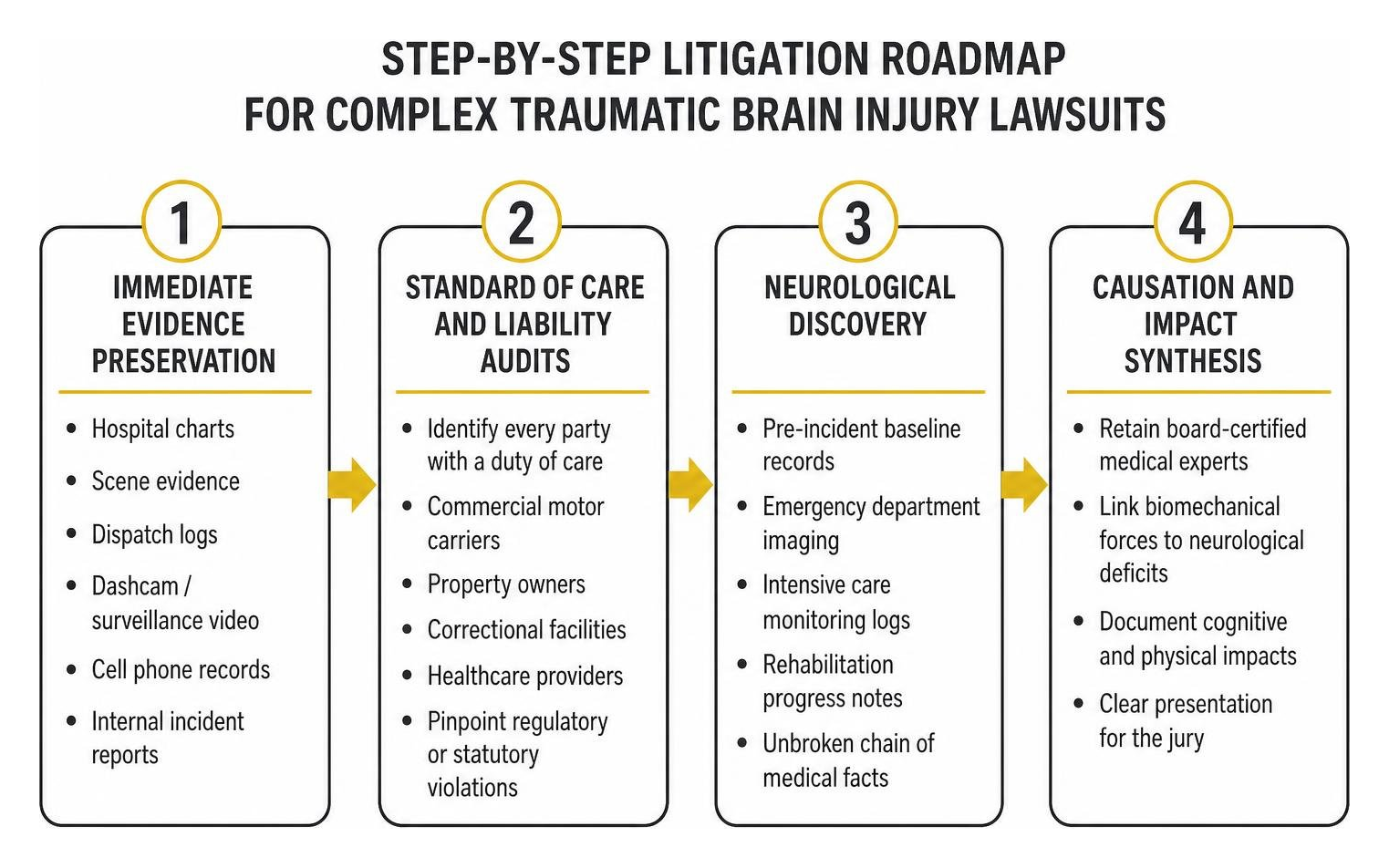
Proving severe head trauma in a civil action demands a structured, meticulous approach. When someone suffers an acute neurological injury due to negligence, abuse, or institutional indifference, our New Mexico personal injury attorneys focus on four primary pillars: early evidence preservation, liability identification, comprehensive medical discovery, and expert witness integration.
- Immediate Evidence Preservation: Beyond hospital charts, this includes securing physical scene evidence, dispatch logs, dashcam or surveillance video, cell phone records, and internal incident reports before they are overwritten or discarded. In many cases, the first 72 hours after a traumatic event are the most critical window for preserving data that may later prove decisive in establishing how the injury occurred and who bore responsibility for preventing it.
- Standard of Care and Liability Audits: Determining every party that owed a legal duty of care—such as commercial motor carriers, property owners, correctional facilities, or healthcare providers—and pinpointing exact regulatory or statutory violations. This process often requires reviewing facility policies, staff training records, and industry standards to demonstrate where the defendant’s conduct fell below what a reasonable institution or individual would have done under similar circumstances.
- Neurological Discovery: Subpoenaing pre-incident baseline records, emergency department imaging, intensive care monitoring logs, and rehabilitation progress notes to construct an unbroken chain of medical facts. Each record serves a distinct evidentiary purpose: baseline records establish the plaintiff’s functional capacity before the incident, emergency records document the immediate physiological response to trauma, and rehabilitation notes track the long-term trajectory of recovery or decline.
- Causation and Impact Synthesis: Retaining board-certified medical professionals to tie the biomechanical forces of the incident directly to specific neurological deficits, creating a clear trial presentation for a jury. This synthesis requires coordinating testimony across multiple disciplines—neurology, neuroradiology, neuropsychology, and physical medicine—so that each expert’s findings reinforce rather than contradict the others.
Documenting Primary and Secondary Damage in a Hobbs Brain Injury Lawsuit
Traumatic brain injuries (TBIs) unfold in two distinct pathological phases. Successfully litigating these claims requires demonstrating how both phases contributed to the plaintiff’s current cognitive and physical deficits.
- Primary Injury: The direct physical damage sustained at the exact moment of impact. This includes focal contusions (bruising of brain tissue), lacerations, skull fractures, and diffuse axonal injury (DAI), where shearing forces tear microscopic nerve fibers across the brain’s white matter. Primary injuries are often irreversible at the moment they occur, which is why establishing the precise mechanism of trauma—whether a fall, a collision, or an assault—is essential to understanding the full scope of harm.
- Secondary Injury: The destructive cellular and biochemical cascade that develops over hours, days, or weeks following the initial trauma. This phase often involves cerebral edema (brain swelling), elevated intracranial pressure (ICP), ischemia (oxygen deprivation), excitotoxicity, and systemic inflammation. Unlike primary injuries, secondary injuries can sometimes be mitigated or prevented through prompt and appropriate medical intervention, which is why delays in treatment or failures to monitor neurological status can constitute independent grounds for liability.
When institutions or caregivers fail to manage secondary cascades—such as delaying emergency transport, withholding anti-seizure medication, or ignoring early signs of herniation—the resulting harm can be catastrophic. Our brain damage lawyers work with neurointensivists and neuroradiologists to isolate how delayed intervention amplified permanent neurological harm. In many cases, the difference between a moderate recovery and a lifetime of profound disability can be traced to a matter of hours in the critical window following the initial trauma.
Evaluating Incident Timelines and Care Facility Negligence
Institutional settings—such as custodial facilities, nursing homes, and residential care centers—owe a defined standard of care to vulnerable individuals. Proving systemic failure requires matching the facility’s administrative records against clinical standards.
Key sources of liability include:
- Medication Administration Records (MARs): Incomplete or altered logs showing missed doses of vital medications, such as anticonvulsants or blood pressure regulators. Discrepancies between prescribed regimens and documented administration can reveal patterns of neglect that extend far beyond a single missed dose.
- Housing and Bed Assignment Logs: Failure to heed documented medical restrictions, such as assigning a top bunk to an individual with a known seizure disorder. These records often reveal whether facility staff communicated critical medical information across shifts and departments.
- Staff Observation and Check-In Rosters: Discrepancies between mandatory visual checks and the actual time a patient was found unresponsive. When rosters show checks occurring at regular intervals but witness testimony or surveillance footage contradicts those entries, the credibility of the entire institutional record may be called into question.
- Internal Incident Reports and Disciplinary Files: Prior citations, internal complaints, or patterns of understaffing that establish institutional notice of hazardous conditions. A single incident may appear isolated until these records reveal a broader culture of inadequate supervision or resource allocation.
The procedural complexity of these cases is demonstrated in the HOBBS v. FORESTAL federal trial court ruling, where administrative delays, correctional medical negligence claims, and direct physical assault allegations required distinct legal tracks and navigating bankruptcy stays for corporate healthcare defendants.
Critical Medical Evidence and Expert Testimony in TBI Claims
Objective medical testing forms the backbone of any brain injury claim. Juries cannot readily see microscopic nerve damage, making advanced diagnostic technology essential to make the invisible visible.
| Neuroimaging Modality | Diagnostic Capabilities in TBI | Evidentiary Value in Trial |
|---|---|---|
| Computed Tomography (CT) | Detects acute intracranial hemorrhage, large hematomas, and skull fractures. | Establishes immediate, life-threatening trauma and emergency room intervention. |
| Standard 1.5T / 3T Structural MRI | Identifies subacute contusions, localized tissue loss, and structural lesions. | Outlines macro-structural brain architecture and physical trauma boundaries. |
| Diffusion Tensor Imaging (DTI) | Measures water diffusion along white matter tracts to detect Diffuse Axonal Injury. | Provides visual, objective proof of microscopic axonal shearing in mild-to-severe TBI. |
| Functional MRI (fMRI) & PET | Maps real-time cerebral blood flow, oxygenation, and glucose metabolism. | Demonstrates functional impairment during memory, language, or executive tasks. |
Our Hobbs personal injury lawyers deploy these diagnostic tools alongside comprehensive neuropsychological evaluations, which quantify specific declines in processing speed, memory retention, and executive functioning. Neuropsychological testing is particularly valuable because it translates subjective complaints—such as difficulty concentrating or personality changes—into standardized, measurable deficits that juries can evaluate against normative data.
Establishing Causation and Mental State Standards
Civil brain injury claims require proving proximate cause by a preponderance of the evidence: showing that the defendant’s act or omission directly caused or substantially contributed to the brain injury. This standard is lower than the criminal burden of proof, but it still demands a rigorous evidentiary foundation connecting the defendant’s conduct to the plaintiff’s neurological harm.
In cases involving intentional torts or aggravated battery, such as physical assaults, the legal analysis often intersects with standards established in criminal jurisprudence. For example, in the landmark State v. Hobbs appellate decision, the Kansas Supreme Court analyzed intent standards in severe head injury cases, reinforcing that when a defendant knowingly engages in conduct reasonably certain to cause great bodily harm, liability attaches even if the precise catastrophic medical outcome was not explicitly intended. In civil court, proving reckless indifference or intentional conduct can open avenues for punitive damages in addition to compensatory relief.
Overcoming Evidentiary Obstacles in a Hobbs Brain Injury Lawsuit

Defense teams routinely attempt to minimize payouts by blaming prior concussions, degenerative disc disease, mental health history, or toxicological factors.
- Pre-Existing Conditions: Under the “eggshell skull” doctrine, a tortfeasor takes the plaintiff as they find them. A pre-existing vulnerability does not excuse a negligent party from liability when their actions aggravate or accelerate a condition. The defense cannot argue that a healthier person would have suffered less harm; the relevant question is what harm the defendant’s conduct caused to this particular plaintiff.
- Baseline Health Comparisons: We dissect years of prior medical records to draw a sharp line between a plaintiff’s functional abilities before and after the incident. Employment records, academic transcripts, and testimony from family members and coworkers can all help establish what the plaintiff was capable of before the injury and what has been lost since.
- Workplace and Industrial Head Trauma: For complex claims involving industrial incidents, our team investigates equipment defects and safety protocol breaches in workplace traumatic brain injuries to defeat employer claims of comparative fault. When an employer argues that the worker’s own negligence contributed to the accident, we examine whether inadequate training, missing safety guards, or pressure to bypass safety procedures created the conditions for injury.
- Toxicology Challenges: When defense counsel points to trace medications or substances, we utilize forensic toxicologists and pharmacologists to prove that the mechanical trauma—not underlying chemical factors—was the primary cause of injury. A positive toxicology screen does not automatically negate liability, and expert testimony can establish the distinction between impairment and mere presence of a substance in the bloodstream.
Calculating Damages and Long-Term Care Needs for Head Trauma
Catastrophic brain injuries alter every aspect of a survivor’s life, requiring sophisticated economic forecasting to ensure life-long financial stability. Our catastrophic injury legal representation works with life care planners, vocational economists, and rehabilitative physicians to calculate both economic and non-economic losses.
Economic damages in a Hobbs brain injury lawsuit typically include:
- Past and Future Medical Expenses: Emergency care, surgical interventions, inpatient rehabilitation, outpatient therapy, and ongoing medication costs. Life care planners project these expenses across the plaintiff’s expected lifespan, accounting for inflation and changes in medical technology.
- Rehabilitation and Therapy Costs: Cognitive rehabilitation, speech-language pathology, occupational therapy, and physical therapy. Many brain injury survivors require years of structured therapy to regain even partial function, and some will need ongoing therapeutic support indefinitely.
- Lost Wages and Diminished Earning Capacity: When a brain injury prevents a return to prior employment, vocational economists calculate both the income already lost and the future earnings the plaintiff would reasonably have expected to receive. This analysis considers the plaintiff’s education, work history, and career trajectory before the injury.
- Attendant Care and Home Modifications: Severe TBIs often require 24-hour supervision, assistance with activities of daily living, and structural modifications to the home such as wheelchair ramps, accessible bathrooms, and dedicated safety equipment.
- Assistive Technology and Adaptive Equipment: Communication devices, mobility aids, and environmental control systems that help survivors maintain independence and quality of life.
Non-economic damages address the human cost of a brain injury that no receipt can capture. These include physical pain and suffering, emotional distress, loss of enjoyment of life, loss of consortium for spouses, and the profound psychological impact of losing cognitive abilities that defined the person’s identity. Juries in New Mexico are instructed to consider the full scope of these intangible losses when determining fair compensation.
Because brain injuries are often permanent, damage calculations must account for decades of future needs. A structured settlement or life care plan that underestimates long-term costs can leave a survivor without resources at the precise moment they need them most. Our team works with financial planners and trust advisors to ensure that any recovery is structured to provide for the plaintiff’s needs throughout their lifetime.
Frequently Asked Questions About Brain Injury Litigation
What types of medical scans are most effective in proving a traumatic brain injury?
While initial emergency room CT scans are vital for identifying skull fractures and acute hemorrhaging, they often appear completely normal in cases of microscopic axonal damage. Advanced 3T MRI sequences and Diffusion Tensor Imaging (DTI) are far more effective at revealing diffuse axonal shearing by measuring disruptions in white matter tracts. Functional neuroimaging, such as fMRI or PET scans, further supports claims by illustrating metabolic abnormalities during cognitive tasks. The most persuasive cases typically combine multiple imaging modalities with neuropsychological testing to present a complete picture of both structural and functional impairment.
How do courts handle pre-existing conditions in severe head trauma claims?
Under established civil law principles, including the eggshell skull rule, a defendant cannot avoid liability simply because an injured person was uniquely susceptible to injury. If a plaintiff had a prior history of concussions, seizures, or migraines, the defense is liable for the degree to which their wrongful conduct aggravated, accelerated, or worsened the pre-existing condition. Neurologists establish this through differential diagnosis, comparing baseline pre-injury functioning with post-injury deficits. The key distinction is between a condition that was stable and manageable before the incident versus one that became disabling or progressive afterward.
How does a defendant’s bankruptcy stay impact a personal injury claim?
When an institutional or corporate defendant files for Chapter 11 bankruptcy, an automatic stay under 11 U.S.C. § 362 immediately halts ongoing litigation against the debtor to protect its assets. In multi-defendant personal injury lawsuits, plaintiffs can often petition the court to sever claims against solvent co-defendants (such as individual tortfeasors or outside contractors) so those claims can proceed independently, while the stayed claims await relief from the bankruptcy court. This procedural complexity can significantly delay resolution, which is why identifying all potentially liable parties early in the litigation process is essential to preserving viable paths to recovery.
Conclusion
Proving the true scope of a traumatic brain injury requires an exhaustive synthesis of advanced neuroimaging, rigorous timeline reconstruction, and cross-disciplinary expert testimony. Whether addressing institutional neglect, commercial negligence, or severe physical trauma, success depends on presenting an undeniable record of causation and future medical necessity.
At Nix Patterson, LLP, we commit national-level resources, private travel capabilities, and cutting-edge courtroom trial technology to take on well-funded corporate defendants and institutional healthcare systems. If you or a family member is dealing with the devastating aftermath of a severe head injury, speak with an experienced Hobbs catastrophic injury lawyer to evaluate your legal options and pursue the justice and accountability you deserve.