

Turning an Oil Field Shoulder Surgery Claim into Full Financial Recovery
Common Oilfield Hazards and Severe Shoulder Injuries Requiring Surgery
Injured oilfield workers can pursue and maximize an oil field shoulder surgery claim by documenting the accident immediately, obtaining prompt diagnostic imaging, and identifying every potentially liable party beyond the direct employer. A surgical shoulder injury may support a workers’ compensation claim, a third-party personal injury lawsuit, or both, depending on how the accident occurred and who controlled the equipment or work site. Understanding the scope of workplace injury types helps injured roughnecks, roustabouts, and drillers recognize when a severe joint rupture warrants intervention from experienced catastrophic injury lawyers.
Oil and gas extraction remains one of the most physically punishing sectors in the United States. In Texas alone, more than 325,000 workers power the energy sector, yet the industry consistently leads the nation in severe workplace trauma. Every year, roughly 4,000 oilfield workers suffer debilitating injuries across the country, with approximately 45 fatal accidents occurring in Texas annually.
The shoulder is an inherently unstable ball-and-socket joint that relies entirely on a complex network of muscles, tendons, and cartilage for integrity. When sudden forces or crushing loads impact the arm, structural failure occurs. Oilfield shoulder trauma frequently involves:
- Full-Thickness Rotator Cuff Tears: Rupturing the supraspinatus, infraspinatus, or subscapularis tendons, often requiring open or arthroscopic tendon anchors.
- Superior Labrum Anterior to Posterior (SLAP) Tears: Cartilage tears along the glenoid rim resulting from sudden jerking motions, requiring surgical debridement or tenodesis.
- Complex Glenohumeral Dislocations & Instability: Severe displacement causing permanent stretching of the capsule and nerve damage, including brachial plexus trauma.
- Acromioclavicular (AC) Joint Separations & Clavicle Fractures: High-energy impacts requiring metal plate fixation and screw stabilization.
- Advanced Impingement and Secondary Osteoarthritis: Chronic degeneration aggravated by acute trauma, often necessitating total or reverse shoulder arthroplasty.
Heavy Rig Labor and Repetitive Trauma
The mechanical demands of daily drilling operations expose workers to severe workplace injury causes. Manual handling of drill pipe, throwing heavy tongs, operating high-torque makeup wrenches, and working around iron roughnecks subject the glenohumeral joint to extreme physical stresses.
Vibrations from downhole drilling tools, continuous overhead reaching on the monkey board, and hoisting heavy mud bags create micro-tears in the rotator cuff tendons. Over months or years, these micro-traumas degrade tendon elasticity. When a sudden high-load event occurs—such as catching a swinging drill pipe or yanking on a stuck valve—the degraded tendon tears completely, turning a chronic ache into an acute surgical emergency.
Sudden Traumatic Impact and Fall Events
Sudden catastrophic accidents on drilling rigs frequently cause instantaneous joint destruction. National data shows that 41 percent of all oilfield falling accidents occur in Texas, even though fall protection equipment is technically required in roughly 86 percent of industrial settings. When a derrickman falls from an elevated platform or a floor hand slips on slick, oil-covered rig decking, landing on an outstretched arm instantly dislocates the shoulder or crushes the humeral head.
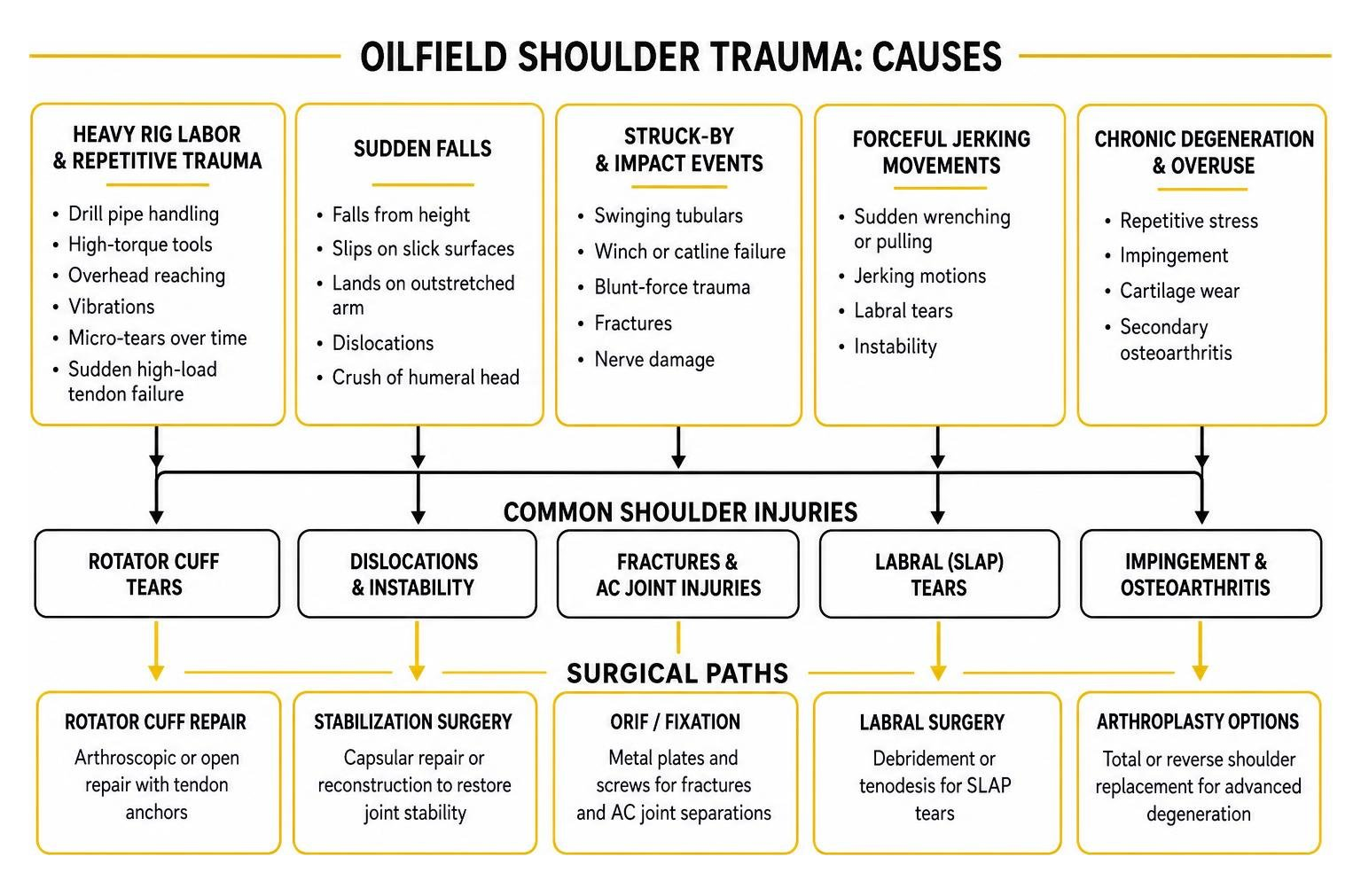
Struck-by accidents are equally dangerous. When winches fail, catlines snap, or heavy tubulars swing loose on the rig floor, workers face blunt-force trauma that fractures bones and severs nerve pathways. In these environments, serious OSHA safety violations frequently transform routine rig tasks into permanent physical disabilities.
Evaluating the True Value of an Oil Field Shoulder Surgery Claim
Evaluating a surgical shoulder claim requires assessing the full scope of medical intervention and economic loss. While the average statutory workers’ compensation settlement for a shoulder injury hovers around $49,838 (roughly $25,821 for medical care and $24,017 in temporary wage indemnity), catastrophic surgical cases in the oil patch are worth substantially more. A severe joint injury that terminates an oilfield career often reaches hundreds of thousands—or millions—of dollars when properly litigated.
| Compensation Factor | Standard Workers’ Comp Claim | Third-Party Personal Injury Lawsuit |
|---|---|---|
| Medical Expenses | Covers approved medical bills according to fee schedules | Full recovery of past and projected lifetime medical costs |
| Wage Loss | Statutory cap (usually 66.6% of average weekly wage) | 100% of past lost wages plus full future lost earning capacity |
| Pain and Suffering | Not available under statutory workers’ compensation | Full financial recovery for physical pain, anguish, and distress |
| Disfigurement & Loss of Quality of Life | Minimal statutory impairment ratings only | Substantial compensation for joint deformity and loss of enjoyment |
| Punitive / Exemplary Damages | Barred in standard workers’ comp claims | Available in cases of gross contractor or manufacturer negligence |
Calculating the worth of a personal injury case requires measuring both economic and non-economic damages. When an oilfield hand undergoes an open rotator cuff repair, subacromial decompression, or bicep tenodesis, the recovery timeline spans 6 to 12 months of intensive physical therapy. If the procedure fails or requires revision surgery, the worker may never lift more than 20 pounds overhead again, permanently ending their career in oil and gas extraction.
Offshore claims under federal maritime jurisdiction demonstrate the true financial exposure of oilfield operators. In the landmark case Diamond Offshore Servs. Ltd. v. Williams, an injured rig worker secured an $8.5 million compensatory damages award after sustaining severe spinal and joint trauma while repairing equipment on an offshore drilling unit. The court upheld substantial damages for lost future earning capacity and ongoing medical needs, demonstrating that the real value of an industrial injury claim is tied to the worker’s long-term loss of livelihood.
Factors That Influence an Oil Field Shoulder Surgery Claim Payout
Multiple medical and legal factors dictate whether a claim settles for a baseline statutory sum or results in a multi-million-dollar recovery:
- Type and Complexity of Surgery: Arthroscopic debridement carries a lower valuation than open tendon reconstruction, labral stabilization, or total joint arthroplasty.
- Permanent Impairment Ratings: Higher whole-person impairment ratings assigned under the AMA Guides to the Evaluation of Permanent Impairment directly increase statutory and non-economic payouts.
- Permanent Lifting and Functional Restrictions: Medical restrictions prohibiting overhead reaching or lifting over 25 pounds prevent roughnecks from returning to oilfield labor.
- Need for Future Revision Surgeries: Medical testimony establishing the future need for joint replacements or hardware removal increases projected life-care costs.
- Loss of Future Earning Capacity: The economic gap between high-paying oilfield wages (often exceeding $100,000 annually with overtime) and sedentary, minimum-wage alternate employment.
Economic and Non-Economic Damages in Severe Joint Injury Cases
When third-party liability exists, injured workers can claim the full spectrum of types of personal injury damages. Non-economic damages compensate for daily physical pain, loss of sleep due to joint discomfort, depression stemming from physical limitations, and the loss of life enjoyment.
Proving these losses requires pairing orthopedic surgeon testimony with vocational rehabilitation assessments and economic loss analyses. By modeling inflation, lost pension contributions, and missed bonuses over the worker’s remaining work-life expectancy, we establish the true economic value of a career cut short.
Navigating Workers’ Compensation Versus Third-Party Lawsuits

One of the most critical legal determinations following a rig accident is distinguishing between exclusive remedy workers’ compensation claims and third-party negligence lawsuits. We guide injured hands through the critical differences between workers’ compensation vs third-party claims to maximize overall financial recovery.
While workers’ compensation pays basic medical bills and a fraction of lost wages regardless of fault, it explicitly bars the worker from suing their direct employer for pain and suffering. However, oil and gas extraction sites are complex, multi-employer environments. When an outside contractor, equipment vendor, or leasing company causes an accident, the worker can pursue a third-party lawsuit outside the workers’ comp system.
Furthermore, Texas allows employers to opt out of the state workers’ compensation system entirely. If an injured hand works for a non-subscriber, suing outside workers’ comp allows them to sue their employer directly for full tort damages if employer negligence contributed to the injury.
Identifying Third-Party Liability on Multi-Employer Well Sites
Investigating multi-employer drilling pads often uncovers overlapping layers of outside fault. Potential third-party defendants include:
- Defective Equipment Manufacturers: Makers of defective top drives, automated pipe-handling systems, or failed hydraulic tongs.
- Independent Drilling Contractors & Operators: Site operators who fail to maintain well control or establish safe simultaneous operations (SIMOPS).
- Third-Party Trucking & Water Haulers: Transportation companies whose drivers cause loading-dock or site traffic collisions.
- Rig Maintenance & Inspection Sub-Contractors: Outside service companies that fail to properly service safety latches, winches, or elevators.
Proving third-party negligence opens the door to complete financial recovery, holding careless contractors accountable through comprehensive employer negligence claims.
Maritime and Offshore Rig Jurisdiction
When shoulder injuries occur on jack-up rigs, drillships, or semi-submersible platforms in the Gulf of Mexico, traditional state workers’ compensation laws yield to federal maritime law.
Under the Jones Act (46 U.S.C. § 30104), qualifying seamen can sue their maritime employer directly for negligence if even the slightest employer fault contributed to the injury. Additionally, offshore workers are entitled to “maintenance and cure”—daily living stipends and complete medical coverage until reaching maximum medical improvement—as well as claims under the General Maritime Law for unseaworthiness of the vessel. For non-seamen on fixed platforms, the Outer Continental Shelf Lands Act (OCSLA) extends federal Longshore and Harbor Workers’ Compensation Act (LHWCA) protections, providing superior medical and wage replacement rates compared to state programs.
How to Prove Work-Related Causation and Overcome Claim Disputes

Insurance carriers vigorously dispute shoulder surgery claims. Because the shoulder naturally experiences wear and tear as people age, adjusters routinely argue that a rotator cuff tear or labral detachment is a “pre-existing degenerative condition” rather than a work-related injury. Successfully proving a workplace injury case requires compiling comprehensive medical and industrial evidence right from the start.
Establishing causation demands strict adherence to legal and medical standards. In federal administrative decisions such as the Employees’ Compensation Appeals Board Decision on Right Shoulder Claim Expansion, claims for secondary or expanded shoulder conditions are routinely rejected if the medical opinions are deemed “speculative or equivocal.” Proving a surgical claim requires definitive, rationalized medical reports that establish a direct and natural causal relationship between rig floor duties and the anatomical damage.
Essential Evidence to Prove Causation in an Oilfield Shoulder Claim
- Immediate Incident Documentation: Written incident reports filed before leaving the well pad, detailing the exact machinery and motion involved.
- Early High-Resolution MRI Scans: Diagnostic imaging performed shortly after the accident showing acute edema, muscle retraction, or bone bruising consistent with sudden trauma.
- Operative and Arthroscopic Photographs: High-resolution intraoperative photos taken by the orthopedic surgeon showing fresh, irregular tendon tears rather than smooth, degenerative fraying.
- Job Safety Analyses (JSAs) and Daily Drilling Logs: Official tour sheets and JSAs proving the worker was engaged in heavy-lifting or torque operations when the injury occurred.
- Co-Worker and Supervisor Witness Statements: Corroborating testimony confirming the mechanical failure, slip event, or immediate physical distress of the worker.
Strategic Evidence for an Oil Field Shoulder Surgery Claim
Insurance companies often hire private investigators to record surveillance video of injured workers in public, hoping to catch them carrying groceries or opening car doors to argue that surgery is unnecessary. Combatting these tactics requires strong expert medical testimony.
In the appellate decision 24-ICA-171, a West Virginia court affirmed authorization for an industrial worker’s shoulder surgery despite surveillance video showing him driving and operating a pressure washer. The court ruled that persuasive orthopedic surgeon testimony regarding internal joint pathology outweighed selective video footage captured by the insurer. We use similar evidentiary strategies to neutralize surveillance and secure surgical authorizations.
Overcoming Pre-Existing Degenerative Condition Defenses
Having prior joint soreness or mild arthritis does not disqualify a worker from obtaining full compensation. Under standard legal principles across Texas, Oklahoma, and New Mexico, an employer takes an employee as they find them (“the eggshell skull rule”). When oilfield trauma aggravates, accelerates, or turns an asymptomatic pre-existing condition into a disabling surgical tear, the entire resulting disability is compensable.
Asserting your legal rights in workplace injury requires pairing orthopedic evaluations with pre-accident medical records to prove that you worked without physical limitations prior to the incident on the rig.
Frequently Asked Questions about Oilfield Shoulder Injuries
What is the average settlement for an oil field shoulder surgery claim?
While general workers’ compensation shoulder settlements average around $49,838, oilfield claims requiring surgical intervention typically settle for significantly higher sums. Payouts for surgical tears involving severe impairment, extensive lost wages, or third-party negligence often range from $150,000 to well over $750,000, depending on liability and insurance coverage.
Can I file a lawsuit if I already receive workers’ compensation for shoulder surgery?
Yes. Receiving statutory workers’ compensation benefits does not prevent you from filing a third-party personal injury lawsuit against negligent contractors, rig operators, equipment leasing companies, or tool manufacturers on the well pad. Money recovered in a third-party suit covers damages that workers’ comp ignores, such as 100% of lost earnings and physical pain and suffering.
How does an insurer challenge the medical necessity of shoulder surgery?
Insurers frequently hire “independent” medical examiners to review MRI scans and claim that the tear is age-related degeneration rather than trauma from the job. They may also use surveillance video to argue you retain functional range of motion. Overcoming these denials requires detailed rebuttal letters, objective functional capacity evaluations, and clear intraoperative photographic evidence from your treating surgeon.
Conclusion
A severe shoulder injury can permanently derail a lucrative oilfield career. Navigating insurance denials, employer disputes, and complex liability networks requires aggressive, sophisticated legal representation.
At Nix Patterson, LLP, we commit deep litigation resources—including private air travel to access remote rig sites and cutting-edge courtroom presentation technology—to confront national energy operators and insurance conglomerates. If you suffered a severe joint injury or underwent surgery after an oilfield accident, consulting our team can help you protect your legal rights, future earnings, and family.