

Why Surviving an Oil Rig Fire Means Calling a Top Burn Injury Attorney Immediately
Why an Oil Rig Burn Injury Attorney Should Be Called Immediately
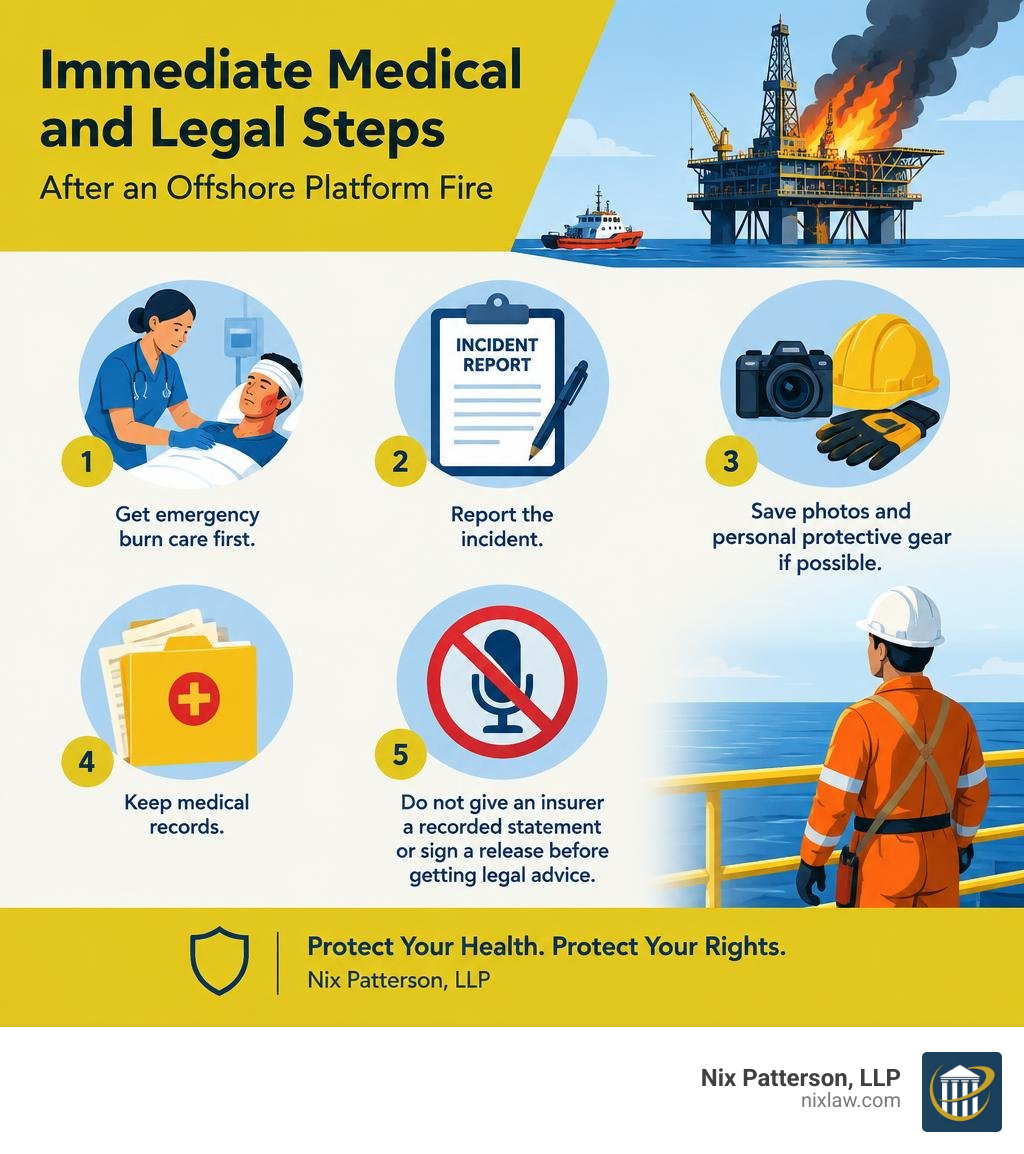
After an offshore fire or explosion, get emergency burn care first. Then protect your legal options: report the incident, save photos and personal protective gear if possible, keep medical records, and do not give an insurer a recorded statement or sign a release before getting legal advice.
An Oil rig burn injury attorney can quickly investigate whether failed hot-work procedures, gas monitoring, a missing fire watch, defective equipment, or unsafe contractor practices caused the fire. Fast action matters because operators may repair the fire area, witnesses may leave the rig, and key records (including permits, inspection logs, and incident reports) can become harder to obtain.
Severe burns can require repeated grafts, rehabilitation, and long-term care. Smoke and toxic-gas inhalation injuries may also worsen after the initial emergency. A lawyer familiar with maritime and offshore injury law can identify the right claim, which may involve the Jones Act, federal benefits, or a claim against a negligent third party.
Nix Patterson, LLP can help injured workers and families pursue evidence and accountability while they focus on recovery.
Catastrophic Causes and Regulatory Violations Behind Offshore Platform Fires
Offshore oil platforms and drilling rigs are self-contained industrial cities operating under massive pressure, surrounded by combustible hydrocarbons. When disaster strikes, workers cannot simply run out the front door. They are miles from shore, often forced to navigate narrow gangways, vertical ladders, and smoke-filled decks to survive.

While the energy sector remains essential, energy operations involve extreme hazards. While OSHA and industry data indicate that roughly four out of ten oil and gas fatalities result from motor vehicle incidents during transit, on-rig fires and well explosions remain the most devastating catastrophic events. Common origins of offshore platform fires include:
- Well blowouts: Catastrophic failures of the hydrostatic barrier or the blowout preventer (BOP) stack that allow pressurized hydrocarbons to erupt onto the rig floor.
- Cutting torch sparks and hot work: Uncontrolled sparks, slag, or open flames falling onto hydrocarbon-contaminated surfaces or near vapor vents.
- Gas pocket ignitions: Undetected methane or hydrogen sulfide pockets accumulating in unventilated areas of the deck or mud processing systems.
- Fuel and hydraulic line ruptures: High-pressure pinhole leaks that atomize flammable fluid into a fine, easily ignitable mist.
- Electrical arcing: Non-explosion-proof electrical equipment, frayed wiring, or compromised switchgear operating in Class 1, Division 1 hazardous locations.
- Mechanical equipment failure: Overheating mud pumps, seized turbine bearings, or failing compressors that reach auto-ignition temperatures.
Investigating complex industrial disasters, such as the Grand Isle platform explosion litigation, reveals that these fires almost never stem from a single, unforeseeable event. Instead, they result from a chain of disregarded safety protocols, deferred maintenance, and bypassed regulatory safeguards.
Three Critical Safety Barriers and BSEE Hot Work Mandates
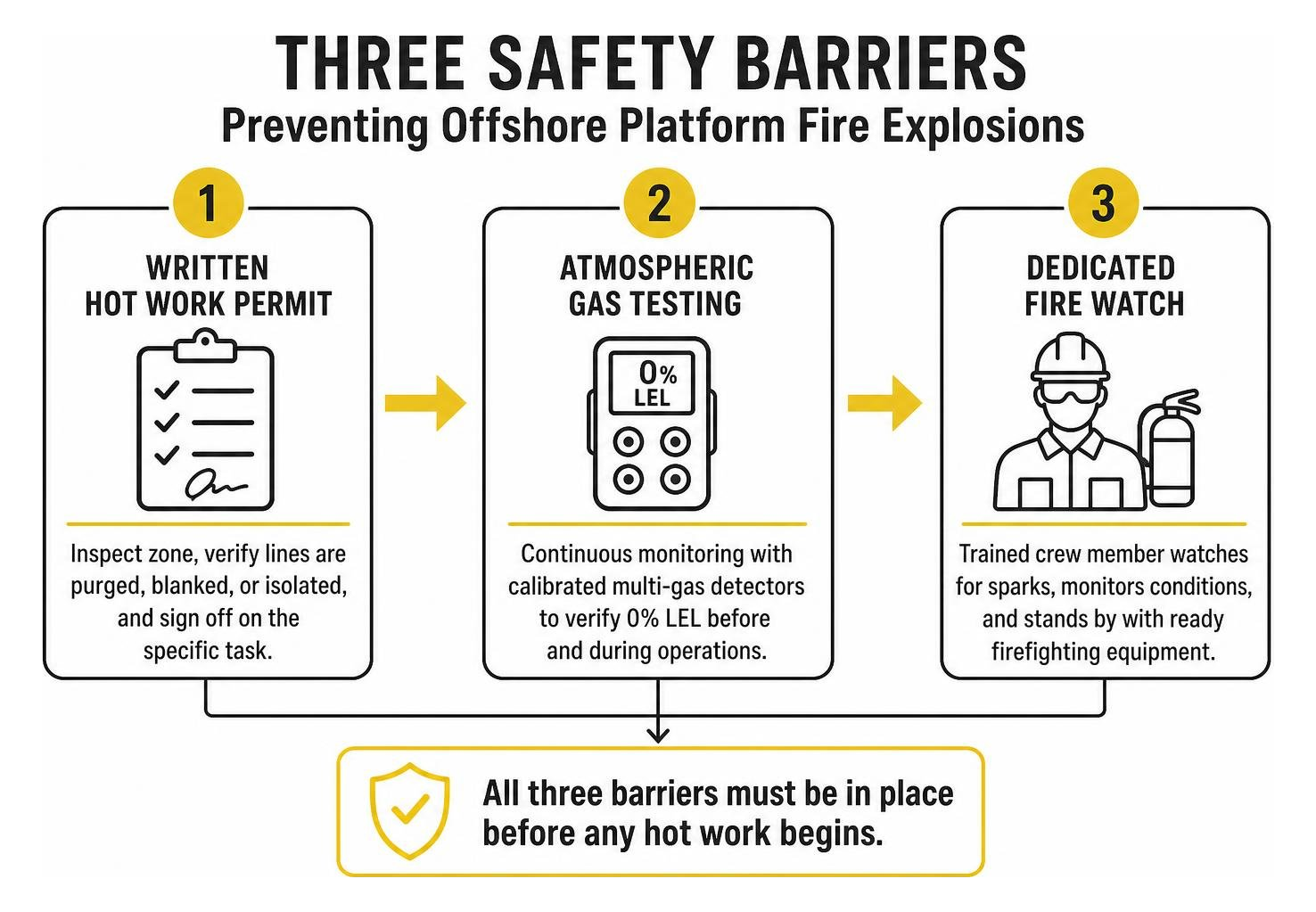
The Bureau of Safety and Environmental Enforcement (BSEE) strictly enforces federal safety mandates under 30 CFR Part 250, alongside industry guidelines like API RP 14G (Fire Prevention and Control on Open-Type Offshore Production Platforms). Federal regulations establish three non-negotiable safety barriers that must be operational before any hot work (such as welding, cutting, or grinding) begins:
- The Written Hot Work Permit: Supervisors must inspect the designated zone, verify that production lines are purged, blanked, or isolated, and formally sign off on the specific task.
- Atmospheric Gas Testing: Continuous monitoring using calibrated multi-gas detectors to verify that flammable vapor concentrations are at 0% of the Lower Explosive Limit (LEL) before and during operations.
- A Dedicated Fire Watch: An assigned, trained crew member whose sole responsibility is watching for sparks, monitoring atmospheric conditions, and standing by with ready-to-deploy firefighting equipment. (A common industry quip is that a fire watch has the only job where staring at a flame for hours is considered a safety measure, yet skipping this simple duty causes catastrophic explosions.)
When operators cut corners to prevent drilling downtime, these safety barriers collapse, leading to life-altering thermal and blast injuries.
Complex Liability: Identifying Every Responsible Party on the Rig
An offshore platform is rarely run by a single corporate entity. Multiple contractors, subcontractors, and service vendors work side-by-side, creating complex liability webs:
- Platform Owner/Operator: Holds primary responsibility for maintaining a safe workplace, managing concurrent operations (SIMOPS), and establishing platform-wide emergency procedures.
- Drilling Contractor: Owns and operates the rig machinery, oversees the drill floor, and directs the roustabouts, roughnecks, and toolpushers.
- Third-Party Hot Work Contractors: Dedicated welding and pipefitting companies responsible for following strict hot-work guidelines and conducting gas tests.
- Safety Oversight and Inspection Contractors: Hired to verify compliance with BSEE regulations and liable when they overlook obvious safety violations or sign off on fraudulent permits.
- Equipment Manufacturers: Subject to product liability claims if defective safety shut-off valves, faulty gas sensors, or compromised emergency escape gear contributed to the disaster.
We deploy immediate investigative teams to review operator logs, maintenance sheets, and safety records, to identify potentially responsible parties and pursue accountability.
Medical Realities of Rig Burns and Why You Need an Oil Rig Burn Injury Attorney
The human body is not built to withstand the temperatures produced by pressurized hydrocarbon fires. A catastrophic offshore fire causes complex trauma involving intense heat, toxic smoke, blast pressure waves, and physical impacts from structural collapse.

Burn severity is evaluated using Total Body Surface Area (TBSA), frequently mapped through the clinical Rule of Nines. When a patient suffers burns over 20% to 30% TBSA, systemic burn shock develops. Blood vessels throughout the body leak fluid into surrounding tissues, causing dangerous drops in blood volume and pressure.
Emergency teams use the Parkland Formula to calculate the massive volume of intravenous fluids required within the first 24 hours just to keep vital organs functioning. A victim with burns covering 30% of their body often spends a full month in an intensive burn unit before rehabilitation can even start.
Recent medical economic studies, including a peer-reviewed pediatric and adult trauma burn analysis published in 2024, show that the cost of burn care easily runs hundreds of dollars per percent of body surface burned during acute hospitalization alone, excluding secondary surgeries, psychological support, and lifetime rehabilitation.
Severe Burn Classifications and Hidden Inhalation Injuries
Burns are categorized by how deeply they penetrate the skin layers:
- First-Degree Burns: Damage limited to the epidermis, causing redness, swelling, and pain.
- Second-Degree (Partial-Thickness) Burns: Destruction extends into the dermis, causing severe blistering, nerve exposure, and extreme pain.
- Third-Degree (Full-Thickness) Burns: The epidermis and dermis are entirely destroyed, extending into subcutaneous fat, muscle, and bone. These areas often appear charred, leathery, or waxy white. Paradoxically, the deepest third-degree areas may initially cause less sharp pain because the underlying nerve endings are incinerated.
Beyond external thermal damage, inhalation injury is one of the deadliest components of an oil rig fire. Breathing superheated air, vaporized oil, synthetic smoke, and toxic hydrogen sulfide gas causes direct thermal injury to the upper airway and chemical damage to the lungs.
Airway tissues can swell shut hours after the incident, and delayed pulmonary edema can cause respiratory collapse even in workers who initially walked away from the blast.
How an Oil Rig Burn Injury Attorney Calculates Lifetime Medical Damages
Securing fair compensation requires projecting decades of complex medical care. Severe burns are never cured with a single hospital discharge. They require ongoing treatment, including:
- Surgical Debridement and Skin Grafting: Removing dead tissue and applying autografts (harvested from undamaged skin) or synthetic dermal matrices.
- Contracture Release Surgeries: Burn scars contract as they heal, pulling joints into rigid, unnatural positions that require surgical release to restore movement.
- Infection Management: Burned skin loses its natural protective barrier, leaving patients vulnerable to life-threatening sepsis and antibiotic-resistant infections.
- Physical and Occupational Therapy: Daily stretching, compression garments worn 23 hours a day for years, and retraining for basic physical tasks.
- Psychological and Psychiatric Care: Treating Post-Traumatic Stress Disorder (PTSD), severe depression, sleep disturbances, and the emotional impact of disfigurement.
- Vocational Loss: Evaluating whether an injured offshore worker can ever return to high-earning heavy industrial labor.
Our firm works closely with independent life care planners, medical economists, and surgical experts to estimate future financial needs and develop settlement demands based on projected lifetime costs.
Maritime Jurisdictions, Legal Deadlines, and Defense Tactics
Navigating an offshore burn injury claim involves a patchwork of federal maritime statutes, compensation acts, and state tort laws. The applicable legal framework depends on the rig’s exact location, whether it was floating or fixed to the seafloor, and your specific job duties.
Navigating Legal Frameworks with an Oil Rig Burn Injury Attorney
Determining your legal status is the first step toward securing financial recovery:
- The Jones Act (46 U.S.C. § 30104): Protects workers classified as “seamen,” meaning those who contribute to the mission of a vessel in navigation (such as drillships, semi-submersible rigs, and jack-up rigs) and spend at least 30% of their time in service of the vessel. Seamen have the right to sue their employer for negligence under a favorable legal standard, as well as pursue claims for vessel unseaworthiness and receive maintenance and cure benefits regardless of fault.
- Longshore and Harbor Workers’ Compensation Act (LHWCA): Covers maritime employees who do not qualify as seamen. While it provides baseline statutory workers’ compensation, Section 905(b) allows injured workers to file third-party lawsuits against negligent vessel owners and third-party contractors.
- Outer Continental Shelf Lands Act (OCSLA): Applies to fixed, bottom-founded platforms located on the Outer Continental Shelf beyond state waters. OCSLA applies federal law supplemented by the laws of the adjacent state (such as Texas or Louisiana), opening the door to third-party personal injury lawsuits.
Critical Statutes of Limitations
Missing a statutory filing deadline will permanently bar your right to financial recovery. Deadlines vary significantly by jurisdiction:
- Jones Act Seaman Claims: Injured workers have 3 years from the date of the incident to file suit.
- LHWCA Administrative Claims: Formal injury claims must generally be filed within 1 year.
- State-Specific Onshore & Territorial Deadlines:
- Texas: 2 years (Tex. Civ. Prac. & Rem. Code § 16.003)
- New Mexico: 3 years (NM Stat. § 37-1-8)
- Oklahoma: 2 years (Okla. Stat. Title 12, § 95)
- Louisiana (OCSLA adjacent): Tort claims are subject to strict prescriptive periods.
Countering Insurance Defense Playbooks and Protecting Critical Evidence
Corporate operators and their maritime insurance carriers act quickly after an explosion to limit financial liability. Their defense playbooks routinely include:
- The Recorded Statement Trap: Risk managers may visit injured workers in hospital waiting rooms or burn units, asking leading questions to shift blame onto the worker while they are under heavy pain medication.
- The Fast Lowball Settlement: Offering quick settlement checks paired with broad liability releases before the full medical extent of a burn or inhalation injury is known.
- “Independent” Medical Examinations (IMEs): Retaining defense-friendly physicians who downplay burn depths, dispute the need for future plastic surgeries, or declare workers fit for duty prematurely.
- Social Media and Physical Surveillance: Hiring investigators to photograph injured workers during their recovery, using minor daily activities out of context to challenge disability claims.
- Spoliation of Evidence: Quickly repairing fire-damaged equipment, painting over ignition zones, and overwriting digital gas monitoring logs under the guise of emergency platform restoration.
Our attorneys immediately intervene by issuing formal evidence preservation letters, filing emergency protective orders, and seeking key BSEE investigation files, electronic gas monitoring records, and safety permits while they remain available.
Frequently Asked Questions About Offshore Burn Injury Claims
What immediate steps should be taken after an offshore burn injury?
Your health is the absolute priority:
- Get emergency medical care: Ensure emergency transport to an American Burn Association-verified burn trauma center.
- Report the injury: File an official incident report with your supervisor, noting safety violations or equipment failures if known.
- Preserve physical evidence: Keep all unwashed, damaged personal protective equipment (PPE), fire-retardant clothing, boots, and safety glasses.
- Decline recorded statements: Do not sign waivers, releases, or recorded statements for company investigators or insurance adjusters.
- Consult legal counsel: Contact an experienced maritime trial team before physical evidence on the platform is repaired or altered.
Who is responsible for paying medical bills and lost wages during recovery?
Under the Jones Act, maritime employers must provide maintenance and cure, which pays for necessary medical care and basic living expenses until you reach Maximum Medical Improvement (MMI), regardless of fault. Non-seamen covered by the LHWCA receive statutory disability and medical compensation.
However, because these administrative benefits cover only a portion of actual losses, we often pursue third-party lawsuits against negligent platform operators, contractors, and equipment manufacturers to seek compensation for past and future lost earnings, pain and suffering, and permanent scarring.
Can a lawsuit be filed if the platform operator claims the explosion was an unavoidable accident?
Yes. Industrial explosions and rig fires are almost never unavoidable accidents. They stem from safety breakdowns, ignored gas warnings, inadequate hot-work oversight, or defective machinery.
Even if an operator claims an unpreventable flash fire, our independent investigations frequently uncover regulatory violations under BSEE rules (30 CFR Part 250), bypassed safety interlocks, missing fire watches, or systemic corporate negligence.
Stand Up for Your Recovery with Nix Patterson, LLP
A catastrophic oil rig fire changes a worker’s life in an instant. While you focus on healing, complex medical procedures, and supporting your family, corporate defense teams and maritime insurers are already working to limit their financial responsibility.
At Nix Patterson, LLP, we bring substantial resources, advanced courtroom technology, and a track record of multi-billion-dollar recoveries to every case we handle. We move quickly to secure physical evidence, obtain digital sensor data, consult top burn-trauma physicians, and pursue accountability for negligent corporations in federal and state courts.
If you or a loved one suffered severe burns or toxic inhalation injuries in an offshore or oilfield disaster, contact our team today for a free, confidential case evaluation with our experienced oil field injury lawyers. We handle cases on a contingency fee basis, meaning you pay no legal fees unless we successfully recover compensation on your behalf.