

Put an Experienced Oil Rig Shoulder Injury Attorney on Your Side When Rig Work Shuts Down Your Arm
How Rig Classification and Seaman Status Dictate Your Offshore Shoulder Claim
The physical realities of offshore energy work are relentless. Whether you are throwing chain on the drill floor, guiding casing into place, or maintaining heavy machinery, your shoulders bear the brunt of the daily grind. When an accident sidelines your arm, the legal remedies available to you depend heavily on two foundational concepts: where the injury occurred and your specific connection to the vessel.
Offshore legal jurisdiction is not one-size-fits-all. The maritime laws governing the Gulf of Mexico and coastal waters create distinct paths for injured workers depending on whether the structure floats or rests permanently on the seabed.
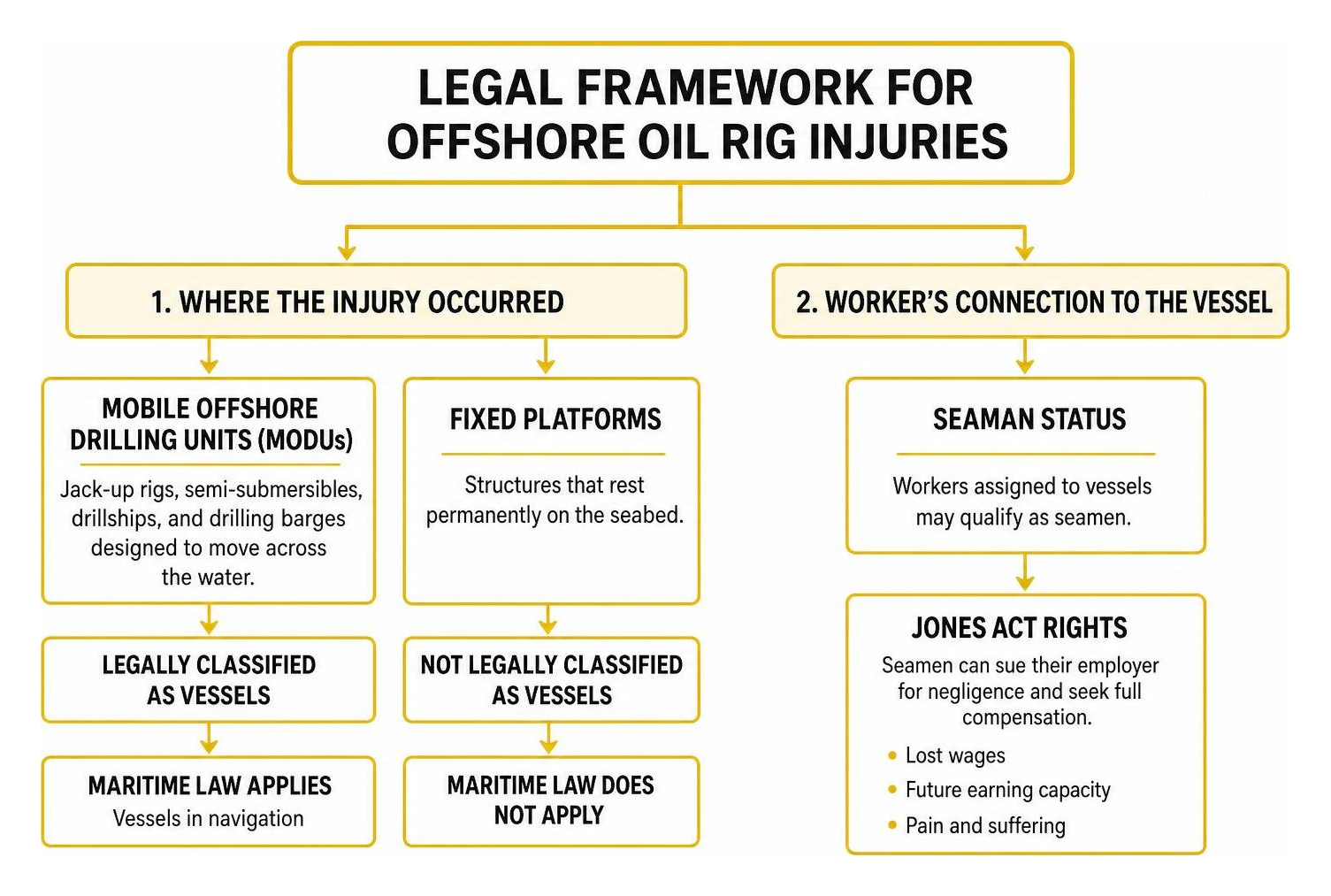
Mobile Offshore Drilling Units vs. Fixed Platforms Under Maritime Law
To understand your rights, we must first examine the legal classification of the structure where you were hurt. Maritime law draws a sharp boundary between vessels in navigation and fixed structures:
- Mobile Offshore Drilling Units (MODUs): Jack-up rigs, semi-submersibles, drillships, and drilling barges are designed to move across the water from one well site to another. Under federal maritime law, these structures are legally classified as vessels. Workers assigned to MODUs can qualify as seamen under the Jones Act (46 U.S.C. § 30104), giving them the right to sue their employer directly for negligence and seek full compensation for lost wages, future earning capacity, and pain and suffering.
- Fixed Platforms: Structures permanently attached to the outer continental shelf (such as traditional steel-jacket production platforms) are not vessels under maritime law. Instead, injuries occurring on fixed platforms fall under the Outer Continental Shelf Lands Act (OCSLA, 43 U.S.C. § 1331 et seq.). OCSLA generally extends the administrative remedies of the Longshore and Harbor Workers’ Compensation Act (LHWCA, 33 U.S.C. § 901 et seq.) to platform workers. While the LHWCA provides statutory no-fault medical and disability benefits, it typically bars direct negligence lawsuits against your direct employer, limiting personal injury actions to at-fault third parties.
Identifying the exact structure and its operational status at the time of your injury is the first strategic step in any offshore shoulder claim.
Applying the Chandris Test: Why an Oil Rig Shoulder Injury Attorney Evaluates the 30 Percent Rule
Even when a structure is classified as a vessel, not every person onboard automatically qualifies for Jones Act seaman status. In the landmark decision Chandris, Inc. v. Latsis, 515 U.S. 347 (1995), the U.S. Supreme Court established a two-part test to determine seaman status:
- Contribution to Mission: The worker’s duties must contribute to the function of the vessel or to the accomplishment of its maritime mission. Because drilling, maintenance, and deck operations are central to a MODU’s core purpose, roughnecks, roustabouts, mechanics, derrickmen, and crane operators easily meet this requirement.
- Substantial Connection: The worker must have a connection to a vessel in navigation (or an identifiable fleet of vessels under common ownership or control) that is substantial in terms of both its duration and its nature.
To satisfy the duration element of the Chandris test, the Supreme Court adopted an objective guideline: a maritime worker who spends less than roughly 30 percent of their total working time in the service of a vessel on navigable waters generally does not qualify as a seaman.
When evaluating a shoulder claim, we analyze your complete employment records, daily tour sheets, and multi-rig assignments. If you split your hitches between fixed production platforms and drilling vessels, demonstrating that you crossed that 30 percent threshold can mean the difference between a capped statutory workers’ compensation check and a full personal injury lawsuit under the Jones Act.
Common Offshore Shoulder Injuries, Causation, and Independent Medical Evidence
Offshore drilling relies on immense hydraulic, mechanical, and human power. Your shoulder joint, a shallow ball-and-socket design stabilized primarily by soft tissue, is exceptionally vulnerable to violent shifts in load, awkward overhead torque, and slip-and-fall impacts on slick grating.
Rotator Cuff Tears, SLAP Lesions, and Fractures from Heavy Pipe Handling
Rig operations place unique, high-impact stresses on the upper extremities. The most common disabling shoulder injuries we see on drilling rigs include:
- Full-Thickness Rotator Cuff Tears: The supraspinatus, infraspinatus, teres minor, and subscapularis tendons keep your arm seated in the shoulder socket. When an uncontrolled drill pipe swings, iron roughnecks jam, or manual tongs kick back unexpectedly, the sudden eccentric load can shear these tendons completely off the humerus bone.
- SLAP Lesions (Superior Labrum Anterior to Posterior): The labrum is the ring of cartilage surrounding the shoulder socket. Heavy pulling, overhead impact, or reaching out to brace against a fall down a wet rig stairway can rip the top of the labrum where the biceps tendon attaches.
- Acromioclavicular (AC) Joint Separations and Fractures: Blunt-force impacts, such as dropped objects, swinging crane loads, or falls from the monkey board, frequently result in fractured clavicles, fractured humerus heads, or torn ligaments binding the collarbone to the shoulder blade.
When a rig worker suffers an acute shoulder tear, employers and their maritime insurers routinely claim the damage is merely “degenerative wear and tear” related to years of manual labor.
Under maritime law, the eggshell skull doctrine may counter this defense. An employer must take the worker as they find them. If you had asymptomatic arthritis or mild tendon fraying, but an on-deck incident caused that stable condition to become symptomatic, torn, and completely disabling, the negligent party may be liable for the resulting disability, depending on the evidence and applicable law. Objective MRI imaging, intraoperative photos, and detailed orthopedic causation reports are essential to demonstrate the clear mechanical trauma linking the rig incident to your physical loss.
Why an Oil Rig Shoulder Injury Attorney Demands Independent Medical Evaluations Over Company Doctors
In the immediate aftermath of an offshore accident, rig operators often steer injured crew members toward company-retained clinics and occupational physicians. While presented as a convenience, company doctors frequently face conflicting incentives:
- Premature “Light-Duty” Releases: Company physicians may minimize diagnostic findings on MRIs, diagnose a full-thickness tendon tear as a simple “strain,” and quickly clear the worker for light duty to prevent the incident from being recorded as a Lost Time Incident (LTI) under federal reporting rules.
- Inadequate Conservative Care: Rig hands are sometimes prescribed basic anti-inflammatory medications and a few days of heat therapy rather than receiving an early referral to a board-certified orthopedic shoulder surgeon.
- Pressure to Return Offshore: Being cleared to climb vertical ladders, manipulate heavy drill pipe, or throw slips before a torn labrum or rotator cuff has mechanically healed leads to catastrophic reinjury and permanent joint degradation.
Under general maritime law, an injured seaman has the unequivocal legal right to choose their own treating physician. We insist on comprehensive Independent Medical Evaluations (IMEs) by reputable orthopedic surgeons, functional capacity evaluations (FCEs), and advanced 3T MRI diagnostic imaging. Your long-term physical mobility and future career should never depend on a medical opinion tailored to protect a drilling contractor’s safety score.
Regulatory Violations, Maritime Remedies, and the Scope of Financial Recovery
When an offshore worker suffers a debilitating arm or shoulder injury, the legal framework dictates not only how liability is proven, but also the extent of available financial recovery.
| Legal Category | Jones Act Negligence & Unseaworthiness | LHWCA / OCSLA Benefits |
|---|---|---|
| Fault Requirement | Employer negligence (featherweight burden) or vessel unseaworthiness | No-fault administrative compensation system |
| Medical Expenses | Potential recovery of past and future injury-related medical costs | Reasonable and necessary medical care via schedule |
| Lost Earnings | Potential recovery of past lost wages and future lost earning capacity | Fixed percentage of Average Weekly Wage (subject to statutory maximums) |
| Non-Economic Damages | Potential recovery for pain, suffering, mental anguish, and physical impairment | None (no compensation for physical pain or emotional distress) |
| Right to Jury Trial | Yes, full trial before a federal or state civil jury | No, administrative hearings before an Administrative Law Judge (ALJ) |
Maintenance, Cure, and Wrongful Termination Before Maximum Medical Improvement
For workers qualifying as Jones Act seamen, general maritime law provides an ancient, absolute right known as maintenance and cure. This is a no-fault remedy that begins the moment you are injured in the service of the vessel:
- Maintenance: A daily living stipend intended to cover basic food and lodging costs onshore comparable to what you would have received aboard the rig.
- Cure: The direct payment of all reasonable and necessary medical treatments, physical therapy, diagnostic scans, medications, and surgical interventions.
Maintenance and cure obligations continue until the worker reaches Maximum Medical Improvement (MMI), the point at which an orthopedic physician determines that the injury has healed as much as it ever will, and no further medical treatment will improve physical function.
Unfortunately, maritime employers often terminate maintenance and cure prematurely by relying on brief check-ins with company-retained physicians who claim the worker is “at MMI” while the treating orthopedic surgeon is still recommending surgical repair. When an employer arbitrarily, capriciously, or bad-faith refuses to pay maintenance and cure, federal courts can hit them with punitive damages and mandatory attorney fees.
BSEE Safety Violations, Negligence, and Damages Under Diamond Offshore Servs. Ltd. v. Williams
Safety aboard offshore platforms and MODUs is strictly governed by the Bureau of Safety and Environmental Enforcement (BSEE) under 30 C.F.R. Part 250, along with Coast Guard maritime safety standards. BSEE enforces safety protocols regarding mechanical lifting, crane operations, floor safety, and mechanical integrity.
When a company incurs an Incident of Noncompliance (INC) or violates safety management systems (SEMS) protocols, such as failing to use mechanical lifting aids for heavy loads or neglecting maintenance on hoisting winches, those violations serve as powerful evidence of negligence and unseaworthiness.
The financial stakes in offshore orthopedic injury cases are well illustrated by the Texas appellate decision in Diamond Offshore Servs. Ltd. v. Williams (Diamond Offshore Servs. Ltd. v. Williams, 510 S.W.3d 57 (Tex. App. 2015)), vLex United States. In that case, a rig mechanic suffered a disabling injury while manually maneuvering heavy rig elevator components without adequate mechanical assistance.
The jury returned a verdict of $8.5 million in compensatory damages (plus $235,381 in pre-judgment interest) after hearing comprehensive expert testimony regarding the worker’s career-ending physical limitations, extensive future medical needs, lost earning capacity, and physical pain. The evidence in Williams highlighted the necessity of quantifying:
- Past and Future Lost Earning Capacity: Rig workers work demanding rotational schedules (such as 14/14 or 28/28 hitches) with substantial overtime, bonuses, and job-specific benefits. When an arm or shoulder injury permanently restricts lifting to under 30–50 pounds, an offshore career is effectively over, requiring detailed economic modeling to capture lifetime wage loss.
- Future Injury-Related Medical Needs: In addition to primary surgeries (such as total shoulder arthroplasty or rotator cuff re-anchoring), long-term recovery often requires physical therapy, long-term pain management running $5,000 to $10,000 annually, and potential revision surgeries costing tens of thousands down the road.
- Pain, Suffering, and Mental Anguish: The loss of physical strength, independence, and the pride of working heavy industrial jobs takes an undeniable toll on mental well-being.
Why You Need an Oil Rig Shoulder Injury Attorney When Dealing with Complex Jurisdiction and Anti-Indemnity Laws
Offshore drilling environments are rarely single-company worksites. On any given day, an offshore operation involves the leaseholder/operator, a primary drilling contractor, casing crews, mud engineers, crane service providers, and third-party catering outfits. When an arm injury happens, figuring out which company is legally accountable requires untangling a web of multi-employer contracts and overlapping state and federal statutes.

Outer Continental Shelf Lands Act and State Law Prescriptive Periods
When an accident occurs on a fixed platform on the Outer Continental Shelf, OCSLA mandates that the civil laws of the adjacent state (such as Louisiana or Texas) are adopted as surrogate federal law, provided they do not conflict with federal regulations.
For claims off the coast of Louisiana, this brings specific state statutes into play:
- Prescriptive Periods: Louisiana tort claims are governed by specific statutory deadlines. Under recent legislative updates, personal injury claims are subject to a two-year prescriptive period. Missing this filing window completely extinguishes your right to compensation.
- Comparative Fault Rules: Louisiana applies comparative fault principles. While an injured worker’s recovery can be reduced by their percentage of fault, knowing how adjacent state laws interact with OCSLA is vital when balancing multiple negligent defendants.
Navigating these deadlines and jurisdictional tests requires experienced Louisiana Oil Rig Accident Lawyers who routinely evaluate complex OCSLA platform claims alongside maritime Jones Act litigation.
The Louisiana Oilfield Indemnity Act and Shifting Contractor Liability
In offshore contracts, operating oil companies frequently attempt to force smaller drilling contractors and service vendors to sign broad defense and indemnity agreements. Under these clauses, the operator demands that the contractor hold them harmless for any injuries on the rig, including injuries caused entirely by the operator’s own direct negligence.
To stop this practice, the Louisiana Legislature enacted the Louisiana Oilfield Indemnity Act (LOIA), La. R.S. § 9:2780. The statute declares that any provision in an agreement pertaining to a well for oil, gas, or water that requires defense and indemnity for the negligence or intentional fault of the indemnitee is null, void, and against public policy.
LOIA prevents major oil companies from hiding behind contract language when their flawed engineering, defective equipment, or negligent safety directives cause a catastrophic shoulder injury. LOIA may invalidate certain indemnity provisions, but an injured worker’s ability to hold a party liable depends on the evidence and applicable law.
Immediate Steps to Protect Your Health and Offshore Injury Claim
The hours and days following a rig injury are critical. The steps you take on the deck and in the medic’s office will have a direct impact on your physical recovery and any future legal claim.
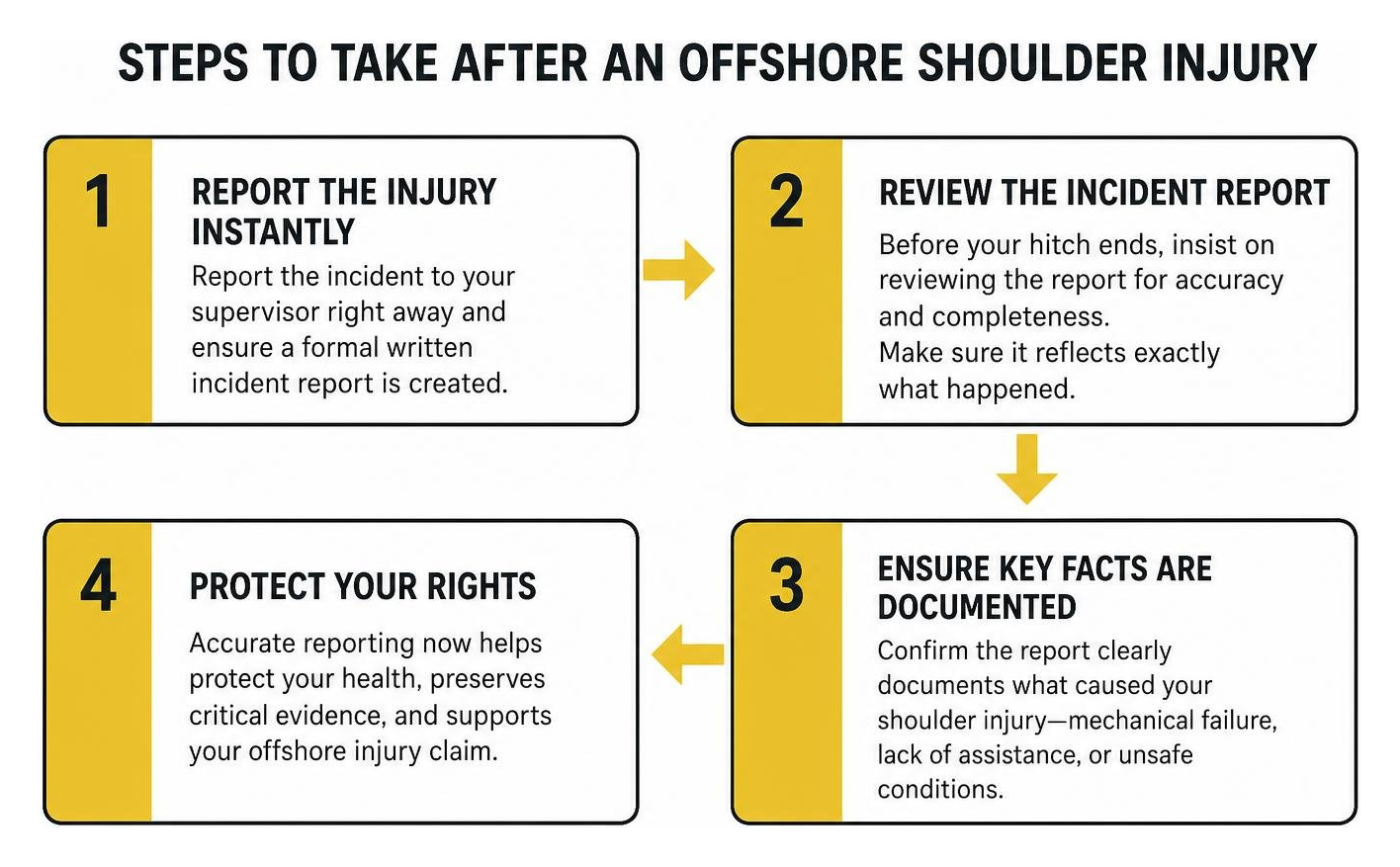
Critical Evidence Preservation and Incident Reporting Protocols
To protect your legal rights and prevent the loss or destruction of vital evidence, take these actionable steps immediately:
- Report the Injury Instantly to Your Supervisor: Verbally report the incident and ensure a formal written incident report is generated before your hitch ends. Insist on reviewing the report for accuracy, ensuring it clearly documents the mechanical failure, lack of assistance, or unsafe conditions that caused your shoulder injury.
- Document the Exact Scene and Equipment: If you can do so safely, use your phone to take photographs and video of the worksite, the specific tools involved (such as tongs, winches, cables, or elevators), and any visible hazards (such as oil-slicked deck plates or missing safety guards).
- Identify Witnesses: Collect the full names, company employers, job titles, and personal contact details (phone numbers and personal emails) of your fellow crew members who saw the incident or worked the same tour.
- Request USCG Form 2692 Filings: Serious marine casualties require the vessel owner or operator to submit a formal Form CG-2692 (Report of Marine Casualty) to the United States Coast Guard. Request a copy of this public record.
- Preserve Communications and Safety Logs: Save all emails, text messages, pre-tour safety meeting logs (JEM/JSA forms), lift plans, and safety alerts related to your incident.
- Seek Immediate Independent Medical Attention: When you reach shore, do not rely solely on the company clinic. Schedule an evaluation with an independent orthopedic shoulder surgeon to obtain objective diagnostic imaging (MRI) and establish a clear baseline of your injury.
Frequently Asked Questions About Offshore Shoulder Injuries
Can I still recover damages if I had a pre-existing shoulder condition?
Recovery may be possible. Under maritime law and the common-law eggshell skull doctrine, an employer or negligent third party may be responsible for aggravation, acceleration, or worsening of a pre-existing condition, depending on liability and the evidence. Even if an MRI reveals underlying age-related wear or asymptomatic degenerative disc disease, you may be able to recover compensation if the offshore incident activated symptoms, caused structural tendon tearing, and eliminated your ability to perform heavy rig work, depending on liability and the evidence.
How long do I have to file a shoulder injury lawsuit after an offshore accident?
Your deadline depends on the maritime jurisdiction governing your claim:
- Jones Act Claims: Negligence claims against a maritime employer carry a strict three-year statute of limitations (46 U.S.C. § 30106) from the date of injury.
- OCSLA Claims (Fixed Platforms off Louisiana): Claims governed by Louisiana surrogate law are subject to a two-year prescriptive period.
- LHWCA Claims: Administrative notice must typically be given to the employer within 30 days, and a formal claim (Form LS-203) must be filed with the Office of Workers’ Compensation Programs (OWCP) within one year.
Because these deadlines vary substantially, consulting an attorney as soon as possible can help you identify and meet applicable filing deadlines.
What happens if my employer stops paying maintenance and cure before my shoulder heals?
If an employer arbitrarily cuts off your maintenance living stipend or refuses to authorize necessary shoulder surgery before you reach Maximum Medical Improvement (MMI), they may be violating federal maritime law, depending on the circumstances. We can file an expedited motion with the court to ask the court to order payment of benefits and reinstatement of your medical care, and seek punitive damages and legal fees where the evidence and applicable law support those remedies.
Conclusion
When a severe shoulder tear, dislocation, or joint fracture ends your ability to handle heavy pipe and climb rig ladders, your career, income, and physical independence are all on the line. Navigating the intersection of the Jones Act, LHWCA, OCSLA, and state anti-indemnity statutes requires aggressive, resource-intensive legal representation.
At Nix Patterson, LLP, we bring vast financial resources, advanced trial technology, and decades of trial experience to complex maritime and oilfield litigation. We investigate the mechanical failures, hold negligent operators accountable, and build compelling, expert-backed cases designed to secure the full financial recovery our clients deserve.
If a serious shoulder injury has shut down your arm and your livelihood, reach out to our team of Carlsbad oil field accident lawyers today for a comprehensive, confidential case evaluation.