

Navigating Grief and Justice After a Fatal Carlsbad Oilfield Accident
First Steps After a Fatal Carlsbad Oilfield Accident
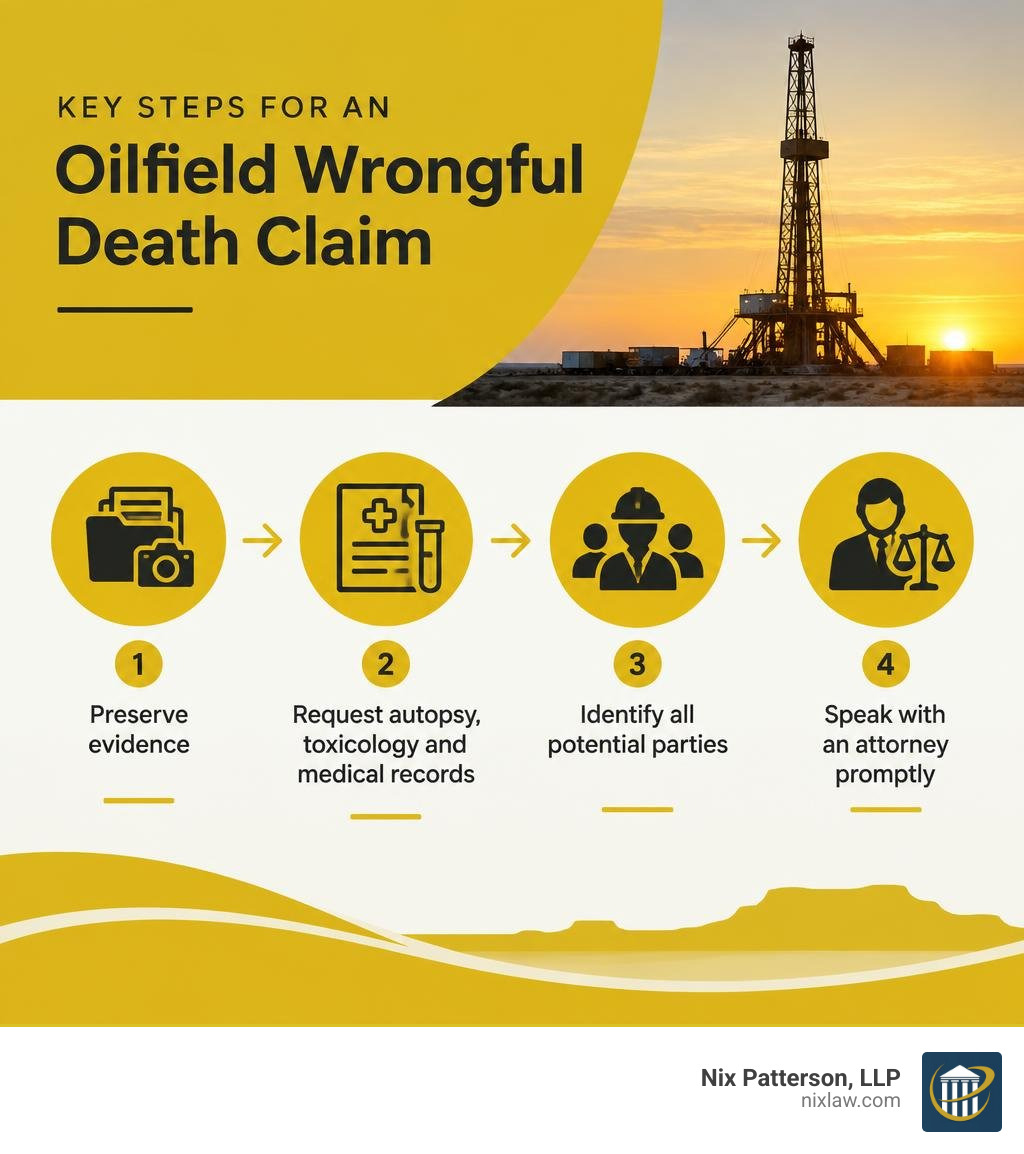
A Carlsbad oil field wrongful death lawsuit may help a family seek accountability when a fatal incident was caused by unsafe work practices, faulty equipment, a contractor’s actions, or a dangerous product. The most important early steps are:
- Preserve evidence, including incident reports, drilling logs, photos, witness names, and the decedent’s personal items.
- Request autopsy, toxicology, and medical records.
- Identify parties beyond the employer, such as operators, contractors, equipment makers, and product sellers.
- Speak with an attorney promptly to protect evidence and meet New Mexico filing deadlines.
Oilfield work in the Permian Basin can involve serious hazards, from falls and explosions to toxic exposures. In one Carlsbad-area case, a family alleged that a worker suffered fatal seizure-like symptoms after consuming a kratom beverage bought to stay alert for a night shift. The lawsuit points to an autopsy finding that attributed the death to toxic effects of mitragynine, a psychoactive kratom compound.
A workplace death can involve more than a workers’ compensation claim. A careful investigation may reveal a third-party claim against a company whose unsafe product, equipment, or conduct contributed to the loss.
Understanding the Legal Grounds for a Carlsbad Oil Field Wrongful Death Lawsuit
Operating across the sprawling expanse of the Permian Basin involves high pressures, heavy industrial machinery, flammable hydrocarbons, and round-the-clock physical labor. Because drilling operations are inherently dangerous, every company operating on a site, from the wellhead leaseholder down to individual trucking outfits, owes a defined duty of care to everyone working on the location.
When companies cut corners to accelerate drilling schedules or boost profit margins, catastrophic failures occur. Establishing legal grounds for a wrongful death claim requires demonstrating that a party had a duty of safety, breached that standard through negligence or willful conduct, and directly caused a fatal incident. Consulting experienced wrongful death lawyers helps grieving families analyze regulatory inspection records, identify gross negligence, and decipher complex liability structures among multi-tiered corporate entities.
Federal and state oversight agencies, including the Occupational Safety and Health Administration (OSHA) and the New Mexico Occupational Health and Safety Bureau, mandate strict safety standards for extraction sites. Citations for missing safety guards, neglected blowout prevention testing, or deficient gas detection systems often serve as critical evidence in civil courtrooms to establish statutory negligence.
Identifying Fatal Hazards and Negligence on Permian Basin Rigs
Permian Basin extraction sites present a dynamic web of severe hazards. Rig hands, supervisors, and roustabouts face high-risk scenarios every shift, including:
- Catastrophic Equipment Failures: Worn rotary hoses, defective top-drives, fracturing iron ruptures, and malfunctioning iron roughnecks.
- Well Blowouts and Explosions: Uncontrolled kicks from high-pressure geological formations that ignite volatile vapors at the surface.
- Toxic Gas Releases: Silent accumulations of hydrogen sulfide ($H_2S$) or methane displacing breathable air in confined cellar areas.
- Falls from Extreme Heights: Inadequate derrick harness anchor points, missing mid-rails on mud tanks, and uninspected catwalk grating.
- Struck-by Incidents: Swinging drill pipe stands, uncontrolled winch lines, and heavy dropped objects falling from the crown block.
When safety oversight collapses, working with attorneys who provide comprehensive representation in Carlsbad can help independent investigators determine whether third-party subcontractors or equipment rental outfits skipped essential non-destructive metal testing or neglected necessary blowout drill procedures.
Product Liability and Toxic Exposures: The Carlsbad Oil Field Wrongful Death Lawsuit Precedents

Workplace fatalities on southeastern New Mexico drilling operations are not exclusively mechanical. Product liability and chemical toxicity claims frequently intersect with the grueling demands of oilfield work. Extended twelve-to-fourteen-hour shifts, grueling weather, and irregular rotational schedules push crew members to seek products to maintain alertness, occasionally with devastating outcomes.
A notable legal proceeding arose following the death of Christopher Wayne Hays, a drilling rig supervisor working in the Carlsbad region. In an attempt to stay awake during a demanding shift, Hays purchased and consumed an over-the-counter herbal beverage known as “Super K Kratom” from a local retailer, Express Smoke & Vape. Shortly after ingesting the beverage, Hays suffered severe seizure-like episodes and died.
The legal action filed by his surviving family against the retailer and the manufacturer, MIT 45 Inc., centers on dangerous product formulation, toxic potency, and failure to warn. The drink allegedly contained 150mg of mitragynine, the primary psychoactive alkaloid in the plant Mitragyna speciosa. An official autopsy performed by the University of New Mexico School of Medicine concluded that Hays died directly from the “toxic effects of mitragynine.”
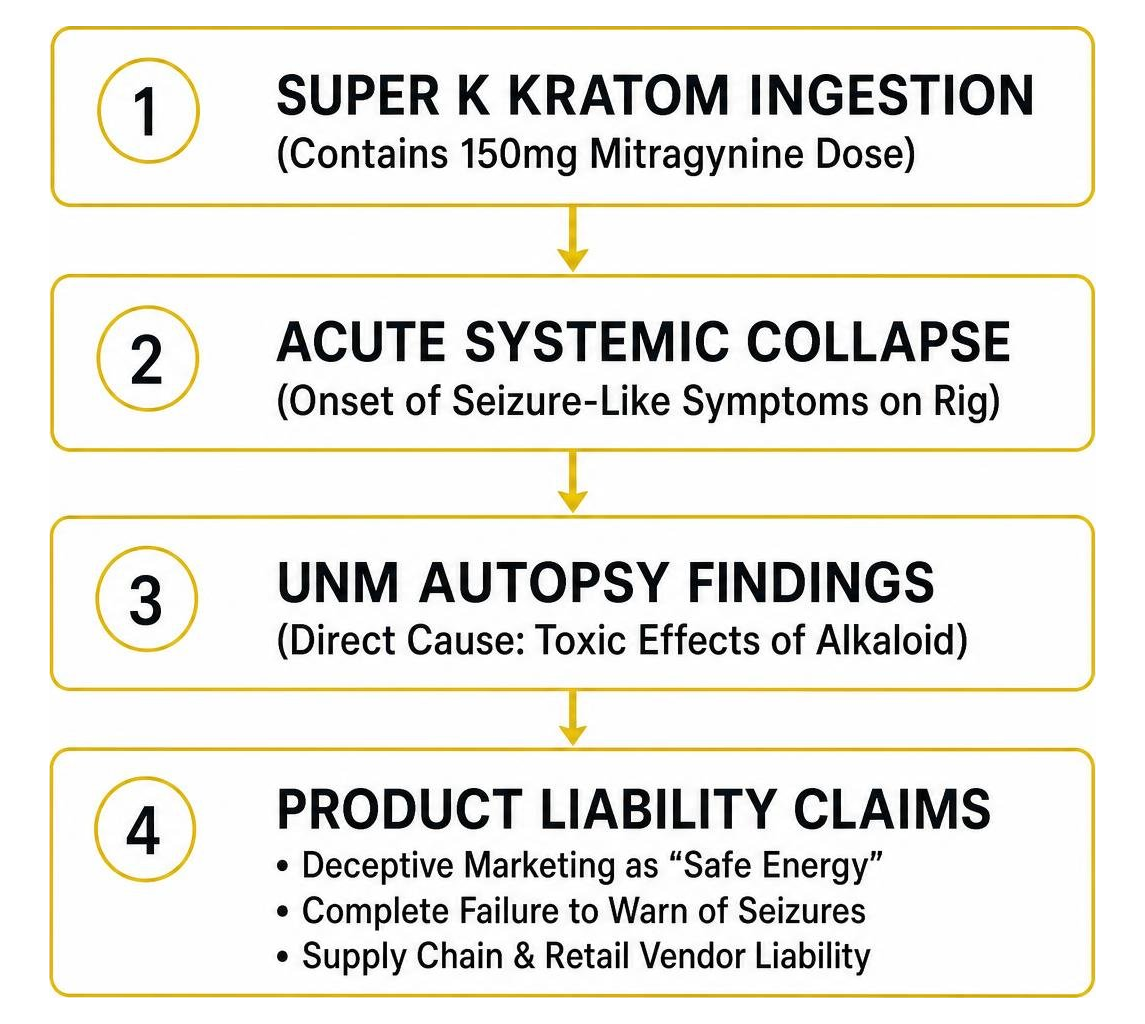
The complaint alleges that the product was deceptively marketed as a natural, safe energy supplement while concealing extreme physiological dangers. The U.S. Drug Enforcement Administration (DEA) has highlighted that kratom acts as a mild stimulant in minute amounts but functions as a potent, habit-forming sedative with distinct opiate-like and seizure risks at higher concentrations. A related case in Georgia saw state bureau investigators determine that a 23-year-old man died solely from mitragynine intoxication with no other illicit substances present.
Product liability cases of this nature parallel the legal themes present in historical reporting on oilfield fatality lawsuits, such as the civil actions emerging from industrial well accidents where chemical misrepresentations and safety omissions resulted in preventable loss of life.
Step-by-Step Guide to Pursuing an Oilfield Fatal Injury Claim
When an unexpected fatality strikes an oilfield family, the path through the legal system requires immediate, methodical action. Understanding the distinction between statutory no-fault workers’ compensation benefits and comprehensive civil litigation against third parties is critical.
| Aspect | Workers’ Compensation Death Benefits | Third-Party Wrongful Death Lawsuit |
|---|---|---|
| Target Defendant | Direct employer / Employer’s insurer | Third-party contractors, operators, manufacturers |
| Proof of Fault | No requirement to prove employer fault | Must establish negligence, recklessness, or product defect |
| Wage Loss Recovery | Capped percentage of average weekly wages | Full lifetime earning capacity and lost future benefits |
| Emotional Damages | Not recoverable | Recoverable (loss of companionship, mental anguish) |
| Punitive Damages | Unavailable under standard rules | Available for gross negligence or intentional misconduct |
To pursue accountability and seek damages after an oilfield accident, follow this three-step framework:
Step 1: Preserving Rig Site Evidence and Autopsy Reports
Evidence at an active drilling location can vanish within hours. Drilling mud is recycled, broken sheaves are welded or discarded, and well-control electronic logs can be overwritten.
- Issue Formal Spoliation Letters: Send formal legal notices to the well operator, drilling contractor, and all service vendors demanding the preservation of iron inspection certificates, raw electronic data recorder (EDR) telemetry, daily drilling logs, safety meeting rosters, and internal closed-circuit video.
- Secure Medical and Forensic Documentation: Obtain copies of the field incident report, emergency medical service run sheets, medical examiner photographs, and complete toxicology screens. In catastrophic fatality matters, retaining seasoned representation for catastrophic injury claims helps preserve the strict chain of custody needed to present autopsy findings in court.
- Interview Key Witnesses: Take sworn depositions and recorded statements from derrickmen, mud loggers, toolpushers, and third-party transport drivers before they rotate out to other international basins or locations.
Step 2: Determining Third-Party Liability Beyond Workers’ Compensation
Under the New Mexico Workers’ Compensation Act, direct employers are generally protected by the exclusive remedy rule from ordinary negligence claims. However, this statutory shield does not protect independent third parties who contributed to the deadly incident.
A thorough legal investigation into complex workplace injury claims isolates liability across separate entities operating simultaneously on the pad:
- Directional Drilling Contractors: Misinterpreting bottom-hole pressure telemetry or failing to flag dangerous formation zones.
- Casing and Cementing Crews: Inadequate primary cement jobs that allow gas channeling up the annulus.
- Equipment Rental & Servicing Companies: Renting out defective blowout preventer (BOP) stacks, worn drill pipe with internal wall degradation, or degraded high-pressure unions.
- Retailers and Manufacturers: Producing and selling contaminated, misbranded, or lethally concentrated supplements to crew members without clear warnings.
Step 3: Initiating a Carlsbad Oil Field Wrongful Death Lawsuit Within New Mexico Deadlines
Under New Mexico Statutes Annotated (NMSA) § 41-2-1, the New Mexico Wrongful Death Act governs civil actions arising from fatal misconduct. Navigating the New Mexico wrongful death statute of limitations is critical: families generally have three years from the date of the decedent’s death to file a lawsuit in civil court.

The action must be brought by a court-appointed Personal Representative for the benefit of surviving heirs. The financial recovery obtained does not pass through the standard estate probate debt process. Instead, it is distributed directly to the statutory beneficiaries (such as the surviving spouse, children, or dependent parents) under NMSA § 41-2-3.
Establishing Liability Among Operators, Contractors, and Product Vendors

Litigating fatal accidents in the energy sector involves deciphering intricate contractual webs. Oil and gas well sites rarely involve a single corporate entity. Instead, operators, leaseholders, drilling companies, well-servicing outfits, mud engineers, and catering companies share the same compact location.
When an incident occurs, these entities often deploy defense teams to point fingers at one another, citing complex indemnity provisions and master service agreements (MSAs). Unraveling these multi-party conflicts requires counsel seasoned in complex oil and gas dispute resolution to prevent defendants from shifting responsibility away from clear safety failures.
Operator Duty of Care vs. Independent Contractor Responsibility
A central question in oilfield litigation is whether a primary lease operator can be held responsible for injuries sustained by an independent contractor’s crew.
Federal and state courts examine operational control, site management, and the legal status of installed equipment. For example, in the maritime oilfield decision analysis of operator liability in Dupre v. Chevron USA Inc., the court examined whether an offshore platform operator owed a direct duty of care to a contractor’s employee who suffered a fatal fall. The court explored the appurtenance doctrine and contractual allocations of safety responsibilities, emphasizing that when an operator does not exercise direct control over an independent contractor’s rig and equipment, liability hinges entirely on the exact language of their operating agreements and actual operational control.
Procedural tactics and litigation costs also shape these disputes. In the federal oilfield wrongful death matter court cost analysis in Petri v. Kestrel Oil & Gas Props., the court addressed disputes surrounding taxable costs under Federal Rule of Civil Procedure 54(d) and 28 U.S.C. § 1920, ruling that minor beneficiaries cannot be directly assessed litigation costs, safeguarding the surviving family’s interests against aggressive corporate cost-shifting maneuvers.
Scientific Forensics and Expert Testimony in Rig Fatality Cases
Proving the exact mechanism of a rig death requires advanced forensic engineering, medical pathology, and scientific modeling. Defendants routinely argue that a worker suffered a spontaneous, unrelated health event or that an explosion was an unavoidable “act of God.”
Scientific reconstruction can help evaluate these corporate defenses. For example, in an environmental forensics analysis of oilfield fatal incidents, forensic investigators used stable isotope ratio testing ($D/H$ and $^{13}C/^{12}C$) to differentiate between explosive propellant byproducts and subsurface natural gas releases. The analysis demonstrated that a sudden methane bubble, rather than explosive fumes, caused the asphyxiation of three workers, dismantling the company’s defense.
Whether analyzing gas chromatography, calculating failure stress loads on cracked swivel joints, or establishing the human metabolic impact of mitragynine, working with skilled New Mexico oil field injury lawyers can help families work with scientific experts to present evidence clearly to a jury.
Frequently Asked Questions About Oilfield Fatal Accident Claims
Who is legally permitted to file an oilfield wrongful death action in New Mexico?
Under the New Mexico Wrongful Death Act, the lawsuit must be formally filed by the court-appointed Personal Representative of the deceased worker’s estate. While the Personal Representative is the named plaintiff, the financial recovery is held in trust exclusively for the surviving statutory beneficiaries:
- If there is a surviving spouse and no children, all damages go to the spouse.
- If there is a surviving spouse and children or grandchildren, half goes to the spouse and half is divided equally among the children.
- If there are no children or spouse, proceeds go to surviving parents or siblings.
How do third-party product liability claims differ from standard workers’ comp?
Workers’ compensation is a state-mandated insurance structure providing fixed, no-fault statutory benefits, covering limited medical bills and a capped portion of weekly wage losses. It does not permit recovery for pain, emotional devastation, or punitive damages.
A third-party product liability or negligence lawsuit targets non-employer entities, such as equipment manufacturers, third-party contractors, or commercial supplement vendors (such as the manufacturers of potent kratom extracts). These civil lawsuits allow surviving family members to pursue uncapped damages, including full lifetime earnings, pain and suffering, loss of consortium, and punitive damages.
What damages can surviving family members recover after an oilfield tragedy?
Surviving families may pursue both economic and non-economic damages, including:
- Lost Financial Support: The full value of the wages, benefits, retirement contributions, and career advancement the worker would have earned over their working life.
- Loss of Companionship & Guidance: Compensation for the loss of emotional care, spousal intimacy, guidance, and parental instruction.
- Conscious Pain and Suffering: Damages for the physical agony and mental anguish the worker experienced between the moment of injury and their passing.
- Medical and Funeral Expenses: All emergency transportation, surgical intervention, hospital care, and funeral or burial expenses.
- Punitive Damages: Substantial civil penalties awarded by a jury to punish egregious safety disregard, reckless corporate practices, or deceptive product marketing.
Conclusion
Losing a loved one in a Permian Basin drilling or extraction tragedy alters a family’s future forever. During these periods of overwhelming grief, large oil corporations, equipment manufacturers, and commercial vendors work quickly to limit their exposure and insulate their balance sheets.
At Nix Patterson, LLP, we stand beside grieving families to uncover the truth and pursue accountability. As a national contingency-fee law firm, we bring aggressive legal advocacy, extensive trial experience, and deep institutional resources, including private air travel and advanced courtroom presentation technology, to challenge major corporations. We shoulder the financial risks of complex litigation. Under our contingency-fee arrangement, you pay no attorney fees unless a successful recovery is achieved.
If you have lost a loved one due to an industrial incident, safety failure, or dangerous product in southeastern New Mexico, contact a dedicated Carlsbad oil field accident lawyer today for a confidential, comprehensive case evaluation.