

Navigating the High Stakes of Carlsbad Oilfield Explosion and Burn Lawsuits
6 Major Causes and Chemical Hazards in Carlsbad Oilfield Burn Incidents
An oil field chemical burn attorney helps injured Permian Basin workers pursue financial recovery by identifying negligent third parties, including contractors, site operators, and equipment manufacturers, and filing personal injury lawsuits beyond limited workers’ compensation benefits. While workers’ compensation generally covers medical bills and part of lost wages, an attorney can investigate safety violations, preserve important wellsite evidence, and seek compensation for pain, suffering, disfigurement, and lost earning capacity.
Working in the Permian Basin means dealing with extreme pressures, volatile hydrocarbons, and thousands of gallons of dangerous industrial compounds. When safety standards slip or equipment fails, the results are catastrophic. Oilfield chemical burns rarely occur in isolation; they often accompany sudden blowouts, flash fires, or catastrophic line ruptures that spray workers with toxic mixtures.
Understanding the primary hazards helps determine how an incident occurred and who failed to prevent it. We frequently see several root causes leading to severe chemical trauma:
- High-Pressure Line and Hose Failures: Fluid transfer lines carrying acidic or alkaline solutions can burst under intense hydraulic pressure, drenching workers without warning.
- Defective or Improper Personal Protective Equipment (PPE): Providing the wrong gloves, damaged respirators, or inadequate eye protection directly violates basic safety rules, turning a minor splash into a disabling event.
- Improper Well Acidizing Operations: Mistakes in mixing, pumping, or containing potent stimulation fluids cause rapid blowouts and violent chemical releases.
- Tank Battery Failures and Overflows: Vapors collect in confined tanks, leading to toxic leaks or explosions that shower nearby field hands with corrosive fluids.
- Drilling Mud Chemical Additives: Unsafe mixing and handling of caustic additives like sodium hydroxide create severe skin and respiratory hazards.
- Failure to Decontaminate and Inadequate Wash Stations: OSHA regulations mandate accessible emergency eyewash and shower stations on sites handling hazardous materials. Far too often, remote Permian Basin well pads have dry, frozen, or broken safety showers, letting corrosive chemicals destroy tissue for crucial minutes longer than necessary.
When companies ignore standard safety protocols, workers suffer serious toxic chemical exposure workplace injuries alongside deep workplace burn injuries that require intensive hospital care and long recoveries.
Corrosive Acids and Fracking Fluids
Hydraulic fracturing and well stimulation depend heavily on massive quantities of concentrated acids. Hydrochloric acid (HCl) and hydrofluoric acid (HF) are routinely pumped at high pressure to dissolve rock formations, clean perforations, and clear drilling debris.
When a manifold fails, a high-pressure iron separates, or a valve seal blows out, workers are caught directly in the spray. Unlike household acids, industrial-grade oilfield acids cause instantaneous dermal necrosis—literally destroying skin, subcutaneous fat, and muscle tissue upon contact. Hydrofluoric acid is especially terrifying: it penetrates deep through flesh into bone, binding with calcium in the bloodstream and potentially causing cardiac arrest long after initial skin contact.
Caustic soda (sodium hydroxide) and biocides used in drilling muds and frac fluids present equally severe risks. Caustic solutions cause liquefaction necrosis, turning skin into a gelatinous substance while continuing to burn downward until chemically neutralized.
Toxic Gases, Blowouts, and Battery-Tank Explosions
The oilfield combines severe chemical toxicity with explosive volatility. Hydrogen sulfide ($H_2S$), commonly known as sour gas, is a deadly neurotoxin that can deaden a worker’s sense of smell before causing unconsciousness, severe pulmonary chemical burns, and respiratory failure within moments.
Furthermore, vapors emitted from hydrocarbon storage tanks, flowback ponds, and separator units can ignite unexpectedly. When a battery tank explodes or a well blowout occurs, the resulting blast throws burning hydrocarbons, toxic drilling additives, and superheated corrosive sludge onto everyone nearby. These catastrophic events cause complex poly-trauma, combining concussive blast injuries, blunt force impacts, and combined thermal-chemical burn profiles.
Chemical Burns vs. Thermal Burns: Medical Complexities and Legal Claims
While thermal burns from open flames or hot pipes transfer heat and then stop once the heat source is removed, chemical burns operate on a destructive continuum. A corrosive agent remains active on and inside the body, reacting with tissue proteins until it is thoroughly flushed, neutralized, or completely consumed.
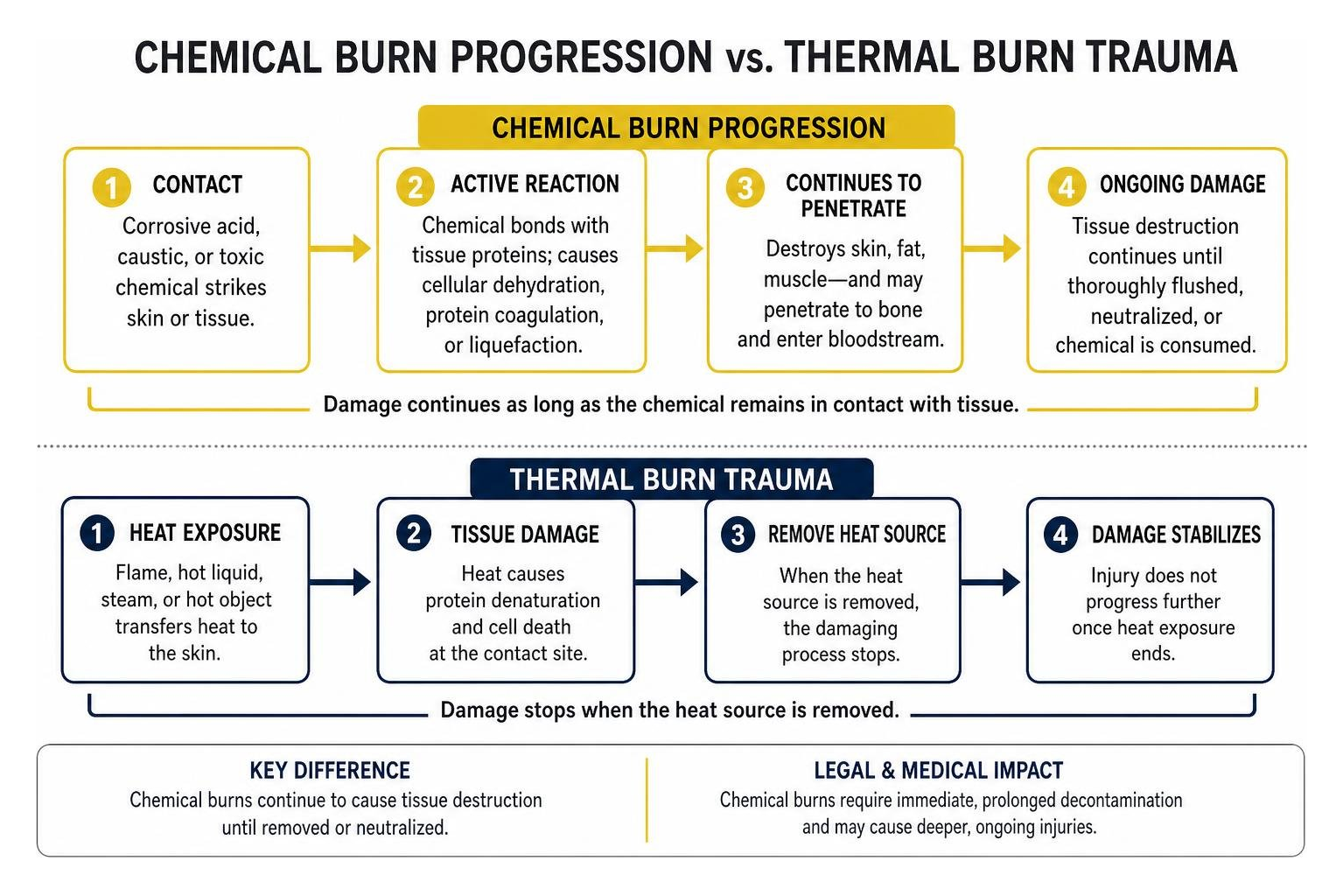
This distinct mechanism changes both the medical treatment protocol and the legal approach needed to secure fair compensation:
| Feature / Consideration | Thermal Burns | Chemical Burns |
|---|---|---|
| Damage Mechanism | Direct heat transfer (flame, hot steam, molten metal). | Chemical reaction, cellular dehydration, protein coagulation, or tissue liquefaction. |
| Duration of Active Damage | Stops once the heat source is removed and skin cools. | Continues until completely decontaminated or neutralized; can progress for hours or days. |
| Systemic Health Impact | Fluid loss, systemic inflammatory response, infection risk. | Organ toxicity, systemic chemical poisoning, cardiac arrhythmias, liver/kidney failure. |
| Respiratory Involvement | Inhalation of hot smoke and soot, causing thermal airway injury. | Inhalation of acid vapors/toxic fumes, causing chemical pneumonitis and pulmonary edema. |
| Evidence Collection | Focuses on heat sources, fire origin, fuel sources, and ignition triggers. | Requires chemical batch testing, Safety Data Sheets (SDS), chemical logs, and wash-station maintenance audits. |
When handling cases involving toxic releases, our team analyzes both the acute skin trauma and the broader legal frameworks that apply to toxic torts and environmental disasters.
Unique Medical and Settlement Considerations in Chemical Burn Cases
Treating an oilfield chemical burn is rarely as simple as bandaging the skin. Victims may need immediate transport to regional burn centers, such as University Medical Center in Lubbock or dedicated centers in Albuquerque, for surgical excision, extensive skin grafting, and reconstructive procedures.
When toxic chemicals enter the bloodstream through the skin or lungs, patients may suffer acute kidney failure, hepatic damage, chronic obstructive pulmonary disease (COPD), or permanent vision loss. Industry data reveals that roughly one in five oilfield eye injuries results in permanent blindness, often due to high-pressure chemical splashes.
Because the path to maximum medical improvement is long and unpredictable, settling a case prematurely can be devastating. A proper claim calculation must account for:
- Multiple stages of future reconstructive surgeries
- Ongoing psychological care for PTSD, anxiety, and depression resulting from visible disfigurement
- Long-term physical and occupational therapy
- In-home medical assistance and advanced wound care supplies
- Complete loss of future earning capacity if the worker cannot return to demanding field labor
Identifying Liable Parties: Why Workers’ Comp Isn’t Your Only Option
A common myth in the oil patch is that if you get hurt on the job, workers’ compensation is your only source of financial help. While workers’ comp provides baseline benefits for medical bills and a portion of lost wages, it does not compensate you for physical pain, mental anguish, physical impairment, or permanent disfigurement.
Oilfield operations involve complex webs of operating companies, drilling contractors, leaseholders, equipment rental firms, chemical haulers, and maintenance crews. When someone other than your direct employer contributes to your injury, you have the legal right to file a third-party personal injury lawsuit.
Depending on the setup of your worksite, several distinct parties may share liability for a chemical burn:
- Site Operators and Leaseholders: Failing to maintain safe operating conditions, enforce site-wide safety standards, or provide functional emergency decontamination equipment.
- Third-Party Service Contractors: Inexperienced crews from other companies who improperly open pressurized lines, fail to bleed off valves, or ignore lockout/tagout procedures.
- Chemical Manufacturers and Transport Companies: Providing mislabeled chemical containers, failing to supply accurate Safety Data Sheets (SDS), or hauling volatile compounds in defective tankers.
- Equipment and Valve Manufacturers: Designing or selling defective pressure relief valves, burst discs, hoses, or protective equipment that fails under rated field pressures.
- Non-Subscriber Employers in Texas: Texas allows private employers to opt out of the state workers’ compensation system. If your employer is a “non-subscriber,” our Texas oil field injury lawyers can sue them directly for negligence, removing common defenses like comparative fault.
Whether your incident occurred in Lea County or Eddy County under our New Mexico oil field injury lawyers, or across the state line in the Texas Permian Basin, holding every negligent party accountable is essential. You can learn more about general industrial claims through an experienced team of workplace injury lawyers.
How an Oil Field Chemical Burn Attorney Proves Third-Party Negligence
Proving liability across multiple corporations on a shared well pad requires an aggressive, evidence-driven approach. When we step in, our legal team investigates every operational layer, including:
- OSHA and State Regulatory Violations: Documenting failures in Hazard Communication standards (29 CFR 1910.1200), process safety management, or eye/face protection rules.
- Job Safety Analysis (JSA) and Tailgate Safety Meetings: Reviewing daily safety logs to prove that contractors failed to identify chemical burn risks or skipped required pre-job safety briefings.
- Lockout/Tagout (LOTO) Breaches: Showing that upstream valves were left open or unverified while maintenance crews worked downstream on chemical lines.
- Subcontractor Communication Breakdowns: Exposing how the operating company failed to notify working crews that hot, acidic, or volatile fluids were being routed through nearby piping.
Federal safety guidelines established by the Occupational Safety and Health Administration govern multi-employer worksites, making regulatory documentation essential when establishing third-party liability in complex chemical burn litigation.
When to Consult an Oil Field Chemical Burn Attorney After a Permian Basin Incident
Time is not on your side after an industrial chemical burn. Oil companies and their commercial insurers deploy rapid-response teams within hours of an incident to control the narrative, interview witnesses, and inspect the scene.

Physical evidence at an active drilling or production pad disappears quickly. Drilling mud is recycled, broken iron is scrapped or replaced, chemical wash-down lines are cleared, and electronic well logs can be overwritten. Contacting dedicated oil field injury lawyers immediately allows for rapid legal intervention, including:
- Filing Formal Spoliation Letters: Issuing formal legal notices requiring every company on the pad to preserve digital sensor logs, SCADA data, dashcam footage, and maintenance logs.
- Securing Temporary Restraining Orders (TROs): Obtaining court orders to freeze the accident scene, preventing operators from altering equipment before an independent forensic team can inspect it.
- Collecting and Testing Chemical Samples: Gathering physical samples of the fluids involved to confirm exact chemical compositions and concentration levels.
- Interviewing Witnesses Before They Scatter: Tracking down contract workers, rig hands, and truckers before they move on to other drilling jobs across the country.
You must also remain aware of state filing deadlines. The statute of limitations for personal injury lawsuits in both New Mexico and Texas is generally two years from the date of the injury. However, waiting even a few months can severely weaken your case as memories fade and critical physical evidence vanishes.
Why You Need a Skilled Oil Field Chemical Burn Attorney on Your Side
Taking on major exploration and production corporations requires substantial legal resources and technical knowledge. At Nix Patterson, LLP, we don’t back down from complex industrial disputes. We deploy private air travel to get our trial lawyers and investigators to remote Permian Basin well pads immediately, preserving crucial evidence before company safety managers can alter the scene.
We partner with chemical engineers, industrial hygienists, well-control authorities, and burn injury experts to reconstruct how an incident happened and demonstrate its full impact to a jury. Understanding why hire an oil field injury lawyer with deep trial experience is often the difference between settling for a low insurance payout and securing a recovery that fully funds a family’s future. For workers injured in surrounding oil-producing regions, our Oklahoma oil field injury lawyers provide that same aggressive, trial-ready representation.
Frequently Asked Questions About Carlsbad Oilfield Chemical Burn Lawsuits
Can I file a personal injury lawsuit if I already accepted workers’ compensation?
Yes. Receiving workers’ compensation benefits does not prevent you from pursuing a third-party personal injury lawsuit against negligent companies other than your direct employer. If a general contractor, chemical supplier, trucker, or equipment manufacturer contributed to your chemical burn, you may pursue a personal injury claim to seek damages for pain, suffering, mental anguish, and lost earnings that workers’ compensation does not cover.
What damages can be recovered in an oilfield chemical burn lawsuit?
In a successful third-party personal injury claim, you can recover both economic and non-economic damages, including:
- All past and future hospital bills, surgeries, skin grafts, and prescription costs
- Lost wages and compensation for your lost future earning capacity
- Physical pain and suffering
- Mental anguish, trauma, and depression
- Permanent physical impairment and visible disfigurement
- Loss of enjoyment of life and family consortium
- Punitive (exemplary) damages in cases involving gross negligence or reckless disregard for safety
Families dealing with severe burn injuries can also review options with our Oklahoma burn injury lawyers when catastrophic incidents cross state borders.
What immediate steps should an injured oilfield worker take after a chemical burn?
Taking the right steps after a chemical exposure protects both your physical recovery and your legal rights:
- Decontaminate Immediately: Remove all clothing soaked in chemicals and flush the affected skin at an emergency eyewash or shower station with clean water for at least 15 to 20 minutes.
- Get Emergency Medical Care: Go straight to an emergency room or burn trauma center. Tell the medical staff the specific name of the chemical you were exposed to, or ask someone to bring the Safety Data Sheet (SDS).
- Report the Incident: Notify your supervisor in writing as soon as practical, ensuring an official incident report is created.
- Preserve Physical Evidence: Do not let anyone wash or throw away your chemical-soaked work boots, FR clothing, gloves, or protective gear. Place them in a sealed container or heavy plastic bag.
- Document the Scene: If you or a co-worker can safely do so, take photos and videos of the burst line, defective valve, spilled chemicals, and lack of functional wash stations.
- Do Not Give Recorded Statements: Insurance adjusters will contact you quickly to minimize their financial liability. Decline to give recorded statements or sign settlement releases until you have spoken with an independent lawyer.
Conclusion
A severe chemical burn on an oilfield is an overwhelming, life-altering trauma. The physical pain, repeated surgeries, and financial strain can feel insurmountable for injured workers and their families. But you do not have to navigate the complex corporate and legal maze on your own.
At Nix Patterson, LLP, we bring substantial financial resources, national trial experience, and aggressive advocacy to every case we handle. We investigate wellsite disasters thoroughly, uncover safety shortcuts, and hold negligent operators, contractors, and manufacturers accountable for the harm they cause.
If you or a loved one suffered severe chemical burns or blast injuries in the Permian Basin, contact a dedicated Carlsbad oil field accident lawyer for a free, confidential case evaluation. We work on a contingency fee basis, so you pay nothing out of pocket unless we secure a recovery for you.