

Why Severe Oilfield Joint and Back Injuries Require Dedicated Legal Help
5 Common Causes of Severe Oil Patch Back and Joint Trauma
Severe oilfield back and joint injuries require dedicated legal representation because wellsite accidents involve complex multi-employer liability, strict workers’ compensation limitations, and substantial long-term damages. An experienced oil field back injury attorney helps injured workers untangle overlapping contractor responsibilities, identify negligent third parties, and secure full financial recovery beyond standard workers’ comp caps.
Working in the oil patch demands grueling physical labor in high-risk environments. Heavy machinery, elevated platforms, and massive drill components make the job inherently dangerous. When safety standards slip or equipment fails, workers often suffer severe damage to their musculoskeletal systems. Looking at the frequent workplace injury causes across energy sites reveals clear patterns behind these life-altering events.
- Slip, Trip, and Fall Incidents: Well decks, mud tanks, and catwalks are constantly slick with drilling fluids, crude oil, grease, and water. A sudden fall from an elevated rig floor, monkey board, or access ladder creates extreme axial loading on the spine, leading to shattered vertebrae, fractured tailbones, and torn joint ligaments.
- Struck-By and Pipe Handling Accidents: Handling drill collars, casing, hydraulic tongs, and high-torque pipe spinners requires immense precision. If a hoist line snaps or a spinner malfunctions, the sheer kinetic energy can strike a worker, throwing them across the deck or crushing their torso against the substructure. These incidents demand thorough catastrophic injury representation because of the permanent disability they cause.
- Heavy Lifting and Awkward Postures: Rig hands routinely lift heavy drill bits, valve assemblies, and mud sacks while twisting in confined spaces. This repetitive micro-trauma and sudden overload frequently tear lumbar soft tissues and rupture intervertebral discs.
- Transportation and Vehicle Rollovers: Rough lease roads, long work shifts, and extreme weather contribute to severe transit collisions. In fact, roughly four out of every ten workers killed in the oil and gas industry die as a result of vehicle crashes. Non-fatal rollovers often leave drivers and passengers with severe cervical and lumbar whiplash, structural fractures, and joint dislocation.
- Blowouts, Fires, and Sudden Explosions: High-pressure well kicks, battery tank failures, and volatile vapor ignitions release violent blast waves. These shockwaves can throw crew members dozens of feet, causing massive blunt-force trauma to the spine and joints.
Fractures, Herniations, and Spinal Cord Impairment
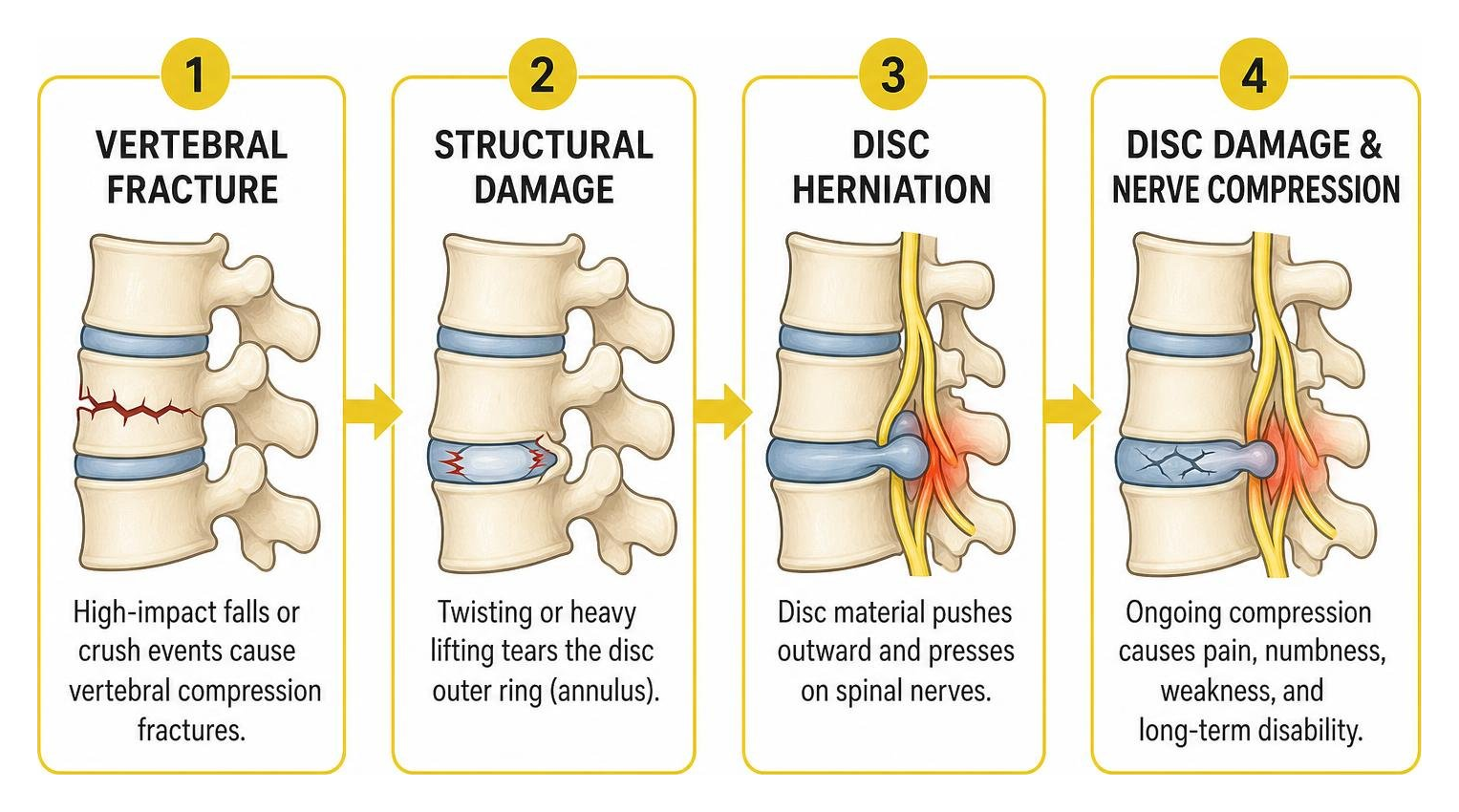
The human spine is a complex column of bones, cushioned discs, and sensitive nerve pathways designed to support movement. When exposed to oilfield impacts, the physical damage is often severe. Understanding the different workplace injury types helps clarify the medical and financial needs ahead:
- Vertebral Compression Fractures: High-impact falls and crush events collapse the vertebral bodies. These fractures often require surgical stabilization with titanium rods, plates, or bone grafts.
- Herniated and Ruptured Discs: The gel-like center of a spinal disc can push through its outer ring during sudden twisting or heavy lifting. When that extruded disc material presses against the spinal cord or sciatic nerve, it causes burning pain, numbness, and severe weakness in the legs.
- Spinal Cord Trauma and Paralysis: Complete or incomplete tears to the spinal cord can cause permanent loss of sensation and motor function below the injury level, leading to paraplegia or quadriplegia.
- Facet Joint Syndrome and Ligament Tears: Intense impacts damage the cartilage within the spine’s stabilizing joints, causing chronic stiffness and arthritis.
How Oilfield Back Claims Differ from Standard Workplace Injury Claims
Resolving an oilfield back injury is far more complex than handling a typical office or warehouse claim. Standard industrial injuries usually involve a single employer and routine workers’ compensation filings. In the energy sector, however, operations involve a multi-layered web of operators, drilling contractors, trucking outfits, and service vendors working side-by-side. Our dedicated workplace injury lawyers regularly untangle these multi-party operations to hold every responsible party accountable.
| Claim Aspect | Standard Texas Workers’ Comp Claim | Oilfield Third-Party Injury Claim |
|---|---|---|
| Fault Requirement | No-fault system; fault does not need to be proven | Must prove negligence by a third party or contractor |
| Covered Medical Care | Limited to approved network doctors and state fee guidelines | Full compensation for private care, future surgeries, and rehabilitation |
| Lost Wage Benefits | Capped at statutory weekly limits (often a fraction of regular pay) | 100% of past lost wages and full future lost earning capacity |
| Pain & Suffering Damages | None; excluded under workers’ comp statutes | Fully recoverable, including physical pain and mental anguish |
| Disfigurement & Impairment | Highly restricted statutory impairment schedules | Full compensation for loss of quality of life and permanent disability |
| Punitive Damages | Barred (except in rare fatal gross negligence cases) | Available if a defendant engaged in gross negligence or willful conduct |
Texas features a unique legal framework. It is the only state where private employers can choose to opt out of the state-regulated workers’ compensation system. If an employer is a non-subscriber, injured workers are not barred from filing a direct lawsuit for negligence, allowing them to pursue full personal injury damages. Even when an employer does carry coverage, injured hands can still pursue third-party claims against other negligent contractors working on the pad.
Identifying Multiple Liable Parties on Complex Well Sites
Well pads function as shared worksites. When safety protocols fail, multiple corporate entities often share legal liability:
- The Lease Operator / Oil Company: Maintains overall operational control and dictates safety culture across the pad.
- Drilling Contractors: Provide the rig and oversee daily drilling activities, mud systems, and hoisting gear.
- Third-Party Service Companies: Perform directional drilling, casing running, wireline logging, cementing, and hydraulic fracturing.
- Equipment Manufacturers: Liable for manufacturing flaws or design defects that cause mechanical failures on the rig floor.
- Logistics and Sand Hauling Fleets: Responsible for safely transporting water, proppant, and heavy machinery without violating driving hour limits.
Holding these entities accountable requires checking whether they complied with safety mandates, including established Occupational Safety and Health Administration (OSHA) standards, thorough Job Safety Analyses (JSAs), and strict well-control protocols.
Crucial Steps to Protect Your Health and Legal Rights After a Rig Accident

The actions taken immediately following a wellsite incident directly shape both medical recovery and financial compensation. Taking these steps helps build a strong foundation for your claim:
- Obtain Immediate, Independent Medical Care: Have your back evaluated by an independent orthopedic surgeon or neurosurgeon. Do not rely solely on company-appointed clinic doctors whose priority may be minimizing claim costs.
- Report the Incident in Writing: Formally notify your direct supervisor and company safety representative. Ensure a written incident report is created, describe your back symptoms clearly, and keep a copy for your records.
- Document the Physical Scene: If physically able, take detailed photographs and videos of the drilling deck, tool failures, slippery conditions, missing handrails, or defective hoists before site managers clear the scene.
- Identify Eyewitnesses: Collect names, personal cell phone numbers, and contractor affiliations for all roughnecks, toolpushers, company men, and third-party hands who saw the incident.
- Preserve Your Work Gear: Do not wash, alter, or discard your damaged coveralls, steel-toe boots, or personal protective equipment. These items serve as vital physical evidence of impact forces.
- Avoid Recorded Statements: Do not provide recorded audio statements or sign medical authorizations for insurance adjusters without legal representation.
- Monitor the Legal Clock: Texas enforces a strict two-year statute of limitations for personal injury lawsuits. Working with attorneys handling regional oil patch litigation ensures your filings are submitted on time.
How an Oil Field Back Injury Attorney Investigates Negligence
Proving liability in complex drilling accidents requires a thorough, forensic investigation. A qualified legal team will immediately send formal spoliation letters to preserve crucial digital and physical evidence before it can be altered or erased:
- Electronic Mud and Drilling Logs (IADC Reports): Reveal real-time well pressure changes, hook loads, and equipment speeds at the moment of injury.
- Rig Maintenance and Inspection Logs: Uncover neglected equipment, worn hoist cables, and deferred mechanical repairs.
- Job Safety Analyses (JSAs) and Hot-Work Permits: Show whether site leaders skipped safety briefings before sending crews into hazardous areas.
- Vehicle Event Data Recorders (Black Boxes): Track vehicle speeds, braking actions, and driver hours before lease road collisions.
- Accident Reconstruction Experts: Biomechanical and drilling experts evaluate the scene to demonstrate exactly how the equipment failed and caused spinal trauma.
Navigating Texas Fault Rules and Compensation for Spine Trauma
Texas personal injury litigation is governed by Chapter 33 of the Texas Civil Practice and Remedies Code, known as the modified comparative fault rule (or the 51 percent bar rule). Under this framework:
- You can recover compensation as long as your share of responsibility is 50 percent or less.
- If you are found partially at fault, your financial recovery is reduced proportionally. For example, if a jury awards $2,000,000 in damages but determines you were 10 percent at fault for not using an available tag line, your final recovery is reduced by 10 percent to $1,800,000.
- If your fault is found to be 51 percent or greater, you are legally barred from recovering any damages from the other parties.
Insurance defense teams often try to shift blame onto injured workers to cross that 51 percent threshold. They may claim that a worker improperly lifted heavy components, failed to watch their step on greasy surfaces, or ignored safety rules.
A successful claim can secure recovery across multiple damage categories:
- Economic Damages: Coverage for emergency room visits, spinal fusion surgeries, diagnostic imaging, physical therapy, prescription medications, past lost wages, and long-term loss of earning capacity.
- Non-Economic Damages: Compensation for chronic physical pain, emotional distress, physical impairment, and lost quality of life.
- Punitive Damages: Extra damages awarded in cases where an operator or contractor demonstrated gross negligence or willful disregard for human safety.
Questions to Ask an Oil Field Back Injury Attorney Before Settling
Before signing a settlement agreement, ask targeted questions to make sure your long-term interests are protected:
- Does this settlement account for future spinal revision surgeries or long-term medication needs?
- Have you worked with a certified life care planner and vocational economist to calculate my lifetime lost earning capacity?
- Are there other responsible third parties, contractors, or equipment makers we should pursue before settling this claim?
- Will this settlement resolve all outstanding medical liens and subrogation claims from health insurers or workers’ compensation carriers?
Relying on guidance from seasoned San Antonio oil patch attorneys helps ensure that every potential source of recovery is explored.
4 Critical Reasons to Retain an Oil Field Back Injury Attorney

Taking on major oil companies and multi-billion-dollar insurance carriers requires significant resources and experience. Retaining experienced legal counsel provides vital support throughout the process:
- Leveling the Field Against Corporate Defense Teams: Energy corporations maintain teams of adjusters, safety directors, and defense lawyers whose job is to minimize claim payouts. Experienced advocates counter these efforts with dedicated investigation and trial preparation.
- Access to Deep Financial Resources: Preparing a major spinal trauma lawsuit requires fronting substantial capital for independent accident reconstructionists, medical experts, life care planners, and economic analysts. We operate on a contingency fee model, advancing all litigation costs so injured workers never pay out of pocket unless compensation is recovered.
- Comprehensive Multi-Party Discovery: Well sites involve overlapping corporate contracts, master service agreements (MSAs), and indemnity clauses. An experienced legal team knows how to navigate these commercial contracts to identify every available insurance policy.
- Trial-Ready Advocacy: When insurance companies refuse to offer fair settlements for catastrophic spine injuries, your legal team must have the track record and trial technology needed to present your case in court. Choosing the right advocates begins with hiring experienced oilfield advocates who are fully prepared to take a case through verdict.
Frequently Asked Questions About Oilfield Back Injuries
Can I sue my employer for a back injury if they carry Texas workers’ compensation?
If your employer subscribes to the Texas workers’ compensation system, that policy serves as the exclusive legal remedy against them for standard workplace negligence. You cannot sue your subscribing employer directly for ordinary mistakes. However, you retain the legal right to file personal injury lawsuits against negligent third parties on the wellsite, such as the lease operator, directional drilling contractors, casing crews, or equipment manufacturers. If your employer opted out of workers’ comp as a non-subscriber, you can sue them directly for negligence.
How does Texas’s modified comparative negligence rule affect my back injury settlement?
Texas applies a 51 percent bar rule to personal injury claims. You are eligible to recover compensation as long as your assigned responsibility for the accident is 50 percent or less. Your final payout is reduced by your exact percentage of fault. If an insurer attempts to claim you are 51 percent or more responsible for the rig accident, having strong legal representation helps protect you against improper blame. Learn more about your options by consulting with experienced oil field injury lawyers.
What should I do if the oil company offers a quick settlement for my spine injury?
Do not sign settlement releases, accept checks, or give recorded statements without an independent legal review. Early settlement offers from energy companies and their insurers are often made before you understand the full scope of your spinal damage. Once you sign a liability release, you give up the right to pursue further compensation if you later require spinal fusion surgery or cannot return to work.
Conclusion
A severe back or joint injury can instantly derail an oilfield career, leaving you with heavy medical bills, intense physical pain, and career uncertainty. Navigating complex site safety rules, multi-employer liability, and Texas comparative fault laws requires committed legal advocacy.
At Nix Patterson, LLP, we are a national contingency-fee law firm that litigates cases for injured workers against major corporations. We differentiate ourselves with aggressive, creative representation, deep resources (including private-jet travel and advanced trial technology), and a proven track record of multi-billion-dollar recoveries.
If you or a loved one suffered a severe back injury on a drilling rig, well pad, or lease road, you do not have to face corporate insurance teams on your own. Connect with our dedicated Carlsbad oil field accident lawyer today for a free case assessment, and let us protect your rights.