

Finding the Right Legal Partner for Catastrophic Lea County Drilling Injuries
Choosing a Hobbs Oil Field Injury Lawyer After a Serious Drilling Accident
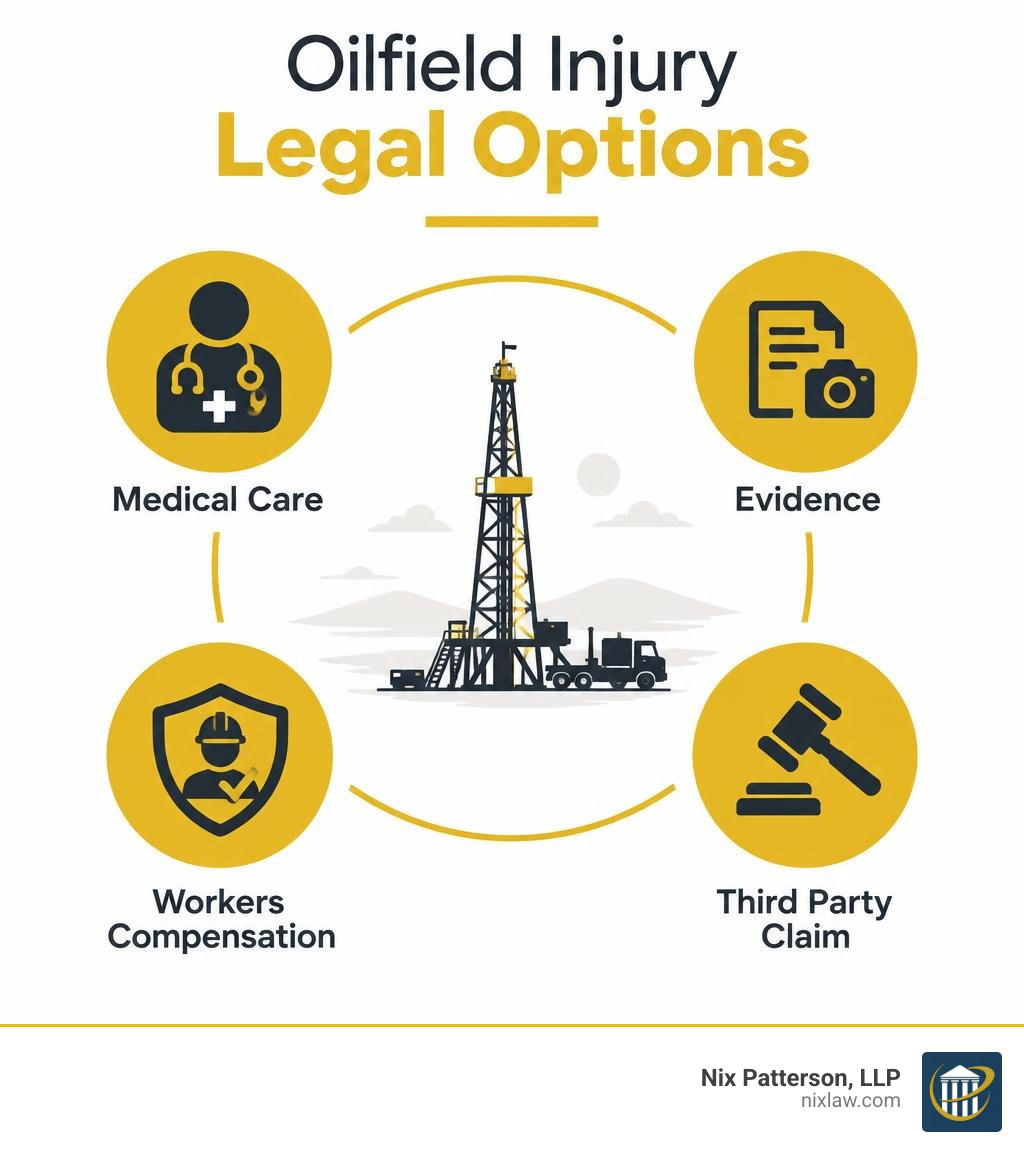
After a catastrophic oilfield injury, act quickly: get medical care, report the incident, preserve photos and records, and speak with a Hobbs oil field injury lawyer who can evaluate potential claims. On a Lea County rig site, that may include workers’ compensation and a separate lawsuit against a negligent contractor, truck driver, or equipment manufacturer.
The Permian Basin’s drilling work carries real risks. Explosions, fires, failed machinery, falls, toxic exposure, and commercial-vehicle crashes can cause burns, amputations, brain injuries, spinal injuries, and lifelong loss of income.
Nix Patterson, LLP can help injured workers and families examine what happened, preserve critical evidence, and pursue responsible parties. Serious cases often involve several employers, complex safety rules, and companies with substantial resources. The right legal team should be ready to investigate beyond the initial incident report and explain its contingency-fee agreement clearly.
Identifying Common Hazards and Catastrophic Drilling Injuries in Lea County
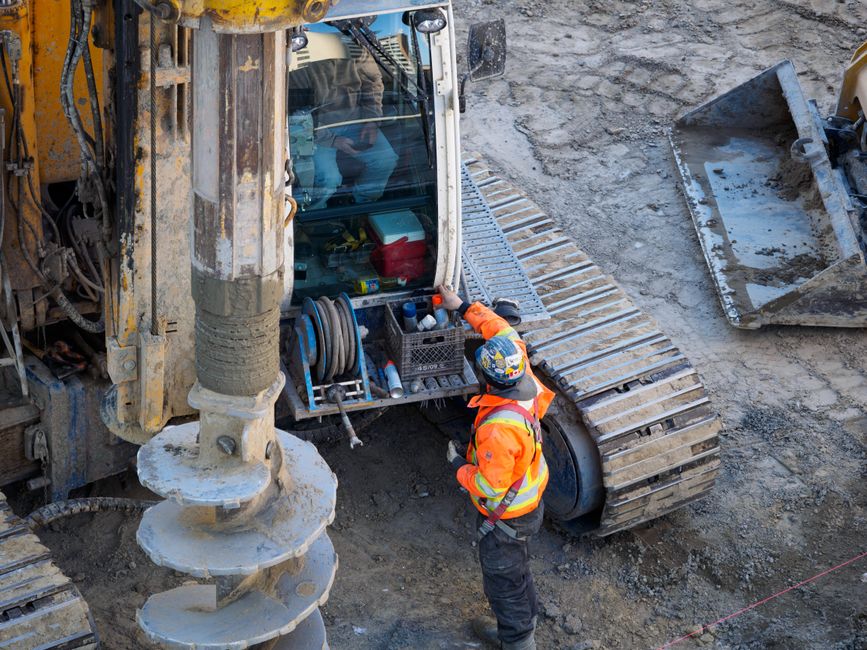
Working in the Permian Basin means dealing with extreme pressures, massive mechanical components, and volatile chemical compounds every single day. Lea County remains one of the busiest drilling regions in the country, and the sheer pace of exploration creates an environment where a single shortcut or equipment failure can lead to life-altering harm. Across the industry in recent years, hundreds of workers have lost their lives and thousands more have suffered severe injuries on job sites.
The physical hazards present on drilling rigs, production batteries, and extraction sites include:
- Well Blowouts and Explosions: Uncontrolled pressure surges can bypass blowout preventers, triggering high-temperature fires, casing failures, and structural collapses.
- Heavy Machinery Failures: Catlines, top drives, iron roughnecks, and drawworks place immense mechanical stress on operators. When cables snap or safety guards fail, “caught-between” and crushing incidents occur rapidly.
- Toxic Gas Exposure: Wells frequently release deadly hydrogen sulfide ($H_2S$), carbon monoxide, or other volatile vapors, causing acute respiratory trauma, central nervous system damage, or sudden loss of consciousness.
- Falls from Heights: Working on the derrick, monkey board, or elevated rig floor exposes roughnecks and derrickmen to serious fall hazards if harnesses, railings, or walking surfaces are neglected.
- High-Pressure Fluid Injection: Hydraulic lines, mud pumps, and manifold systems operating at thousands of pounds per square inch can pierce skin and destroy soft tissue instantly upon rupture.
When these hazards turn into active emergencies, workers face severe medical diagnoses. Our team at Nix Patterson regularly handles cases involving severe burns, traumatic brain injuries (TBIs), spinal cord damage resulting in paralysis, limb amputations, blindness from chemical splashes, and complex crush fractures. If you are dealing with the aftermath of an explosion or machinery breakdown, a dedicated Hobbs oil field accident lawyer can review the site conditions to help investigate what went wrong.
Critical Steps to Take Immediately Following an Oilfield Incident
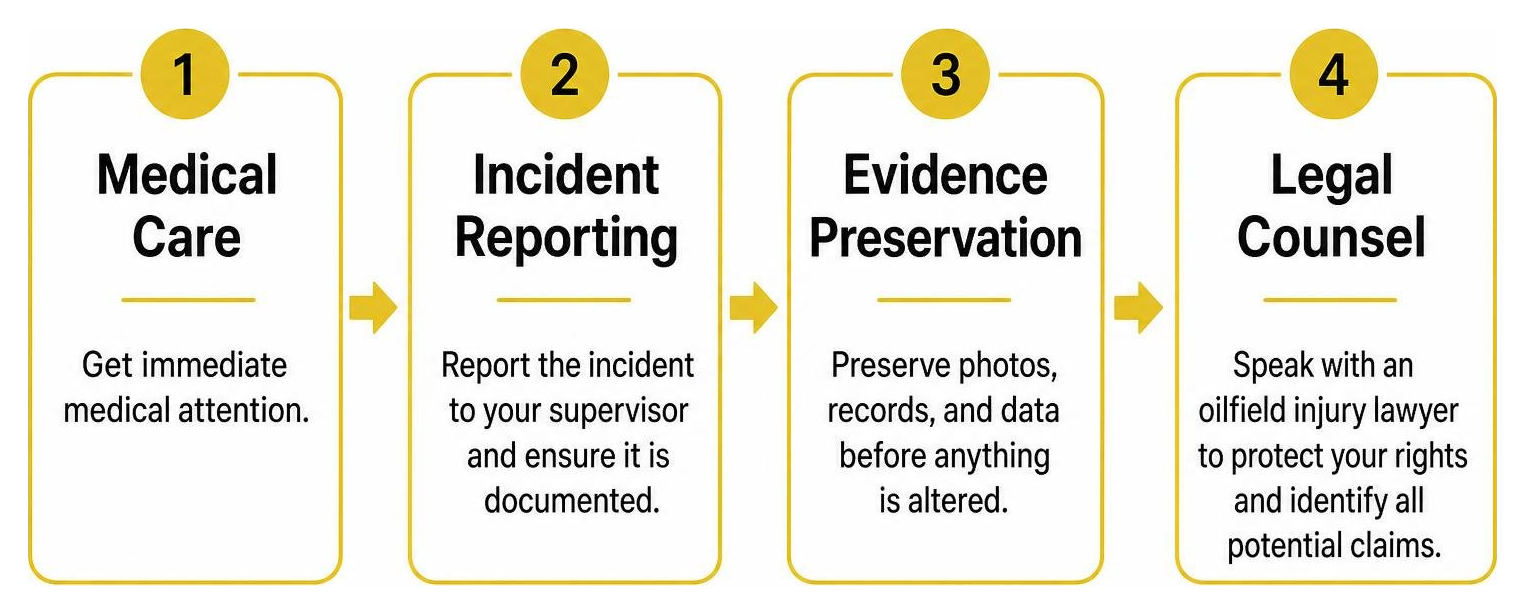
The moments immediately following an accident on a Lea County well pad are chaotic. However, the actions taken by an injured roughneck or their coworkers directly affect both personal recovery and future legal protections.
- Obtain Immediate Emergency Medical Care: Call for emergency transport right away. In rural parts of Lea County, this may require air evacuation to regional burn units or trauma centers. Even if you think your symptoms are manageable, underlying injuries such as internal bleeding, concussions, or chemical lung damage often mask themselves behind initial adrenaline.
- Report the Incident to Site Supervisors: Formally report the injury to your direct supervisor and the company man. Ensure the report is documented in writing and accurately reflects how the incident occurred, without accepting unwarranted blame.
- Preserve Physical Evidence and Rig Data: If safely possible, photograph damaged machinery, snapped cables, skid marks, digital gauge readings, and the surrounding layout. Never allow an employer or third party to alter, scrap, or repair failed machinery before it can be independently inspected.
- Gather Witness Contact Information: Crew members, hotshot drivers, and third-party contractors frequently rotate across different locations in Hobbs and west Texas. Collect full names, phone numbers, and company affiliations before crews disperse.
- Trigger Regulatory Inquiries: Serious incidents must be reported to the Occupational Safety and Health Administration (OSHA) and the New Mexico Occupational Health and Safety Bureau (NM OSHA). Independent regulatory findings often provide critical baseline data for subsequent investigations.
- Retain Legal Counsel Before Giving Recorded Statements: Insurance adjusters representing rig operators or third-party contractors will attempt to take recorded statements early in the process. Consult experienced legal counsel before signing releases or providing recorded interviews.
How a Hobbs Oil Field Injury Lawyer Evaluates Workers’ Comp vs. Personal Injury Claims
Many injured oilfield hands assume their only legal remedy is state workers’ compensation. While the New Mexico Workers’ Compensation Act provides a system for eligible workers to seek coverage for direct medical care and a portion of lost wages without requiring proof of fault, it strictly limits financial recovery. Workers’ comp does not reimburse workers for physical pain, mental suffering, loss of enjoyment of life, or the full extent of future lost earning capacity.
However, drilling operations involve numerous separate companies operating in close proximity. When an entity other than your direct employer causes or contributes to your harm, you can pursue a third-party personal injury lawsuit alongside your workers’ comp claim.
| Benefit / Damage Category | New Mexico Workers’ Compensation | Third-Party Personal Injury Claim |
|---|---|---|
| Fault Requirement | No-fault system | Requires proof of negligence or product defect |
| Medical Expenses | Covered based on fee schedules | Past and projected lifetime medical costs may be sought |
| Lost Wages | Partial temporary/permanent disability benefits | Past lost earnings and future lost earning capacity may be sought |
| Physical Pain and Suffering | Not recoverable | May be recoverable |
| Emotional Distress | Generally not recoverable | May be recoverable |
| Loss of Household Services | Not recoverable | May be recoverable |
| Punitive Damages | Unavailable | Available for gross negligence or willful misconduct |
Evaluating these concurrent claims requires an in-depth understanding of New Mexico civil procedure and labor laws. A detailed review of how drilling contracts interact with state law helps pinpoint the financial remedies available to your family, which is why work injury claims require a dedicated Hobbs oilfield accident attorney to handle multi-layered site relationships. For broader context on workplace safety standards, the Occupational Safety and Health Administration publishes guidance on multi-employer worksite responsibilities.
Pinpointing Third-Party Liability on Multi-Employer Rig Sites
A standard Lea County drilling operation brings together leaseholders, operating companies, drilling contractors, mud engineers, directional drillers, casing crews, wireline operators, and trucking haulers. This multi-employer structure often leads to scenarios where third parties create severe hazards.
Third-party liability commonly arises through:
- Subcontractor and Service Company Negligence: If a third-party cementing crew fails to mix casing slurry correctly, or a directional drilling technician mishandles downhole pressure, the resulting blowout is actionable against that third-party entity.
- Defective Equipment and Product Liability: Manufacturers, designers, and distributors of defective top drives, safety valves, blowout preventers, or sensors can be held strictly liable when equipment fails under standard operating parameters.
- Site Owner and Operator Oversight: While operators use independent contractors to distance themselves from direct liability, retaining active operational control over safety procedures on the pad exposes them to direct negligence claims.
- Commercial Transportation Collisions: Countless heavy vehicles, water haulers, and sand haulers travel along NM-18, US-62, and unpaved lease roads every hour. If an exhausted, improperly trained, or speeding commercial hauler causes a collision, an experienced Hobbs truck accident lawyer can help pursue claims against the transport carrier and driver.
Key Strategies for Selecting Qualified Rig Injury Representation

Catastrophic oilfield litigation is distinct from everyday personal injury law. Energy conglomerates and drilling service providers maintain dedicated emergency response units and national defense firms whose primary objective is limiting corporate liability.
To challenge these corporate entities on equal footing, injured workers need a law firm equipped with substantial resources, investigative capabilities, and courtroom readiness.
Essential Steps for Choosing a Hobbs Oil Field Injury Lawyer
When choosing an attorney for a catastrophic Permian Basin injury, focus on practical criteria that directly impact case outcome:
- Examine Verified Trial Performance: Look beyond standard settlement records. Does the law firm possess a demonstrated history of taking major energy corporations to trial and securing multi-million-dollar verdicts? At Nix Patterson, our attorneys have recovered billions of dollars across high-stakes litigation, including a landmark $2.6 million settlement with BP PLC following the Deepwater Horizon disaster.
- Verify Financial Capabilities: Complex drilling cases require upfront investments for metallurgical testing, downhole simulations, digital accident reconstructions, and economic loss projections. Ensure your legal team has the balance sheet to fund litigation fully without cutting corners.
- Evaluate Technical and Field Resources: Top-tier litigators do not wait for defense summaries. They deploy private aircraft, retain prominent drilling engineering experts, and access rig sites quickly to secure physical components before evidence disappears.
- Confirm Lea County Legal Familiarity: Deep knowledge of the local court system, the Fifth Judicial District Court in Lovington, and regional jury dynamics is essential for strategic positioning.
- Review the Contingency Fee Structure: You should never have to pay out-of-pocket hourly rates or upfront retainers. Reputable oil field injury lawyers operate strictly on a contingency-fee basis, meaning legal fees and advanced case expenses are recovered solely from a successful settlement or jury verdict.
Maximizing Compensation with a Hobbs Oil Field Injury Lawyer
Securing an adequate financial recovery requires capturing the true, lifetime impact of a permanent impairment. Insurance adjusters evaluate claims using broad averages, but a catastrophic injury disrupts every facet of a worker’s personal, domestic, and professional life.
To build a thorough damages case, our legal team develops:
- Comprehensive Life Care Plans: Developed alongside certified medical planners, these projections outline projected surgeries, prescription therapies, physical rehabilitation, wheelchair-accessible home modifications, and in-home nursing support over a worker’s life expectancy.
- Economic Loss and Vocational Assessments: High-performing energy workers command strong hourly rates, overtime, and field bonuses. When an injury ends a drilling career, forensic economists calculate the real value of lost future earning potential, lost retirement contributions, and missed career advancements.
- Non-Economic Damages Presentations: We gather testimony from family members, coworkers, and medical professionals to illustrate physical pain, chronic nerve damage, sleep loss, and emotional distress.
- Wrongful Death Remedies: When safety failures result in a fatal accident, surviving spouses, children, and parents can pursue justice. A skilled Hobbs wrongful death lawyer helps families seek compensation for lost financial support, funeral expenses, and the profound loss of companionship.
Navigating New Mexico Oil and Gas Litigation and Statutory Deadlines
Filing an oilfield injury claim requires adherence to New Mexico civil statutes and procedural deadlines. Missing a statutory window can extinguish an injured worker’s right to compensation entirely, regardless of how clear the opposing party’s fault may be.
Under the New Mexico Statutes Annotated (NMSA § 37-1-8), the standard statute of limitations for filing a personal injury lawsuit is three years from the date the injury occurred. For wrongful death claims (NMSA § 41-2-2), the three-year timeline generally runs from the date of the person’s death.
While three years may seem like plenty of time, waiting is risky. Drilling equipment gets moved to new locations across state lines, well pads are redrilled or reworked, digital monitoring logs are routinely overwritten, and key rig hands relocate.
Furthermore, New Mexico applies a pure comparative negligence standard (NMSA § 41-3A-1). Under this rule, an injured worker’s financial recovery is reduced in proportion to their percentage of assigned fault, but they are not barred from recovery even if partially responsible.
Defense teams routinely try to exploit this rule by blaming field personnel for their own injuries. Countering these tactics requires establishing OSHA violations, industry standard breaches (such as American Petroleum Institute guidelines), and company protocol failures through objective evidence.
Frequently Asked Questions About Hobbs Oilfield Injury Claims
What is the statute of limitations for filing an oilfield injury claim in New Mexico?
In New Mexico, the statute of limitations for personal injury lawsuits arising from oilfield accidents is generally three years from the date of the incident (NMSA § 37-1-8). For wrongful death claims, the lawsuit must be initiated within three years of the victim’s passing.
However, reporting an injury for workers’ compensation requires immediate action, typically within 15 days of the occurrence. Because physical evidence disappears rapidly from active rig sites, you should consult an attorney as soon as possible.
What is the main difference between workers’ comp and a personal injury lawsuit?
Workers’ compensation is a no-fault administrative system designed to provide basic medical coverage and limited wage replacement. In exchange for these statutory benefits, employees generally cannot sue their direct employer for ordinary negligence.
In contrast, a personal injury lawsuit targets negligent third parties, such as equipment manufacturers, lease operators, service subcontractors, or commercial trucking entities. A personal injury lawsuit allows injured workers to seek full past and future lost earnings, compensation for physical pain and suffering, emotional distress, and, when warranted, punitive damages.
How are attorney fees handled in catastrophic oilfield accident cases?
Catastrophic oilfield accident cases are handled on a contingency-fee basis. This means clients pay no upfront fees, retainers, or hourly rates.
The law firm advances all necessary capital to fund the litigation, including retaining engineering experts, obtaining medical evaluations, and managing discovery. The firm receives an agreed-upon percentage of the final recovery only when the case concludes successfully through a settlement or trial verdict.
Conclusion
A serious injury on a Permian Basin drilling site disrupts your health, your career, and your family’s financial stability. Confronting multinational energy companies, oilfield service contractors, and their insurance providers requires a focused legal team with real trial experience and the resources to see complex cases through to the end.
Nix Patterson, LLP provides aggressive, creative representation for injured workers and their families throughout Lea County. Our firm combines modern trial presentation technology, private travel capabilities for rapid site response, and a proven history of multi-billion-dollar recoveries to advocate for our clients’ rights.
If you or a loved one has suffered severe harm on a drilling site, connect with a dedicated Hobbs catastrophic injury lawyer today for a comprehensive, no-obligation case evaluation. Let us handle the investigation and legal proceedings so you can focus on your recovery.