

The True Impact of Workplace Explosions in a Hobbs Burn Injury Lawsuit
Understanding Liability and Evidence in a Hobbs Burn Injury Lawsuit
When an industrial explosion or flash fire occurs on a job site, identifying who is legally responsible requires sorting through complex layers of contractor agreements, equipment maintenance logs, and safety protocols. Industrial sites, especially in energy, manufacturing, and heavy processing sectors, often involve multiple companies operating in the same workspace.
Nearly 50 percent of burn injuries across the United States stem from preventable accidents, and close to half a million people seek emergency medical care each year for serious burns. When these incidents occur on an industrial site, the resulting trauma generally falls into distinct categories:
- Thermal Burns: Caused by open flames, flash fires, superheated steam, or boiling liquids. These are the most common injuries following fuel line breaches or tank ruptures.
- Chemical Burns: Resulting from direct contact with caustic acids, industrial solvents, or alkaline solutions that destroy tissue on contact.
- Electrical Trauma: High-voltage arc flashes or contact with ungrounded heavy machinery that burn internal tissues and disrupt cardiac rhythm.
- Inhalation Injuries: Inhaling toxic fumes, superheated gases, or vaporized particulates that scorch the respiratory tract and damage lung tissue.
Determining who is responsible for a workplace burn injury requires collecting physical evidence before a site is altered or repaired. Our legal team investigates the mechanical failures, missing safety interlocks, and procedural violations that led to the event.
Assessing Severe Burn Complications and Long-Term Damages
Burn trauma creates medical challenges that extend far beyond initial emergency room visits. While first-degree and many second-degree burns can heal over time without surgical procedures, full-thickness burns destroy all three layers of skin: the epidermis, dermis, and subcutaneous tissue. They often damage underlying muscle, tendons, and nerve endings.
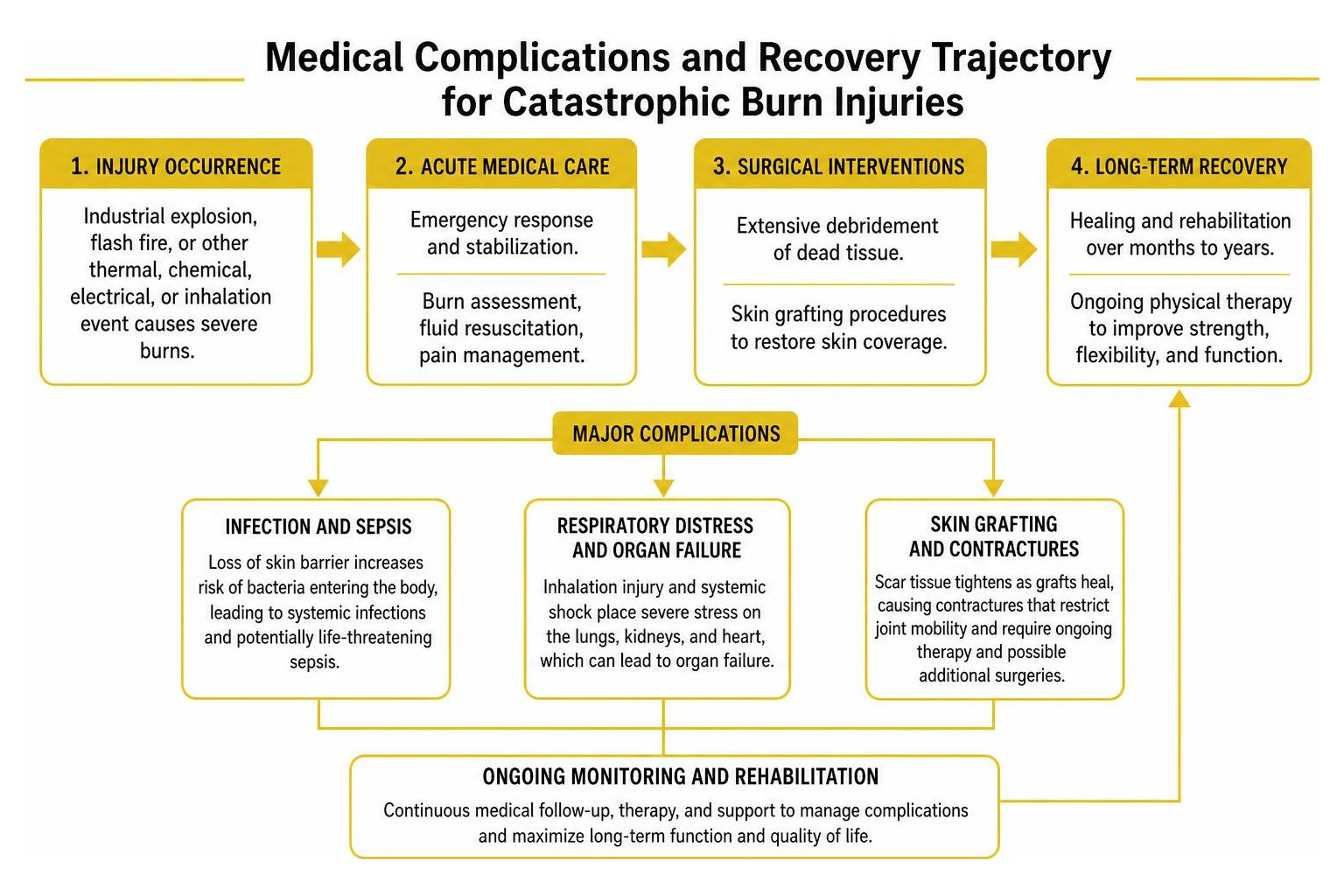
Victims facing severe burn injuries regularly encounter severe secondary complications:
- Infection and Sepsis: The skin acts as the body’s primary barrier against bacteria. When large areas of skin are compromised, systemic infections can rapidly escalate into life-threatening sepsis.
- Respiratory Distress and Organ Failure: Inhalation trauma combined with systemic shock places severe stress on the kidneys, lungs, and heart.
- Skin Grafting and Contractures: Deep tissue burns require extensive debridement and repeated skin graft surgeries. As grafts heal, scar tissue tightens (contractures), severely restricting joint mobility and requiring ongoing physical therapy.
- Permanent Disfigurement and Nerve Damage: Third-degree burns often leave significant scarring and chronic neuropathic pain or numbness, requiring lifelong medical care and psychological support.
Because third-degree burns frequently incur hundreds of thousands, and sometimes millions, of dollars in direct medical costs, our attorneys work closely with life-care planners, reconstructive surgeons, and vocational experts to calculate the total lifetime cost of care.
Establishing Wantonness and Defective Machinery in a Hobbs Burn Injury Lawsuit
Many catastrophic burns on industrial sites are caused by defective equipment, unshielded heating elements, or machinery that lacks essential safety mechanisms. When a manufacturer designs a dangerous product or ignores known safety hazards, injured workers can pursue product liability claims.
In commercial equipment litigation, proving that a manufacturer acted with reckless disregard or wantonness is vital for establishing liability and pursuing punitive damages. A classic example of design defect litigation is found in Hobart Corp. v. Scoggins. In that case, an industrial slant-blade meat saw was engineered with a 15-degree tilt toward the operator. While intended to assist the cut and reduce operator fatigue, the design introduced a latent horizontal force that pulled material, and potentially the worker’s hands, directly into the spinning blade.
Evidence revealed that hundreds of operators had been injured nationwide and that the manufacturer had received direct warnings about the machine’s aggressive pulling action yet failed to redesign the unit or provide adequate safety warnings. The jury initially awarded $510,000 in compensatory damages and $10 million in punitive damages (later remitted to $250,000 compensatory and $2.5 million punitive), establishing a benchmark for how courts evaluate latent machinery hazards and corporate knowledge of product defects.
Similar principles apply to industrial boilers, pressurized vessels, flare stacks, and chemical storage systems. When equipment manufacturers cut corners on pressure-relief mechanisms or fail to install adequate thermal shielding, our trial attorneys work with engineering professionals to demonstrate how design choices directly led to catastrophic failures.
Step-by-Step Guide to Filing a Workplace Burn Injury Claim

Taking swift, structured action after an industrial explosion preserves your legal rights and ensures critical evidence is not lost. Here is the recommended legal process:
- Obtain Comprehensive Medical Documentation: Ensure every burn site, inhalation symptom, and secondary injury is documented by medical professionals. Keep complete records of all surgeries, skin grafts, prescriptions, and physical therapy regimens.
- File an Official Incident Report: Notify your supervisor or plant manager in writing immediately. Request an unedited copy of the internal incident report for your own files.
- Preserve Physical Evidence and Scene Records: Do not alter, discard, or clean personal protective equipment (PPE), scorched clothing, or tools involved in the incident. Retain photographs of the scene, machinery serial numbers, and maintenance tags.
- Initiate an Independent Investigation: Regulatory bodies like OSHA will conduct an inspection, but their findings focus on workplace safety citations rather than civil damages. A dedicated Hobbs oil field accident lawyer from our team will retain forensic engineers, origin-and-cause experts, and safety analysts to preserve physical evidence and review operator logs before critical data is overwritten.
- Evaluate Multi-Party Liability: Identify whether third-party contractors, equipment leasing companies, or product manufacturers share legal responsibility outside the workers’ compensation system.
Navigating Third-Party Negligence and Employer Responsibility
A common misconception among injured workers is that they are limited solely to statutory workers’ compensation benefits. While workers’ compensation provides medical coverage and a portion of lost wages regardless of fault, it prohibits employees from directly suing their direct employer for ordinary negligence in most jurisdictions.
However, complex job sites frequently involve multiple separate entities:
- Third-Party General Contractors and Subcontractors: Negligent maintenance, improper line purging, or failure to follow hot-work permit procedures by other contractors on site can establish grounds for a direct civil lawsuit.
- Equipment and Component Manufacturers: If a valve, control panel, pressure vessel, or fire suppression system fails due to a design or manufacturing defect, an injured worker can file a third-party product liability lawsuit.
- Chemical Suppliers and Distributors: Companies that fail to provide adequate Safety Data Sheets (SDS), toxic chemical warnings, or safe containment systems can be held directly liable.
For example, in complex multi-party matters such as federal product liability litigation involving chemical and safety equipment manufacturers, plaintiffs routinely assert direct claims against multiple chemical producers and equipment designers for defective safety systems and failure to warn. Pursuing these third-party claims allows injured workers to recover damages not covered by workers’ compensation, including full lost future earning capacity, physical pain, and disfigurement.
Critical Timelines and Filing Deadlines for a Hobbs Burn Injury Lawsuit
Every legal claim is governed by strict statutory deadlines known as statutes of limitations. Missing these deadlines permanently bars you from seeking financial recovery:
- Workers’ Compensation Notice Deadlines: Most states require written notice of an injury to an employer within 15 to 30 days of the incident, with formal claim filings required within one to two years.
- Personal Injury and Product Liability Statutes: In states like California, the statute of limitations for personal injury claims is generally two years from the date of the incident (Cal. Civ. Proc. Code § 335.1). Other jurisdictions maintain deadlines ranging from one to three years.
- Claims Involving Public Entities: If an explosion involves a municipal utility, state facility, or public entity, formal administrative tort claims often must be filed within six months of the incident.
Because industrial explosion sites are rapidly repaired or cleared to resume operations, contacting experienced legal counsel early ensures that preservation letters are served immediately, preventing the destruction of vital physical evidence.
Valuing Settlements and Seeking Punitive Damages for Catastrophic Burns
Calculating the value of a burn injury claim requires an evaluation of both tangible economic losses and the profound personal impact of catastrophic trauma.
| Damage Category | Description | Primary Evidence Utilized |
|---|---|---|
| Past & Future Medical Expenses | Emergency transport, ICU burn units, surgeries, skin grafts, rehabilitation, and future reconstructive care. | Medical billing statements, surgical plans, life-care planner projections. |
| Lost Earnings & Earning Capacity | Wages lost during recovery and permanent loss of future earning potential due to physical limitations. | Tax returns, pay stubs, vocational expert assessments, forensic economic reports. |
| Physical Pain and Mental Anguish | Severe nerve pain, phantom limb sensations, post-traumatic stress disorder (PTSD), and depression. | Treating psychologist evaluations, pain management records, personal testimony. |
| Permanent Disfigurement & Scarring | Visible tissue damage, loss of limb function, and contractures restricting movement. | Medical photography, physical therapy records, plastic surgery assessments. |
| Punitive Damages | Additional damages awarded to punish extreme, reckless, or intentional misconduct by a defendant. | Internal company memos, safety audit records, proof of prior notice, expert testimony. |
Calculating Compensatory Damages and Medical Costs
Compensatory damages are designed to make an injured person whole under the law. In burn injury litigation, economic losses extend far into the future. Third-degree burns requiring skin grafts often result in repeated surgeries over many years to release contractures as scar tissue tightens.
Non-economic damages address the intangible consequences of severe burn trauma. Burn rehabilitation is widely recognized in the medical community as one of the most painful recovery processes in medicine, often involving daily debridement procedures and intense physical therapy. Our legal team collaborates with medical experts, economic analysts, and vocational rehabilitation professionals to document the physical, financial, and emotional impact of these injuries.
Meeting the Legal Standard for Punitive Damage Awards
In addition to standard compensatory damages, burn injury lawsuits involving gross negligence or intentional safety violations may warrant punitive damages. Unlike compensatory damages, punitive damages are intended to punish a wrongdoer for egregious behavior and deter similar corporate conduct.
To secure punitive damages, the law requires a heightened burden of proof:
- Clear and Convincing Evidence: The plaintiff must demonstrate that the defendant acted with malice, oppression, fraud, or conscious disregard for the safety of others.
- Proof of Prior Knowledge: Evidence showing that a company knew a piece of machinery or industrial process was hazardous, such as prior injury reports, internal safety warnings, or ignored audit recommendations, can support a finding of wantonness.
- Appellate Scrutiny and Remittitur: Courts carefully evaluate whether punitive damages bear a reasonable relationship to compensatory damages, ensuring the award withstands post-trial motions and appeals.
Frequently Asked Questions About Burn Injury Claims
Navigating the legal process after an industrial accident can be daunting. Our personal injury attorneys have compiled answers to the most common questions asked by burn victims and their families.
How much does it cost to hire an attorney for a burn injury case?
We represent clients on a contingency-fee basis. This means you pay zero upfront costs or out-of-pocket legal fees. Our firm advances all litigation expenses, including hiring top-tier engineering experts, conducting depositions, performing accident reconstructions, and managing trial exhibits. We only collect an attorney fee if we secure a financial recovery on your behalf through a settlement or jury verdict. You can learn more about why hire a personal injury lawyer on a contingency basis during an initial case review.
Can an injured employee sue an employer directly for burn injuries?
Under standard workers’ compensation laws, you generally cannot sue your direct employer for simple negligence. However, direct lawsuits against an employer are permitted under specific exceptions, such as when an employer intentionally removes an essential safety guard, commits an intentional tort, or acts with gross negligence in violation of statutory safety mandates. Furthermore, injured workers routinely file third-party lawsuits against negligent general contractors, property owners, equipment manufacturers, and maintenance companies that contributed to the incident.
How long does it take for a complex burn injury lawsuit to settle?
The timeline for resolving a burn injury lawsuit varies depending on the complexity of the accident and the time needed to reach maximum medical improvement (MMI). Settling a claim before understanding the full extent of future surgeries and long-term disability can leave a victim without adequate funds for future care. While straightforward claims may resolve in 12 to 18 months, complex multi-party product liability and industrial explosion cases often require two or more years of intensive discovery, motion practice, and trial preparation.
Conclusion
Industrial explosions and catastrophic burn injuries change lives in an instant. Navigating the physical recovery, emotional trauma, and mounting medical bills requires comprehensive legal support. At Nix Patterson, LLP, our national litigation team utilizes extensive resources, including advanced trial technology and dedicated investigative support, to take on corporate defendants and equipment manufacturers.
If you or a loved one has suffered severe burns in an industrial or workplace explosion, reach out to an experienced Hobbs catastrophic injury lawyer today for a detailed, no-obligation case evaluation. We will review the facts of your case, identify all responsible parties, and pursue the compensation you need to rebuild your life.