

Understanding the True Value of Your Permian Basin Oil Accident Case
How Oil Field Accident Compensation Is Determined in Serious Injury Claims
Understanding the true financial impact of an oilfield injury requires looking far beyond initial emergency room visits. Properly evaluating how much a claim is worth demands a comprehensive financial and medical analysis. Oilfield work is grueling, and when heavy iron, pressurized lines, or volatile gases fail, the resulting physical trauma often permanently alters a worker’s livelihood.
Insurance adjusters typically rely on standardized software designed to minimize payouts. They tally existing medical bills and propose a settlement before the full scope of your physical disability or career impact is known. In serious injury claims, total compensation is determined by calculating both immediate losses and the projected lifetime costs of medical care, physical impairment, and lost earning power.
| Compensation Factor | Workers’ Compensation Benefits | Full Civil Personal Injury Lawsuit |
|---|---|---|
| Medical Expenses | Covers reasonable, authorized medical treatment directly tied to the injury. | Recovers 100% of past, ongoing, and future estimated medical procedures and home care. |
| Lost Wages | Partial wage replacement (usually subject to statutory weekly caps). | Complete recovery of actual lost income, past bonuses, and projected future earning capacity. |
| Physical Pain & Suffering | Not recoverable under statutory workers’ comp. | Fully recoverable, accounting for acute pain, chronic discomfort, and daily limitations. |
| Mental Anguish & Trauma | Generally excluded unless tied directly to specific statutory criteria. | Recoverable for PTSD, depression, anxiety, sleep disturbances, and emotional distress. |
| Disfigurement & Scarring | Highly limited statutory impairment ratings. | Compensates for visible scarring, burns, amputations, and permanent physical changes. |
| Loss of Enjoyment of Life | Not covered. | Compensates for the inability to participate in hobbies, family activities, and daily pleasures. |
| Punitive Damages | Never available through standard workers’ compensation. | Available in cases of gross negligence, reckless disregard, or intentional safety violations. |
Maximizing Economic Damages in Oil Field Accident Compensation
Economic damages form the measurable financial baseline of a claim. These figures reflect direct monetary losses resulting from the incident. Maximizing this component requires an exhaustive accounting of every expense, both current and projected.
To capture the true scope of financial harm, our team works alongside economic forecasters and medical life-care planners to document all categories of personal injury damages:
- Past and Future Medical Costs: Immediate trauma surgery, intensive care stays, skin grafts for burn injuries, spinal stabilization, reconstructive procedures, physical therapy, prescription medications, and adaptive medical equipment.
- Life-Care Plans: In cases involving traumatic brain injuries (TBIs), paralysis, or severe amputations, an injured worker may require lifelong in-home nursing assistance, home modifications (such as wheelchair ramps and accessible bathrooms), and routine medical maintenance.
- Past Lost Wages: Every dollar of income lost from the moment of the accident through the date of resolution, including overtime, safety bonuses, hazard pay, and per diem allowances that form a significant portion of an oilfield worker’s income.
- Diminished Earning Capacity: If physical restrictions prevent you from returning to heavy manual labor or rig work, compensation must bridge the gap between what you earned before the accident and what you can earn in a light-duty or sedentary role over your remaining working years.
- Vocational Retraining: The direct costs of education, certifications, or career transition services if you must pivot to an entirely new line of work.
Non-Economic Damages and Full Oil Field Accident Compensation
While economic damages replace lost dollars, non-economic damages address the profound human toll of a catastrophic injury. Oilfield incidents often leave deep psychological and emotional scars alongside physical trauma.
These subjective damages account for how an injury alters your day-to-day existence:
- Physical Pain and Suffering: Compensation for the acute physical agony experienced during the incident, through multiple surgeries, and throughout chronic, lifelong rehabilitation.
- Mental Anguish and Psychological Trauma: Rig explosions, well blowouts, and severe crush events frequently cause post-traumatic stress disorder (PTSD), severe depression, debilitating anxiety, flashbacks, and sleep disruption.
- Physical Impairment and Disability: The loss of bodily function, mobility, strength, or dexterity that prevents you from living an independent, active life.
- Disfigurement and Scarring: Severe burn injuries, chemical exposure scarring, or surgical disfigurements that alter physical appearance and cause emotional distress.
- Loss of Consortium and Society: The strain placed on marital relationships, including the loss of companionship, affection, comfort, and physical intimacy.
Calculating Settlement Value and Long-Term Disability
Accurately valuing a severe injury requires detailed technical and medical modeling. Settlement values are not pulled out of thin air; they reflect objective factors:
- Injury Severity and Permanence: Catastrophic injuries—such as spinal cord trauma, third-degree burns over substantial portions of the body, or multiple limb fractures—command higher values due to extensive ongoing medical needs.
- Life Expectancy and Work Horizon: A 28-year-old roughneck facing a lifetime of disability has decades of lost earnings and future care needs that must be accounted for in any fair resolution.
- Liability Strength: Cases with documented violations of industry-standard safety practices, such as ignoring American Petroleum Institute (API) guidelines or Occupational Safety and Health Administration (OSHA) rules, establish clear fault, raising settlement value.
- Corporate Insurance Limits: Oilfield operations involve multi-layered commercial general liability (CGL), umbrella, and excess insurance policies across multiple contractors, often unlocking millions of dollars in total coverage.
To support these claims, we employ vocational experts, orthopedic surgeons, and industrial safety engineers to evaluate your medical records and calculate lifetime financial needs.
Workers’ Compensation vs. Third-Party Lawsuits in Permian Basin Accidents
One of the most critical legal determinations following a well-site disaster is navigating the boundary between workers’ compensation vs third-party claims. Many injured workers mistakenly believe that workers’ compensation is their only legal option. In reality, well sites are crowded, multi-company work environments where multiple entities operate simultaneously.
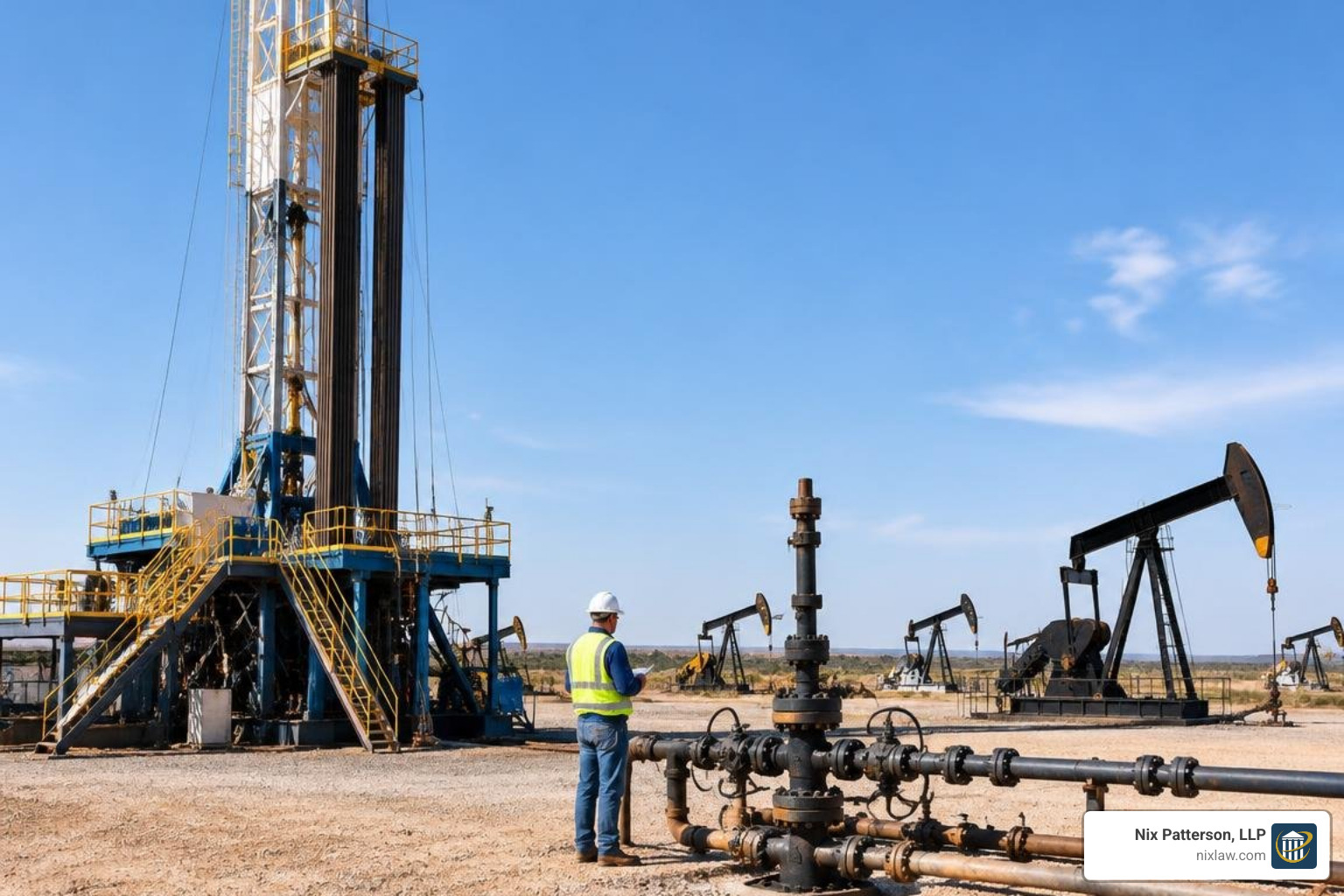
Under standard workers’ compensation laws, benefits are paid regardless of fault, but the system operates as an “exclusive remedy” against your direct employer. In exchange for prompt, no-fault coverage, workers give up the right to sue their subscribing employer for pain, suffering, or full lost wages.
However, this immunity applies only to your direct employer. If another company on the lease site contributed to your injury through careless actions, improper maintenance, or safety violations, you can file a separate third-party personal injury lawsuit against that business while still receiving workers’ compensation benefits.
Understanding Non-Subscriber Employer Liability in Texas
Texas is unique: it is the only state in the country that does not require private employers to carry statutory workers’ compensation insurance. Employers that opt out of the state system are known as “non-subscribers.”
Understanding employer negligence and workers’ compensation coverage is critical for Permian Basin workers. Under the Texas Labor Code, when an injured worker sues a non-subscriber employer for negligence, the employer loses its traditional common-law defenses:
- The employer cannot claim the worker was contributorily negligent.
- The employer cannot claim the worker assumed the risk of dangerous oilfield work.
- The employer cannot claim the injury was caused by the negligence of a fellow employee.
If an injured worker shows that the non-subscribing employer’s negligence played even a small role in causing the incident, the employer can be held liable for full personal injury damages, including pain, suffering, and complete wage loss. Proving what rights Midland oil field workers have after a catastrophic injury often begins with confirming the employer’s true insurance subscriber status.
Identifying Liable Third Parties on Multi-Employer Well Sites
Drilling sites, production facilities, and fracking operations host dozens of independent contractors daily. When an accident occurs, our experienced oil field injury lawyers investigate every entity involved on the lease to identify all liable parties:
- Lease Operators / Oil Companies: The overall leaseholder responsible for site safety, establishing operational rules, and maintaining safe working conditions.
- Drilling Contractors: Companies responsible for rig machinery, rig crew operations, pipe handling, and daily drilling activities.
- Service Contractors and Subcontractors: Third-party vendors handling wireline operations, casing, mud logging, well logging, hydro-vac services, or water hauling.
- Equipment Manufacturers: Designers and manufacturers of blowout preventers (BOPs), iron roughnecks, winches, pressure valves, top drives, and safety harnesses who may be liable under strict product liability for defective designs or manufacturing flaws.
- Commercial Trucking Companies: Sand haulers, water tanker fleets, and equipment haulers whose drivers cause collisions on lease roads or public transit routes in the Permian Basin.
Critical Evidence and Proving Negligence After a Rig Disaster
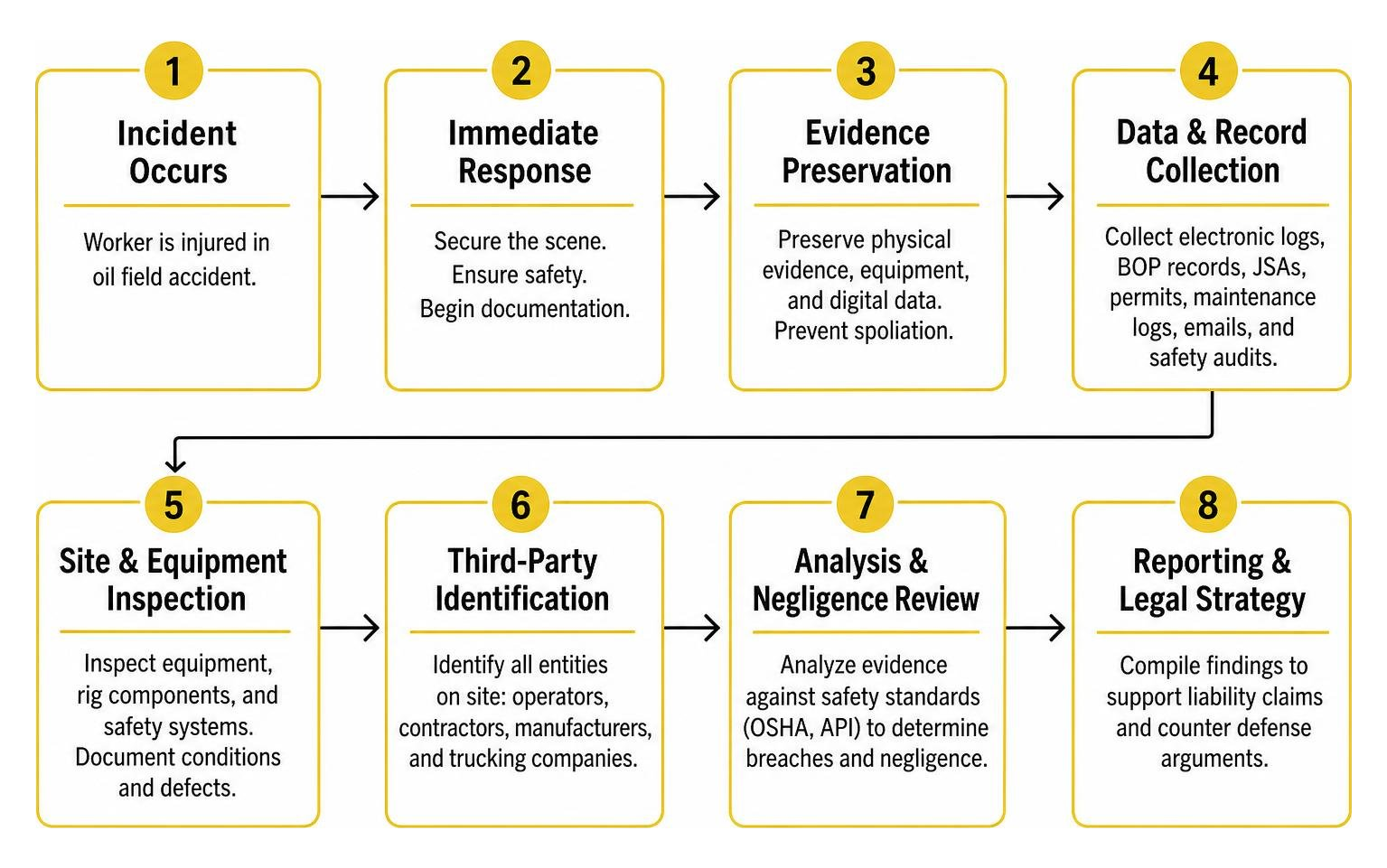
Oil and gas companies move fast after an accident. Defense lawyers, corporate safety directors, and insurance adjusters often arrive on scene within hours of a blowout or equipment collapse to control the narrative and inspect physical equipment. Proving negligence requires immediate, methodical evidence preservation.

Proving liability depends on showing that a company failed to uphold reasonable care, violated OSHA standards, or ignored API safety guidelines. Critical evidence includes:
- Electronic Data Logs and Telemetry: Modern drilling operations generate vast amounts of digital data, including pump pressures, torque, rate of penetration (ROP), and automated mud level readings.
- Blowout Preventer (BOP) Inspection Logs: Pressure test records, maintenance histories, and hydraulic actuator logs that demonstrate whether pressure control systems were functioning properly.
- Job Safety Analyses (JSAs) and Work Permits: Daily safety paperwork, hot work permits, and lockout/tagout (LOTO) logs that reveal whether crews identified hazards before beginning work.
- Corporate Safety Audits and Internal Emails: Written communications showing that management was aware of worn-out machinery, understaffed crews, or ignored maintenance schedules to keep production moving.
Overcoming Comparative Fault Defenses
When oilfield workers file injury claims, corporate defendants routinely point fingers at the worker, arguing that personal error or carelessness caused the incident.
In Texas, third-party civil claims are governed by modified comparative fault (also known as proportionate responsibility). Under this rule:
- A plaintiff can recover compensation as long as their share of fault does not exceed 50%.
- If you are found 20% responsible and a third-party contractor is found 80% responsible, your total financial award is reduced by 20%.
- If you are found 51% or more at fault, you are completely barred from recovering compensation from third parties.
In New Mexico, pure comparative fault applies. Under this system, you can recover damages regardless of your percentage of fault, with your recovery reduced strictly by your allocated percentage of responsibility.
Overcoming these defense tactics requires using physical evidence, witness interviews, and maintenance logs to prove that systemic equipment failures, inadequate training, or unsafe company operating procedures—not individual worker error—caused the incident.
Essential Documentation to Preserve Immediately After an Incident
To protect your legal rights and preserve critical proof before it is lost or altered, take these documentation steps:
- Obtain copies of all incident reports and witness statements gathered by safety personnel.
- Secure photographs of damaged equipment, failed lines, warning signage, and physical scene layout before the site is cleaned or altered.
- Request and preserve maintenance records, daily drilling logs, and safety inspection reports.
- Maintain a personal log of every medical appointment, physical therapy session, out-of-pocket expense, and daily pain symptom.
- Retain all safety gear, worn work clothing, and damaged personal protective equipment (PPE) in its post-accident state without washing or modifying it.
Deadlines and Legal Avenues for Catastrophic Harm and Wrongful Death
Navigating complex oilfield litigation requires meeting strict statutory deadlines. Missing these cutoffs permanently forfeits your right to hold negligent companies accountable, making early consultation with knowledgeable oilfield accident lawyers essential.
Understanding why work injury claims require experienced representation is critical when dealing with cross-border operations spanning Texas and New Mexico. Multi-employer worksites involve complex choice-of-law provisions, overlapping insurance coverages, and conflicting venue rules that require seasoned legal handling.
Permian Basin Statutes of Limitations Across Texas and New Mexico
The Permian Basin straddles West Texas and Southeastern New Mexico, meaning an accident’s exact geographic location determines the applicable legal deadlines:
- Texas Injury and Wrongful Death Claims: Under Texas law, injured workers generally have two years from the date of the incident to file a personal injury or wrongful death lawsuit. However, workers’ compensation injuries must be formally reported to your employer within 30 days. For regional legal guidance, speak with our Texas oil field injury lawyers.
- New Mexico Injury Claims: New Mexico generally provides a three-year statute of limitations for personal injury lawsuits, but wrongful death actions must be filed within three years of the decedent’s passing. Workers’ compensation claims require written notice to the employer within 15 days. Consult our New Mexico oil field injury lawyers to protect your rights.
Tolling provisions—which extend these filing deadlines—are rare in industrial accidents and apply only in narrow circumstances, such as legal incapacity or fraudulent concealment of evidence by an employer.
Wrongful Death Claims for Fallen Oilfield Workers
When an oilfield explosion, toxic hydrogen sulfide (H2S) leak, or heavy equipment failure results in a fatal tragedy, the worker’s surviving family members have the right to seek justice and financial security.
Surviving spouses, children, and parents can pursue a wrongful death claim to recover:
- Loss of financial support, including the future income, benefits, and retirement savings the worker would have provided.
- Loss of companionship, guidance, instruction, and emotional care.
- Mental anguish and grief experienced by surviving family members.
- Funeral, burial, and related memorial costs.
Additionally, an estate representative can bring a survival action on behalf of the deceased worker to recover the medical bills and physical pain experienced between the time of injury and death. If you have questions about fatal incidents across the region, our Oklahoma oil field injury lawyers can help families evaluate multi-state corporate liability.
Frequently Asked Questions About Oilfield Injury Claims
What immediate steps should I take after an oilfield accident to protect my claim?
- Get Immediate Medical Attention: Your health comes first. Accept emergency transport, inform doctors of every symptom, and follow all medical recommendations.
- Report the Incident in Writing: Notify your supervisor immediately. Ensure an official written incident report is filed, and request a copy for your records.
- Preserve the Scene and Physical Evidence: If safe, take photos and videos of the scene, machinery, safety gear, and surrounding conditions. Identify witnesses and secure their direct contact details.
- Decline Recorded Statements: Insurance adjusters will contact you quickly. Do not give recorded statements or sign settlement releases without legal counsel.
- Contact a Dedicated Attorney: An early investigation allows your legal team to issue formal spoliation letters that legally force companies to preserve electronic data and physical evidence. For regional legal support, consult an attorney to understand your options under Texas law.
Can I file a lawsuit if my employer doesn’t carry workers’ compensation insurance?
Yes. If your employer is a non-subscriber in Texas, you can file a personal injury lawsuit directly against them for negligence. Under Texas law, non-subscribing employers cannot use common-law defenses such as contributory negligence or assumption of risk. This makes it easier to recover full civil damages, including pain, suffering, and complete wage loss, if the employer failed to provide a safe workplace, proper equipment, or adequate crew training.
How does comparative fault affect my recovery if I was partially at fault?
Your recovery depends on the state where the incident occurred:
- In Texas: The modified comparative fault rule applies. You can recover damages as long as you are 50% or less at fault. Your final financial award is reduced by your percentage of fault. If you are found 51% or more responsible, you receive nothing.
- In New Mexico: The pure comparative fault rule applies. You can recover damages even if your fault exceeds 50%, with your total compensation reduced by your specific percentage of responsibility.
Conclusion
Catastrophic oilfield injuries disrupt every aspect of a worker’s life, creating severe physical, emotional, and financial burdens. Navigating corporate defenses, multi-contractor worksites, and complex insurance policies requires decisive action and substantial legal resources.
At Nix Patterson, LLP, we bring deep institutional resources, cutting-edge trial technology, and an aggressive approach to holding negligent oil operators, contractors, and manufacturers accountable. We take the time to investigate every angle of your case, preserve critical digital and physical evidence, and pursue the full compensation you need to rebuild your life.
If you or a loved one suffered a serious injury in the Permian Basin, contact a dedicated Carlsbad oil field accident lawyer today for a free, confidential case review. We handle cases on a contingency fee basis, meaning you pay nothing unless we secure a recovery for you.